


Nasdaq 100 Analysis: Uncertainty Returns to NDX Following Tariff Announcements
Nasdaq 100 falls around 3% over two sessions after Monday's nearly 6% rally, as tariff concerns and Fed uncertainty weigh on sentiment.
Written by
Julian Pineda
Market Analyst
As November approaches its end, the indecision that has started to develop across the U.S. equity market remains a relevant theme, particularly around the Nasdaq 100. After the strong rebound seen at the beginning of the week, when the index advanced nearly 6.0% during Monday's session, the following two sessions ahead of the Thanksgiving market closure have reflected a decline of roughly 3.0%, highlighting that uncertainty is once again becoming an important feature of the index's price action.
Part of the confidence that had returned to the market thanks to Nvidia at the start of the week has begun to fade following recent announcements regarding potential tariffs from the United States. Added to this is the possibility of a more aggressive Federal Reserve, which continues to act as a constant source of uncertainty for markets. Together, these factors have once again complicated the recovery in sentiment and could continue highlighting a period of indecision around the Nasdaq 100 in the short term.
Are Tariffs Returning?
Although the bullish move around the Nasdaq 100 was quite significant at the start of the week due to the relief generated by Jensen Huang's return as president of Nvidia, that recovery in confidence failed to remain consistent. In fact, during today's session the index fell nearly 4.5%, a move that now appears linked to a new source of uncertainty for risk assets: the recent announcements of potential tariffs from the United States.
During the session, it became known that, following a trade investigation, the United States determined that at least 14 major economies, including the European Union and China, maintain industrial policies that could distort global competition and negatively affect U.S. industry over the long term. As a result, proposals involving new import tariffs have once again emerged. Tariffs of up to 20% are being considered for the European Union and China, while economies such as Japan, South Korea, and Taiwan could face tariffs of around 15%.
While these measures have not yet been implemented, the announcement has been enough to reintroduce concerns related to inflation, corporate margins, and global economic growth. Many companies continue to depend on international supply chains, and a potential escalation in trade tensions could increase costs and affect business activity over the coming months.
This situation appears to have slowed the recovery in sentiment seen at the start of the week. In fact, indicators such as the Fear & Greed Index continue to hover around 16 points, reflecting an "extreme fear" environment and highlighting that investors remain cautious as new risks emerge for economic growth.
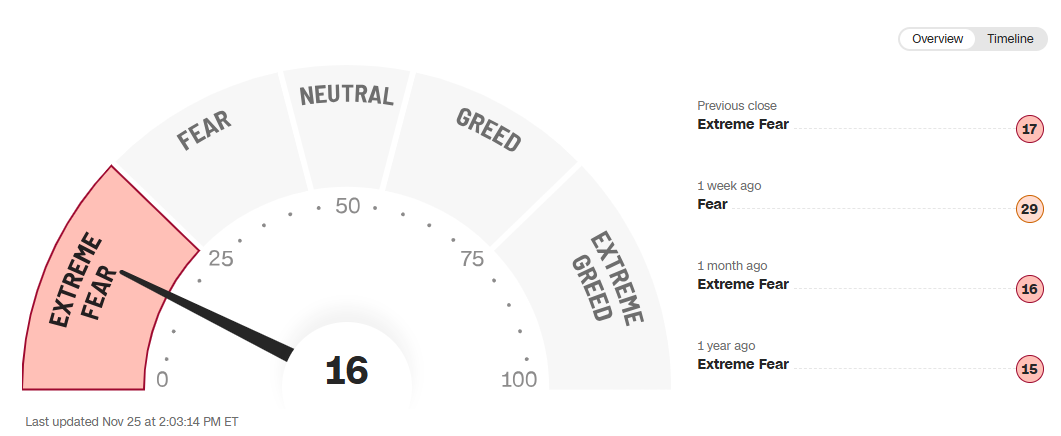
Source: CNN
The situation is particularly relevant for the Nasdaq 100, given the significant exposure many of its companies have to global supply chains. This uncertainty has also been reflected in the performance of the index's largest components. Looking at the ten most influential companies within the Nasdaq, only Apple (+0.3%), SpaceX (+0.95%), and Meta (+2.56%) managed to post gains during the session, while the remaining components recorded notable declines, reflecting that confidence around the technology sector remains relatively fragile.
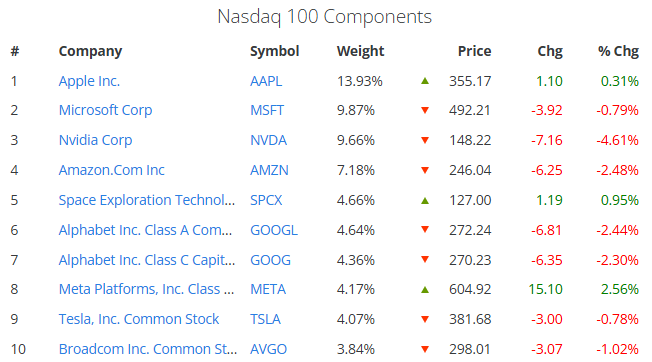
Source: Slickcharts
With all of this in mind, the boost in confidence generated by Nvidia earlier in the week appears to be losing momentum. The market is now facing a new source of uncertainty linked to the possibility of an escalation in trade tensions, a development that could affect the long-term outlook for companies. Until there is greater clarity regarding the direction these proposals will take, the current phase of indecision facing the Nasdaq 100 could remain relevant over the coming weeks.
Is the Central Bank Still a Threat?
Another important factor to consider is that markets continue to price in a more aggressive Federal Reserve over the coming months. There is currently close to a 100% probability that the Fed will raise rates again at the December 9 meeting, taking the benchmark rate toward the 4.25% area.
This expectation remained intact even after the release of the latest Core PCE Index YoY, where inflationary pressures once again came in above expectations. Markets had expected a reading of 3.2%, but the official figure reached 3.3%, reinforcing the view that inflationary pressures remain relevant within the U.S. economy.
This suggests that the conditions necessary for a more aggressive Federal Reserve remain in place. At the same time, a higher interest-rate environment could increase borrowing costs, affect consumer spending, and reduce liquidity available for risk assets such as Nasdaq. As a result, if new economic data or Fed commentary continue supporting a more aggressive central bank into year-end, indecision or even a new period of weakness could remain relevant around the Nasdaq 100 over the coming weeks.
Nasdaq 100 Technical Forecast
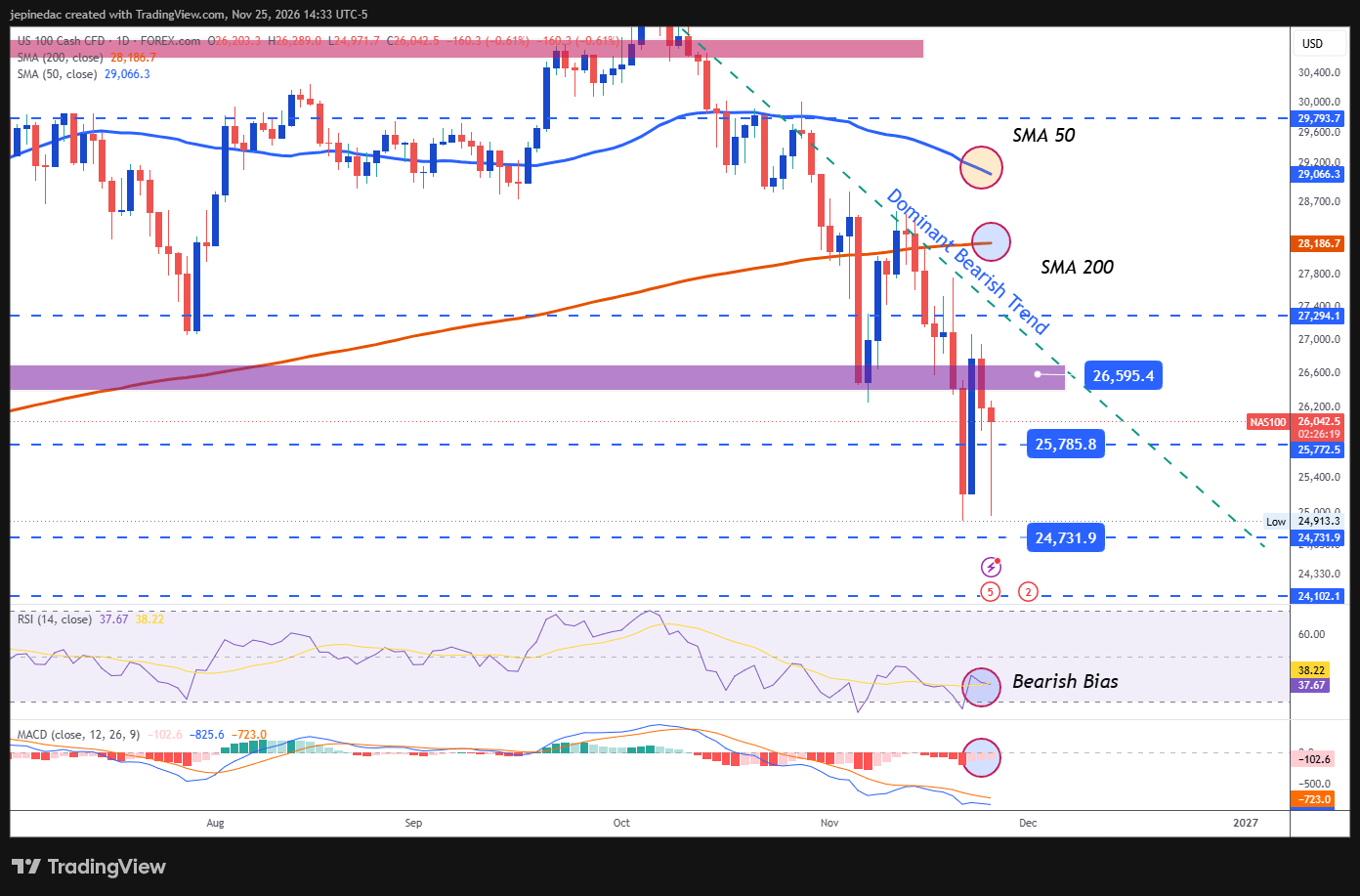
Source: StoneX, Tradingview
- Bearish trend remains in place: Since the first days of October, the Nasdaq 100 has been developing a pattern of progressively lower highs and lower lows. The decline observed over recent weeks has given this structure even greater relevance, breaking the trading range that had remained in place for months and giving way to a new bearish phase that currently stands out as the chart's dominant technical pattern. The recovery attempt seen at the beginning of the week was not enough to put this structure at risk, meaning it could remain an important reference for price action in the weeks ahead.
- MACD: The MACD histogram continues to develop below the neutral 0 line, reflecting meaningful selling pressure around short-term moving averages. As long as this reading remains in place, the bearish bias could continue to be an important feature of index price action.
- RSI: The RSI continues to show a similar picture, with the indicator remaining below its neutral 50 level. This suggests that, on average, selling momentum continues to dominate and could keep highlighting a bearish dynamic within the chart over the short term.
Key Levels:
- 26,600 points - Key Resistance: This barrier corresponds to one of the most important retracement areas observed in previous weeks and also coincides with the base of the new bearish structure. Price action returning to this level could begin to challenge the recent weakness and create room for a more meaningful bullish bias over the coming weeks.
- 25,800 points - Nearby Barrier: A recent equilibrium level that also aligns with an important retracement area from previous months. As long as price continues developing around this reference without moving decisively away from it, a broader phase of indecision could begin emerging as the dominant short-term structure.
- 24,700 points - Key Support: A level corresponding to lows not seen since April of this year and currently representing the most important downside barrier on the chart. Price action that continues showing selling pressure around this area would reinforce the dominance of the bearish bias and could open the door to a more aggressive downward trendline becoming the chart's dominant structure over the coming weeks.
Written by Julian Pineda, CFA, CMT – Market Analyst
Follow him on: @julianpineda25
Latest market news









Web Trader platform
Our sophisticated web-based platform is packed with features.
Open an account today
Experience award-winning platforms with fast and secure execution.
Economic calendar
Related articles

Gold and S&P 500 analysis: What now after Warsh’s hawkish speech?
The dollar surged across the board after the Fed Chair Kevin Warsh surprised with a hawkish-leaning speech at the Jackson Hole summit. All the bearish dollar bets that had been accumulated since last Friday on the back of data weakness and bond market troubles had to be squared and that triggered a short squeeze rally for the dollar. Gold and silver dropped, as a result, as too did bitcoin, while US indices were giving back earlier gains.


Nasdaq 100 Forecast: NDX slips ahead of Fed Chair Warsh’s speech
U.S. stocks are edging lower on Friday, giving back some of yesterday's gains after Nvidia's strong outlook revived the tech trade. The focus has now shifted firmly to Fed Chair Kevin Warsh's Jackson Hole speech, with investors looking for more clarity on the outlook for interest rates.


Nasdaq 100 forecast: Tech stocks shine as Nvidia results underpin AI trade
Much of this week’s attention has been on Nvidia’s earnings, and the chipmaker delivered the sort of numbers of investors had been hoping for. US index futures initially wobbled before moving higher overnight, with the results providing a fresh lift to the AI trade