


EUR/USD Forecast: ECB and US inflation set to test the range
EUR/USD remains trapped in a tight range, but Thursday’s ECB decision and US inflation data could provide the catalyst needed to break it.
Written by
David Scutt
Market Analyst
- EUR/USD remains driven by front-end rates
- ECB September hike fully priced, second heavily favoured by December
- US CPI, PPI may determine September Fed hike fate
- Key moving averages continue to contain EUR/USD
EUR/USD remains very much a front-end rates play from a day-to-day directional perspective, putting emphasis on any data or events that can change the policy outlook for the ECB or Federal Reserve. Unfortunately, with a sparse calendar in the early parts of the week, traders may have to be satisfied with a period of range trading ahead of what will be a potentially volatile end to the week, with the ECB’s September policy decision, along with key inflation data from the United States.
Relative rates, not energy, are driving direction
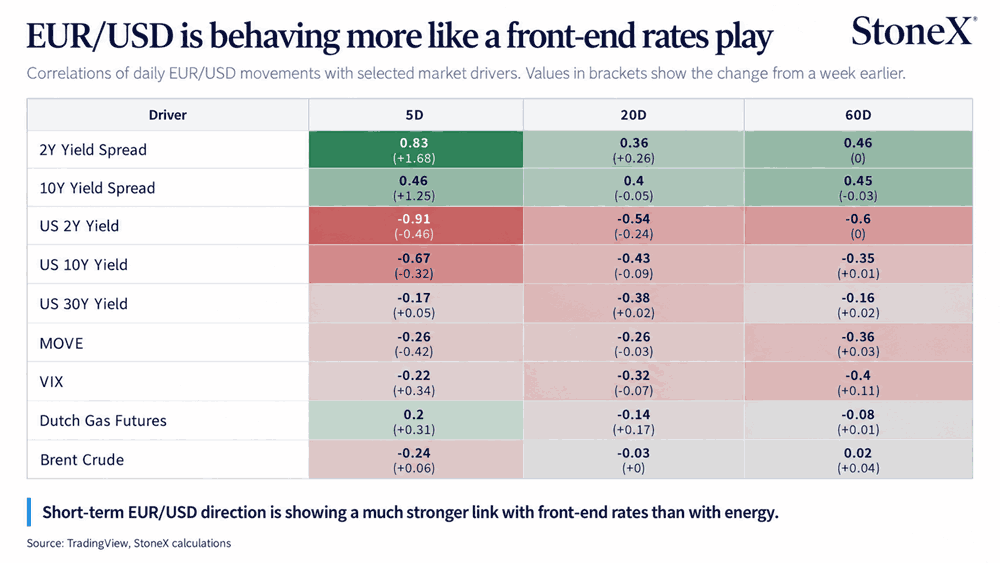
Reinforcing the importance of the relative monetary policy outlooks for the pair, the correlation matrix below shows a strong relationship with both German-US two-year yield spreads and outright US two-year yields. The negative relationship with US two-year yields makes for a compelling case, not only over the short term, where it is incredibly strong, but also over longer periods where there remains a consistent and relatively tight relationship between the two.
Source: TradingView
Interestingly, despite continued gains in energy prices, which in the past have weighed on the euro through both a relative terms of trade and energy security perspective, the matrix suggests their influence over the pair has diminished to almost negligible levels over the past week, month and quarter.
Data momentum favours Europe
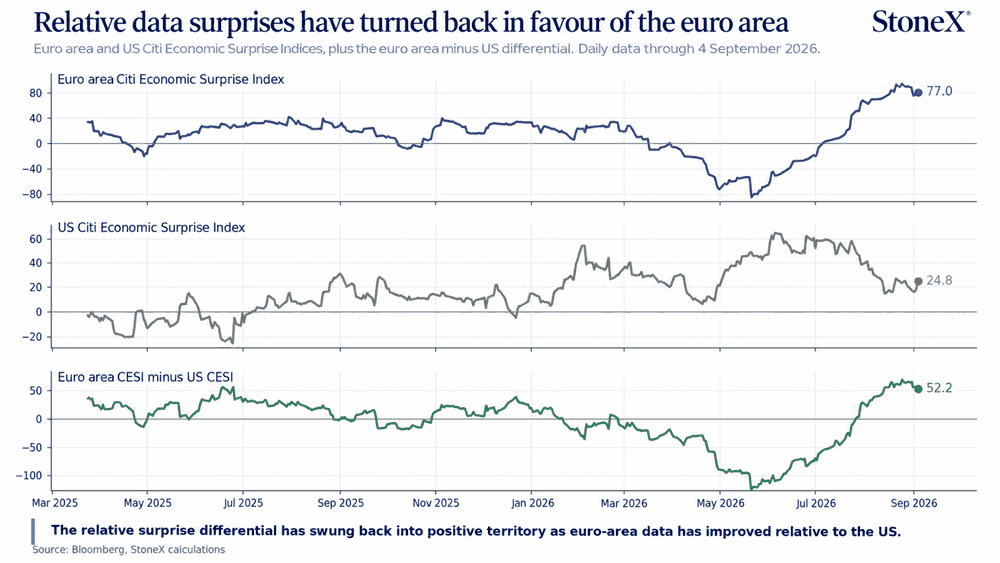
One factor that may be underpinning the front-end rates influence is the recent economic data surprises, with euro area data outperforming expectations by considerably more than the United States. As the chart below shows, the gap between the two Citi Economic Surprise Indices has swung sharply back in favour of the euro area, reflecting both stronger European data and a comparatively softer patch for the US. However, that trend has rolled over a touch in recent times, coinciding with similar price action in EUR/USD.
Source: LSEG
Citi Economic Surprise Indices measure whether economic data is coming in above or below market expectations, with greater weight applied to more recent releases and those that have historically generated greater market volatility.
Can the ECB validate hawkish pricing?
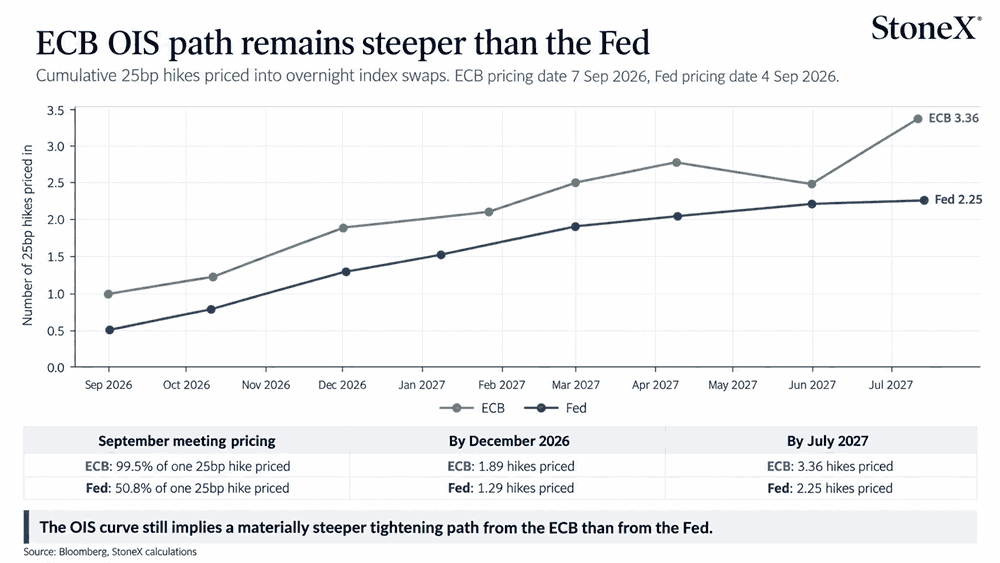
The resilience of euro area data, which has essentially caught up to what we’d seen in the United States for a lengthy period of time, combined with persistently elevated energy prices, has meant that market pricing for the ECB rate outlook has shifted more hawkish relative to periods earlier in the conflict. Implied pricing from swaps now essentially fully prices a move at the Bank’s September meeting, with a second move by December also heavily favoured at just shy of 90%.
Source: Bloomberg
In contrast, while policy rates in the United States remain far higher than in Europe, the expected path of tightening from the Fed is far less steep, with a move in September only marginally favoured at just over 50%. The first move of the cycle is not fully priced until the Fed’s December meeting, with only just over two full hikes priced out to the middle of next year.
With a rate hike this week from the ECB essentially deemed a lock, and with markets looking for at least another two rate increases this cycle, from the euro side of the equation, the tone of the policy statement, President Christine Lagarde’s press conference and updated forecasts from ECB staff will likely determine how EUR/USD fares following the rate decision.
Source: ECB
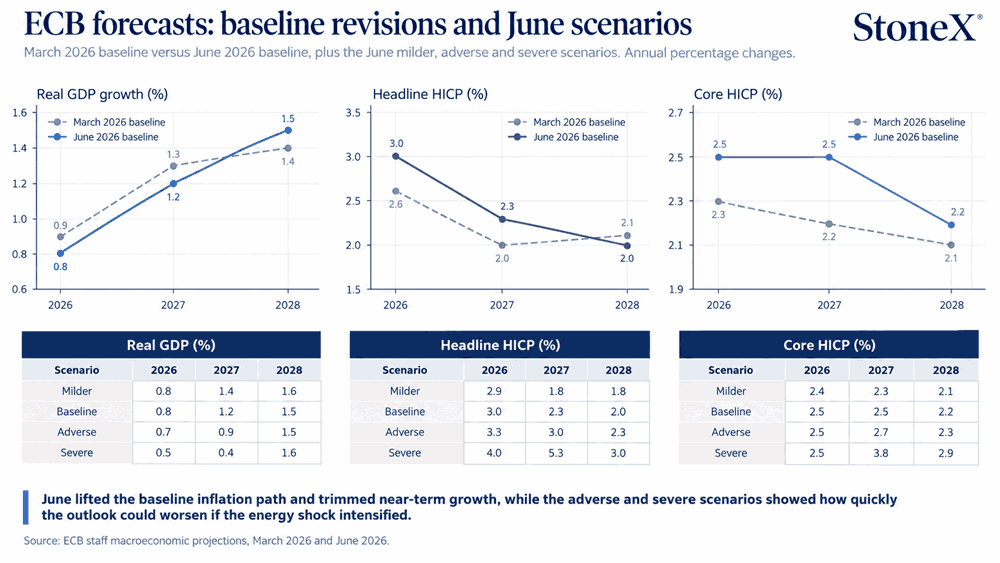
Relative to what the ECB was forecasting three months ago, the milder scenario has more or less played out, negating some of the fears about the stagflationary effects of far higher energy prices on economic growth and headline and underlying inflation, under assumptions for energy prices that were far higher than what ultimately eventuated. As such, it suggests that, at the margin, the ECB’s updated forecasts may come across as not hawkish enough to justify current market pricing.
PPI and CPI could determine Fed timing
On the US side of the ledger, with Friday’s blowout payrolls report providing no barrier to prevent a rate hike, and with the Fed now in a blackout period ahead of its meeting next week, it almost feels like a binary setup around the PPI and CPI reports for EUR/USD.
If we get a hot reading, say north of 0.3% for core CPI, there’s a strong probability markets will swing heavily in favour of a rate increase, particularly based on what Kevin Warsh was saying at Jackson Hole in late August. But if we were to see an undershoot, that could allow the Fed time to reassess incoming data, pointing to December as the more likely meeting where a rate increase could be delivered.
And given EUR/USD seems to be more heavily influenced by the US interest rate side of the equation, based on the message from the matrix above, these reports loom as the key data points that could determine how EUR/USD closes out the week.
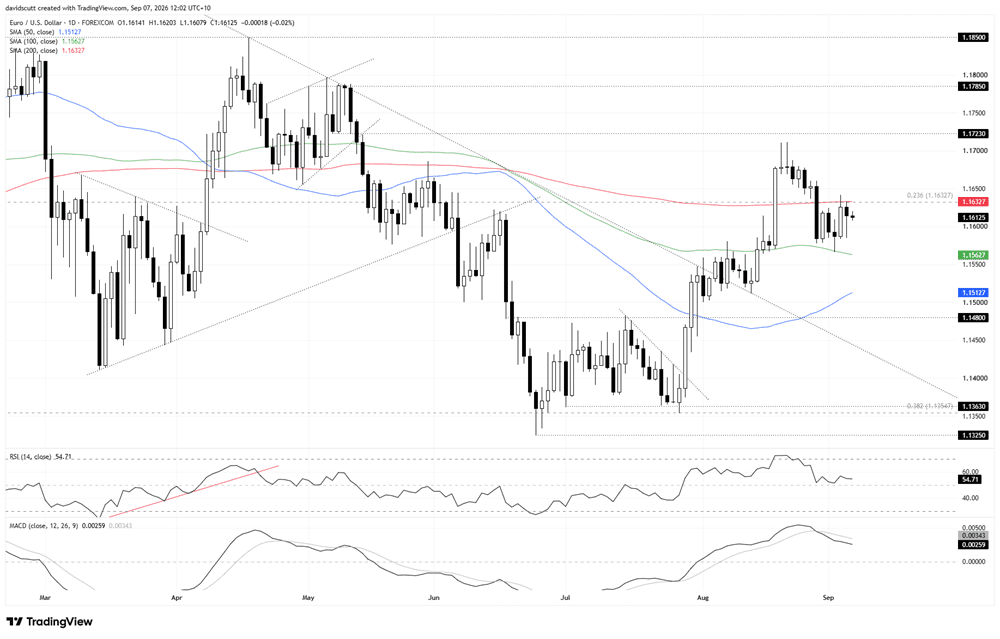
Moving averages define the range
Source: TradingView
Looking at EUR/USD on the daily chart, you can see the pair has been very rangy between the 200-day moving average and 23.6% Fib retracement of the October 2025 to January 2026 bull move clustered on the top side, and the 100-day moving average on the downside. Those are the immediate levels to watch this week heading into the key risk events on Thursday and Friday.
The message from the oscillators is one of neutrality rather than a bullish or bearish directional bias, with RSI (14) sitting just above 50 while MACD has staged a bearish crossover, although it remains in positive territory. That again fits with the rangy price action favoured ahead of these risk events.
Outside of the existing range, the levels to watch on the top side are 1.1710, where twin failures emerged in late August, along with 1.1733 just above, a minor level that previously acted as support in May. Above that, 1.1785 is a more pronounced resistance level located overhead.
Underneath the 100-day moving average, EUR/USD consistently attracted bids above 1.1500 during the first half of August, making that the first level of note, especially with the 50-day moving average also currently in the vicinity. Below that, 1.1480 is another level that has previously acted as both support and resistance earlier this year.
Latest market news











Web Trader platform
Our sophisticated web-based platform is packed with features.
Open an account today
Experience award-winning platforms with fast and secure execution.
Economic calendar
Related articles

EUR/USD forecast: All eyes on Warsh at Jackson Hole - Forex Friday
For much of this week, the EUR/USD has been edging lower with the US dollar regaining some ground after last week’s sell-off that was triggered, in part, by the bond market worries. Investors have been unwilling to bet further against the US dollar so far this week ahead of Kevin Warsh’s keynote speech at the Jackson Hole summit, due later today.


Bitcoin Forecast: BTC/USD Back to $80K Ahead of Warsh’s Jackson Hole Speech
After surging over $15,000 in the past 10 days alone, there is risk of a near-term pullback if Warsh says anything remotely hawkish at Jackson Hole - what are the levels to watch from here?


DAX and EUR/USD forecast: Lower energy prices, yields offer support
But the question, of course, is how much further oil prices and bond yields can fall. For now, the combination is supportive of risk assets and is helping to sustain a relatively benign decline in the dollar. The focus today will be on US core PCE inflation, due for release shortly, while Nvidia’s second-quarter earnings will provide another test for risk appetite after the US markets close – not just for US indices but for global tech-heavy indices given the influence Nvidia has over the global tech and AI names.