


Gold forecast: XAU/USD under pressure as investors watch oil and inflation data
While increased haven demand may be one of the major supporting factors, it is the steady climb in bond yields and rising interest rate expectations which make the near-term gold forecast challenging, as zero yielding assets become less attractive in this environment.
Written by
Fawad Razaqzada
Market Analyst
Gold prices edged lower in early London trade after prices fell on Friday to ensure of a second weekly close in the negative territory. While I don’t necessarily expect to see any major fireworks today given the fact the US is out on holiday, it is worth mentioning that thinner conditions could amply moves if we see the break of some key levels. Anyway, regardless of today’s price action this could still be a decisive week for the precious metal. We have key inflation data coming up later this week while growing tensions in the Middle East continue to underpin oil prices, further fanning inflationary concerns. Gold investors are thus weighing haven demand against rising bond yields and elevated interest rate expectations. While increased haven demand may be one of the major supporting factors, it is the steady climb in bond yields and rising interest rate expectations which make the near-term gold forecast challenging, as zero yielding assets become less attractive in this environment.
What will investors be watching this week?
After the stronger-than-expected jobs report last week, the focus is turning to inflation this week.
Friday’s payrolls report suggest the US labour market was perhaps stronger than what recent data had indicated. The combination of stronger employment and relatively firm wage growth has underscored concerns that inflation might be more persistent than hoped, potentially leading the Fed to raise rates and maintain them at higher levels for an extended period.
With the US Labour Day holiday causing a delay in this week’s key data releases, the US CPI report is now due on Friday and is set to be pivotal for the financial markets. Additionally, we have the PPI report on Thursday, coinciding with the ECB’s interest rate decision, which is likely to be a hike.
Meanwhile, there appears to be a bit of a spilt within the Fed, with Chair Kevin Warsh adopting a hawkish stance at the Jackson Hole summit, while Governor Christopher Waller was not so hawkish last week, preferring to see the inflation data before deciding on a vote to hike rates or maintain status quo. This makes the CPI release a crucial piece of economic data, being the last major update before the Fed’s next meeting.
Should inflation come in hotter than anticipated, markets will cement expectations for a September rate hike, which could exert renewed pressure on the near-term gold forecast, especially if Treasury yields rise further.
On the flip side, a softer CPI reading could rekindle hopes for holding rates unchanged, potentially serving as another catalyst for gold to climb higher.
Gold and US indices dipped on Friday following the jobs report, as Treasury yields increased and expectations for a September Fed rate hike grew. Markets are now pricing in about a 59% probability of a hike, up from 49% prior to the jobs figures.
Technical gold forecast and key levels to watch
From a technical analysis perspective, the direction of gold prices remains quite uncertain due to the recent volatile price action.
The fact that gold has fallen for the second consecutive week as of Friday suggests that the bearish trend may have resumed.
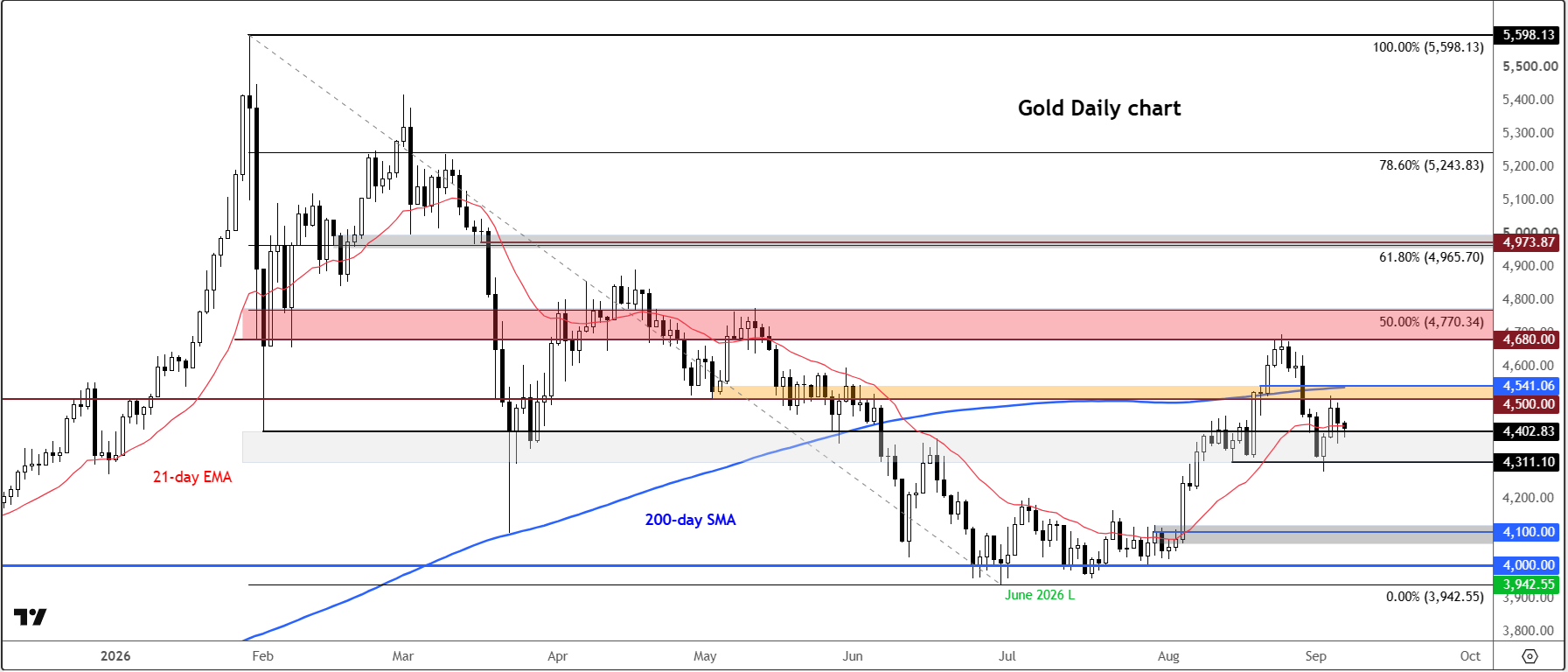
This indicates that the prior bullish run, which began in early August, may have lost momentum, similar to what we observed earlier this year in March. Back then, XAUUSD rallied away from the $4100 area, appeared quite bullish for a few weeks, but then the momentum faded, and selling resumed. We’re seeing a similar pattern this time around, with many of the macro factors that were at play in March still present, such as rising bond yields and oil prices, along with ongoing concerns over inflation.
From a macro perspective, not much has changed to suggest that this time will be different.
However, that doesn’t necessarily mean we’ll see a repeat of past price action.
Nevertheless, the fact that gold has fallen for the second consecutive week does put the market in a bit of a spot of bother, especially considering the break below the $4,310 area, the previous low prior to the last leg of the recent rally.
That level gave way on Wednesday, before the price quickly reclaimed it and ran away from there on the session and the day after, but Friday’s bearish close following the strong US jobs report has put a spanner in the works.
Crucially, the key areas of resistance have held, at least for now.
Among those, the $4,500 level was a previous support and resistance, with $4,461 also providing some resistance.
Above these levels, we have the $4565 area to the $4600 area, which was the base of the most recent selling.
On the downside, the key level to watch remains around the $4,310 area, a level tested last week, briefly broke below, but couldn’t hold.
So, if we do see it retested once more, we could well witness a more decisive break to the downside this time around.
If that’s the case, then the $4,100 level would quickly come back into focus, and below that, the $4000 area.
Overall, the near-term risks to the gold forecast remains tilted to the downside, given the rising bond yields and oil prices, as well as Friday’s stronger payrolls data, all of which continue to boost expectations about a Fed rate hike.
-- Written by Fawad Razaqzada, Market Analyst
Follow Fawad on Twitter @Trader_F_R
Related tags:
Latest market news











Web Trader platform
Our sophisticated web-based platform is packed with features.
Open an account today
Experience award-winning platforms with fast and secure execution.
Economic calendar
Related articles

Euro Technical Forecast: EUR/USD Holds the Line as September Battle Takes Shape 9 4 2026
EUR/USD has defended pivotal support for a second week, with ECB and U.S. inflation risk poised to test the developing September range.


FX Futures Positioning: Dollar Rebound Meets Diverging Forex Bets | COT Report
US dollar longs held firm into Jackson Hole, while euro, yen and commodity FX positioning diverged ahead of ISM and NFP.


USD/JPY weekly outlook: Payrolls may challenge the Fed’s hawkish reset
USD/JPY has finally woken from its slumber. Payrolls now loom as the key test of whether the latest hawkish repricing sticks or sinks.
