


EUR/USD forecast: Currency Pair of the Week | September 7, 2026
The higher oil goes, the worse it may get for the euro, which, to be fair, has performed well during the more recent rises in oil prices compared to earlier this year. Still, the risks to the near EUR/USD forecast remains tilted lower as the pair tests the 200-day average ahead of a pivotal week.
Written by
Fawad Razaqzada
Market Analyst
The EUR/USD is our currency pair of the week, due mainly to the fact we have the ECB’s policy decision being sandwiched between two important US inflation data releases. But with a light calendar in the early parts of the week, traders will get their cues from oil prices, which continue to push higher amid growing escalation between the US and Iran. The higher oil goes, the worse it may get for the euro, which, to be fair, has performed well during the more recent rises in oil prices compared to earlier this year. Still, the risks to the near EUR/USD forecast remains tilted lower as the pair tests the 200-day average ahead of a pivotal week.
Energy’s impact on EUR/USD forecast lower than expected
In recent months, economic data has become increasingly more important for the FX volatility than energy prices. This is because unlike earlier in the year, the starting point for any renewed gains in oil prices has been much higher than the pre-conflict levels. At the start of the year, oil prices skyrocketed both in nominal terms and percentage terms as they climbed from a low base. Recent gains have been far less eye-catching in percentage terms and therefore marginally less inflationary (remember inflation describes the rate of change of prices). Well, that is until now. If we see oil prices break above $100 per barrel, then surely the euro will react negatively, and the focus will turn away from data once more.
Stronger Eurozone economy has kept euro’s downside limited
For now, driving the EUR/USD forecast and direction has been the relative monetary policy outlooks in the Eurozone and US. With both central banks turning hawkish, the pair has remained in consolidation, with a slightly bullish tilt. That’s thanks largely to surprisingly strong Eurozone data, whereas in the US, economic growth has been faltering.
The relatively strong Eurozone data, combined with elevated energy prices, has seen traders price in a rate hike from the ECB and a couple more hikes are also expected during this cycle. The key question therefore is whether the ECB will validate the hawkish repricing of eurozone rates, or whether Christine Lagarde and co will turn out to be a little less dovish.
Validating the hawkish pricing of Eurozone rates will likely provide a bit more support for the euro, which if Lagarde suggests the central bank is happy to see through the latest spike in oil prices and imply that rates will not be tightened further, then that could hit the euro.
For what it is worth, I reckon the ECB will be keen to highlight stagflation risks amid continued Middle East uncertainty more than the mild improvement in the data. That may mean a more dovish policy decision than expected. As such, the EUR/USD could fall in response to the ECB’s choice of wording and economic projections.
EUR/USD forecast: ECB, PPI and CPI among key highlights this week
The ECB’s rate decision is on Thursday, September 10, and the decision is likely to be a hike, as discussed above. The eurozone economy has shown surprising resilience to the Middle East war, while headline inflation has continued to climb with oil prices remaining elevated. What this means for the euro and what we think will happen is something I have discussed above.
Stateside, the first of the two US inflation reports, namely producer price index (PPI), will be sandwiched between the ECB’s interest rate decision and press conference, making the EUR/USD a key pair to watch around 13:00-14:00 BST. Inflation remains the only major US data release before the Fed’s next meeting.
But the big one could be saved to last: US consumer price index (CPI) on Friday, September 11. There’s a bit of a divergence within the Fed, with Chair Kevin Warsh adopting a hawkish stance at the Jackson Hole summit, while Governor Christopher Waller was less so last week, preferring to see the inflation data before deciding on a rate hike or maintaining the current rates. This makes the CPI release a crucial piece of economic data, being the last major update before the Fed’s next meeting.
Technical EUR/USD forecast and key levels to watch
Without beating around the bush, consolidation is the name of the game for the EUR/USD. The pair was testing resistance around 1.1635 at the time of writing. This level was the last support pre breakdown on Friday August 28. Here, we also have the 200-day average converging with a short-term bearish trend line.
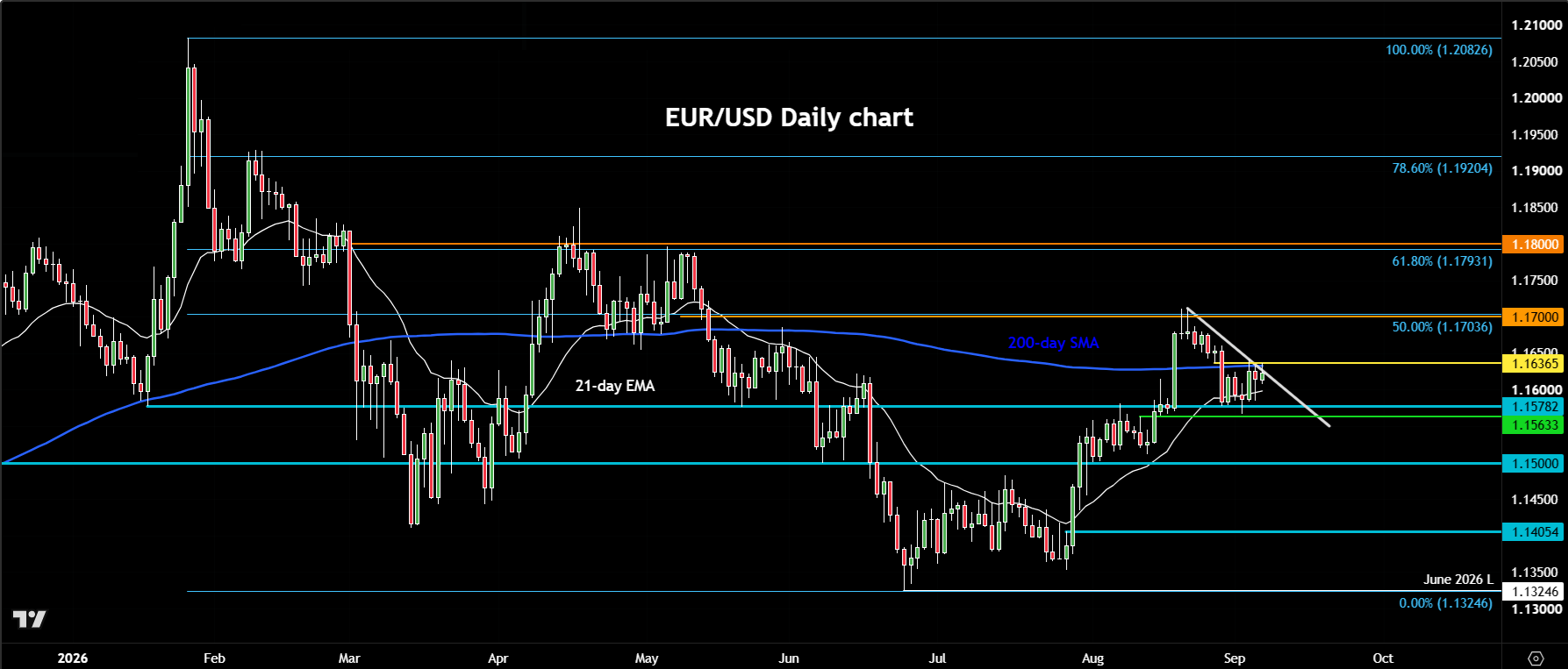
A potential move lower from here would make technical sense, with the next support seen around 1.1565-75 area on the EUR/USD chart. Break that and 1.1500 could become in focus ahead of the 1.1405 level next.
Meanwhile, if the above-mentioned resistance of 1.1635 breaks instead, then 1.1700 could be re-tested fairly quickly. Above that 1.1800 is the next upside objective if the potential rally continues.
-- Written by Fawad Razaqzada, Market Analyst
Follow Fawad on Twitter @Trader_F_R
Latest market news










Web Trader platform
Our sophisticated web-based platform is packed with features.
Open an account today
Experience award-winning platforms with fast and secure execution.
Economic calendar
Related articles

Euro Technical Forecast: EUR/USD Holds the Line as September Battle Takes Shape 9 4 2026
EUR/USD has defended pivotal support for a second week, with ECB and U.S. inflation risk poised to test the developing September range.


FX Futures Positioning: Dollar Rebound Meets Diverging Forex Bets | COT Report
US dollar longs held firm into Jackson Hole, while euro, yen and commodity FX positioning diverged ahead of ISM and NFP.


USD/JPY weekly outlook: Payrolls may challenge the Fed’s hawkish reset
USD/JPY has finally woken from its slumber. Payrolls now loom as the key test of whether the latest hawkish repricing sticks or sinks.
