


EUR/USD forecast: Eurozone stagflation risks mount as dollar holds firm ahead of data
The dollar was bouncing back at the time of writing, after it had eased overnight on the back of some weaker-than-expected economic data yesterday which had prompted markets to scale back expectations of an October Fed rate hike. However, with more significant US data due today and Friday, and with oil prices continuing to remain elevated, the dollar’s broader direction remains bullish.
Written by
Fawad Razaqzada
Market Analyst
The dollar was bouncing back at the time of writing, after it had eased overnight on the back of some weaker-than-expected economic data yesterday which had prompted markets to scale back expectations of an October Fed rate hike. However, with more significant US data due today and Friday, and with oil prices continuing to remain elevated, the dollar’s broader direction remains bullish. Against this backdrop, the near-term risks to our EUR/USD forecast remains titled to the downside, especially with growing signs of stagflation emerging in Europe.
Eurozone data reinforce stagflation concerns
The EUR/USD broke below its summer lows yesterday before recovering some ground this morning. While dovish-leaning remarks from ECB President Christine Lagarde have added to the euro’s woes, the recent decline has been undoubtedly driven predominantly by dollar strength rather than any fundamental deterioration in the single currency.
However, this morning’s economic releases from the eurozone have done little to improve the outlook, with a combination of rising inflation and weakening sentiment reinforcing concerns about stagflation. The renewed recovery in oil prices, amid a lack of progress in US-Iran negotiations, adds another complication for the region’s economic outlook.
French inflation accelerated sharply to 3.0% in September, well above expectations, largely reflecting higher energy prices. The renewed inflationary pressure threatens to erode household purchasing power just as consumption is weakening, while higher borrowing costs are adding to the country’s fiscal challenges.
Germany offered a somewhat more encouraging labour market picture, with unemployment falling by 67,000 in September, taking the number of unemployed to just below 3 million for the first time since June. However, regional inflation readings suggest that German CPI is also picking up, with the national rate potentially returning to around 3.1–3.2%.
Italy’s figures were more concerning. Consumer inflation surged to 4.2% year-on-year in September, up from 3.3% in August and significantly above the 3.8% consensus forecast. At the same time, consumer confidence deteriorated sharply, while business sentiment weakened as renewed caution in the services and construction sectors outweighed a modest improvement in manufacturing.
Taken together, the latest figures highlight the eurozone’s increasingly difficult trade-off between containing inflation and supporting an economy already showing signs of strain, keeping the EUR/USD forecast bearish.
Dollar supported by yields as markets await US data
Yesterday’s disappointing consumer confidence and JOLTS figures weighed on the greenback, although the resulting decline in front-end yields was relatively modest. Today’s ADP employment report and PCE inflation data should provide further clues on the Fed’s next move, with nonfarm payrolls to come on Friday.
Meanwhile, the sharp sell-off in longer-dated US Treasuries continues to weigh on global risk appetite, offering underlying support to the dollar. This is likely to limit the scope for a meaningful correction in the greenback, even if incoming data disappoints.
Attention now turns to September ADP employment and August personal spending and PCE inflation. Core PCE inflation is expected to accelerate from 0.2% to 0.3% month-on-month. Although PCE is the Fed’s preferred inflation gauge, markets may place greater emphasis on the September CPI report due in a couple of weeks. Nevertheless, a stronger-than-expected core PCE reading could push October rate hike pricing higher again.
Technical EUR/USD forecast and key levels to watch
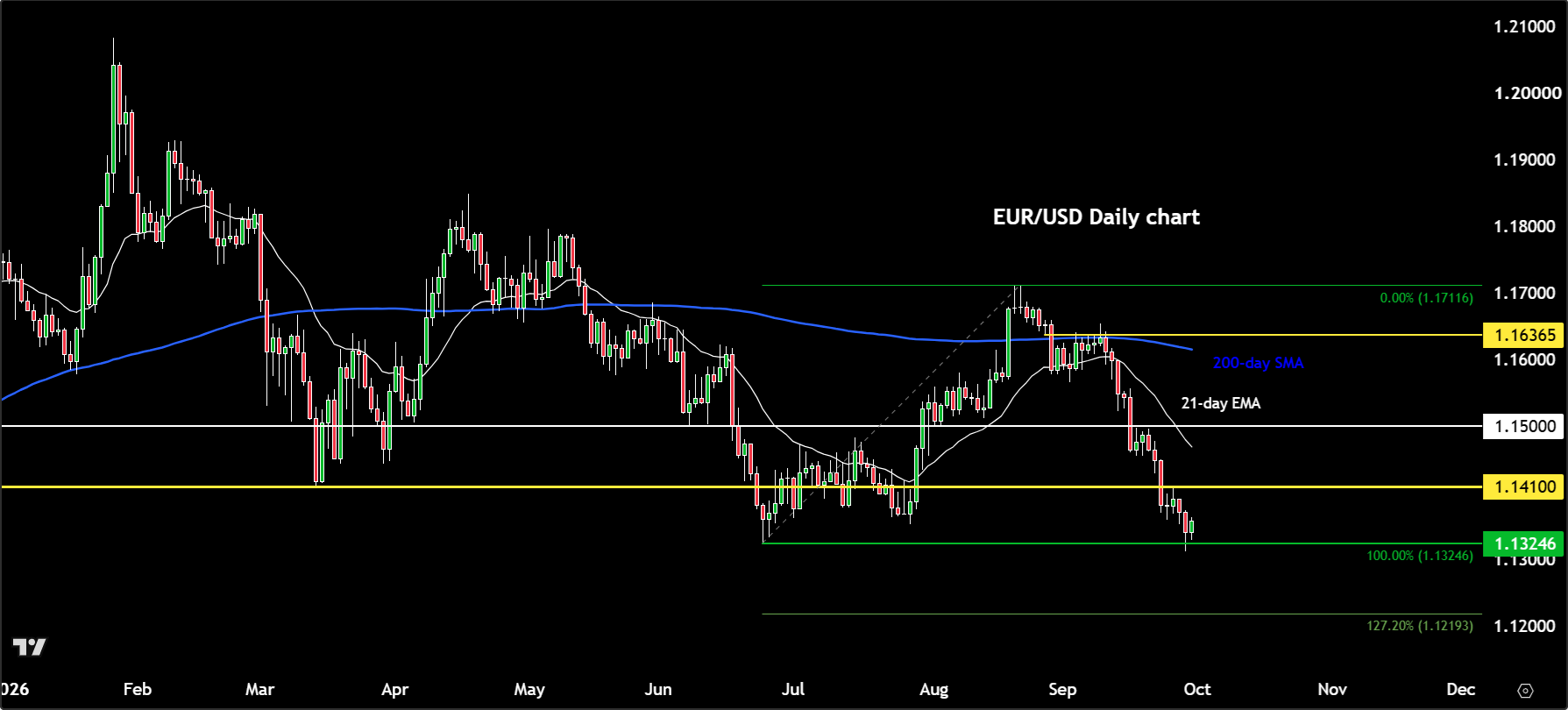
The EUR/USD has met its main downside target i.e., liquidity below the summer lows of around 1.1325. Will it decline further remains to be seen and will depend pretty much on the bond markets. From a technical perspective, a potential closing break below 1.1325 could see the pair start its next leg lower towards the 127.2% Fibonacci extension level of the last upswing that begun in June, at 1.1220. Resistance is now seen at 1.1360ish and then 1.1410 area, followed by 1.1500.
Related tags:
Latest market news









Web Trader platform
Our sophisticated web-based platform is packed with features.
Open an account today
Experience award-winning platforms with fast and secure execution.
Economic calendar
Related articles

Gold and S&P 500 analysis: What now after Warsh’s hawkish speech?
The dollar surged across the board after the Fed Chair Kevin Warsh surprised with a hawkish-leaning speech at the Jackson Hole summit. All the bearish dollar bets that had been accumulated since last Friday on the back of data weakness and bond market troubles had to be squared and that triggered a short squeeze rally for the dollar. Gold and silver dropped, as a result, as too did bitcoin, while US indices were giving back earlier gains.

EUR/USD forecast: All eyes on Warsh at Jackson Hole - Forex Friday
For much of this week, the EUR/USD has been edging lower with the US dollar regaining some ground after last week’s sell-off that was triggered, in part, by the bond market worries. Investors have been unwilling to bet further against the US dollar so far this week ahead of Kevin Warsh’s keynote speech at the Jackson Hole summit, due later today.

Nasdaq 100 forecast: Tech stocks shine as Nvidia results underpin AI trade
Much of this week’s attention has been on Nvidia’s earnings, and the chipmaker delivered the sort of numbers of investors had been hoping for. US index futures initially wobbled before moving higher overnight, with the results providing a fresh lift to the AI trade