

EUR/USD forecast undermined by energy shock ahead of FOMC
The EUR/USD has taken a drop today with the pair coming under pressure from rising energy prices and a rebounding US dollar ahead of the FOMC rate decision, where a hike is all but priced in now. We have a few other central bank meetings and some important data to look forward to as well. For now, all the focus is on energy prices which have rebounded after nothing important happened to de-escalate the situation at the weekend.
Written by
Fawad Razaqzada
Market Analyst
The EUR/USD has taken a drop today with the pair coming under pressure from rising energy prices and a rebounding US dollar ahead of the FOMC rate decision, where a hike is all but priced in now. We have a few other central bank meetings and some important data to look forward to as well. For now, all the focus is on energy prices which have rebounded after nothing important happened to de-escalate the situation at the weekend. The near-term EUR/USD forecast therefore remains titled moderately lower. I say “moderately” because there are other currencies that ever weaker. The Swiss franc, for example, due to interest rates being zero in Switzerland. But in the near-term we could well see a sharp decline in the EUR/USD too, not only because of the hawkish repricing in US rates and oil prices hurting economies of energy importers, but also due to waning risk appetite with the tech sector coming under pressure today amid calls to reduce AI investment.
Before we discuss those macro factors in detail, let’s a have quick look at the chart of the EUR/USD because there has been a key technical development that needs to be watched.
Technical EUR/USD forecast: Triangle break down
The EUR/USD has broken below the lower trendline of its triangle pattern today, taking support around the 1.1565 to 1.1580 area. This is clearly a bearish development in the EUR/USD forecast from a technical point of view.
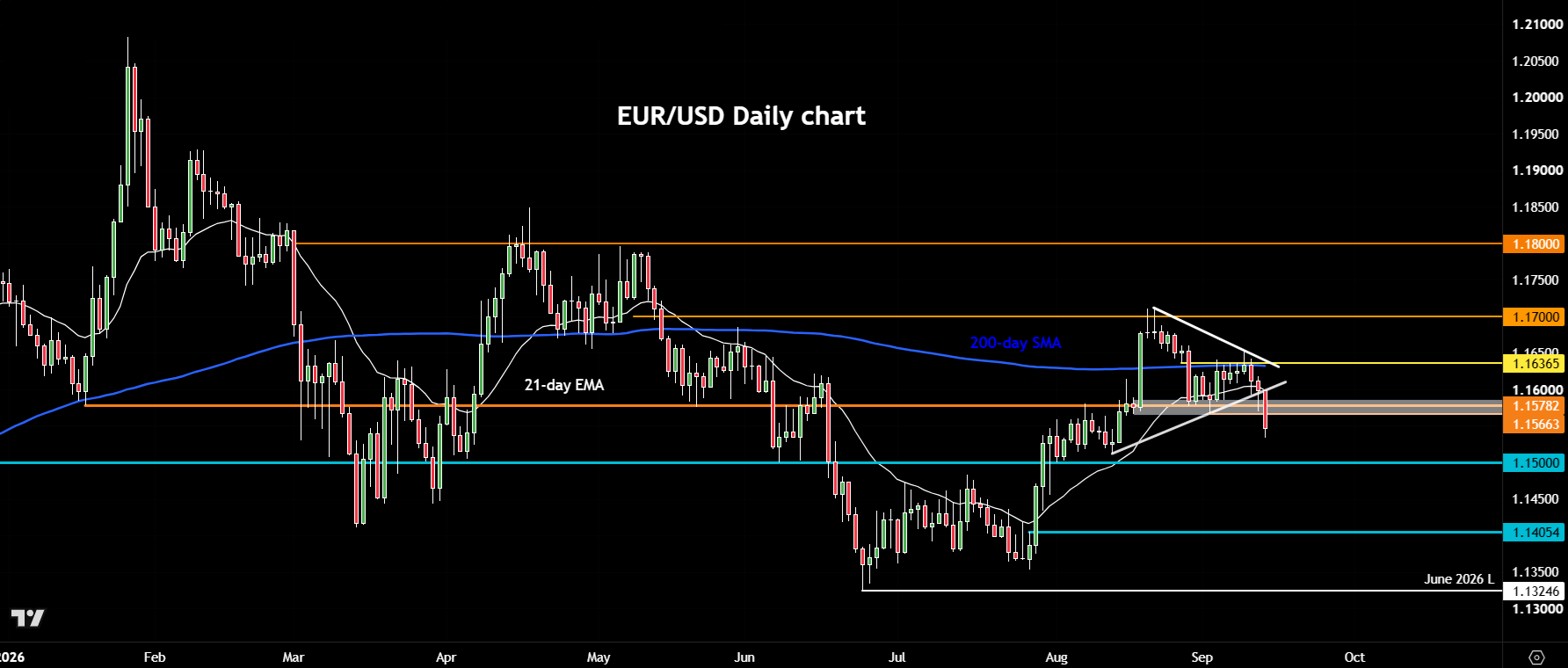
Last week, price was struggling around the 200-day moving average, with resistance near the 1.1635 area. After failing to break above that level and remaining under pressure, mainly due to elevated oil prices, the EUR/USD has decided to break lower instead, which makes fundamental sense.
From here, if selling pressure remains or intensifies, we could see a move towards the 1.1500 handle, with 1.1405 becoming the next potential area of support. Below that, the June low at 1.1325 comes into focus.
On the upside, 1.1635 is clearly a key resistance level. However, the former support zone that was broken today, between 1.1565 and 1.1580, could now become the initial and key area of resistance to watch at the start of this week.
EUR hurt by resumption in crude oil rally
Oil is adding to the pressure facing the EUR/USD and other FX majors. Crude prices fell on Friday, but they have now resumed higher again after Saudi Arabia shut the East-West pipeline following drone attacks from Iraq. The route is an important alternative to the Strait of Hormuz, carrying roughly 7 million barrels a day of exports. Meanwhile, Oman-led discussions with Iran and other Gulf states over a temporary shipping route through the Strait have been postponed.
The combination leaves markets vulnerable to another bout of risk aversion. Equities are already struggling, while renewed calls from prominent technology figures to slow the pace of AI development are adding to concerns around stretched valuations. These developments are clearly negative for the EUR/USD forecast.
That said, the euro does have one source of support: the ECB’s increasingly hawkish tone. Last week’s messaging suggested that policymakers remain open to further tightening, a stance that appears to reflect the surprising resilience of the eurozone economy as much as inflation itself. ECB’s President Christine Lagarde has an opportunity to reinforce — or soften — last week’s message. She is due to speak in Vienna this afternoon.
But I remain sceptical that the ECB will actually deliver further rate increases. For now, though, the shock from higher energy prices will give policymakers a solid reason to keep their rhetoric hawkish. But if we see growth indicators turning soft while oil remains elevated then stagflation risks will come back into play.
Dollar comes back to life
After finishing the week on the front-foot, the dollar has started this week also on the front foot, with both domestic and external developments now working in its favour. Last week’s hotter-than-expected CPI report has effectively locked in a 25bp Federal Reserve rate hike on Wednesday. The key question is what message we will get about inflation and therefore hints about further tightening. The central bank has good reason to sound firm. Inflation has proved sticky, energy prices are rising again, and the bond market is increasingly demanding evidence that policymakers remain serious about price stability. For now, therefore, the balance of risks still favours a moderately stronger dollar, keeping the EUR/USD forecast tilted to the downside until such a time the US dollar debasement narrative comes back into focus.
Related tags:
Latest market news











Web Trader platform
Our sophisticated web-based platform is packed with features.
Open an account today
Experience award-winning platforms with fast and secure execution.
Economic calendar
Related articles

FX Futures Positioning: Dollar Rebound Meets Diverging Forex Bets | COT Report
US dollar longs held firm into Jackson Hole, while euro, yen and commodity FX positioning diverged ahead of ISM and NFP.


Gold and S&P 500 analysis: What now after Warsh’s hawkish speech?
The dollar surged across the board after the Fed Chair Kevin Warsh surprised with a hawkish-leaning speech at the Jackson Hole summit. All the bearish dollar bets that had been accumulated since last Friday on the back of data weakness and bond market troubles had to be squared and that triggered a short squeeze rally for the dollar. Gold and silver dropped, as a result, as too did bitcoin, while US indices were giving back earlier gains.

EUR/USD forecast: All eyes on Warsh at Jackson Hole - Forex Friday
For much of this week, the EUR/USD has been edging lower with the US dollar regaining some ground after last week’s sell-off that was triggered, in part, by the bond market worries. Investors have been unwilling to bet further against the US dollar so far this week ahead of Kevin Warsh’s keynote speech at the Jackson Hole summit, due later today.