


Australian Dollar Outlook: AUD/USD Rally Stalls as Fed Risk Returns
AUD/USD momentum fades as Fed hike expectations return, while RBA officials keep September tightening risks firmly in focus.
Written by
Matt Simpson
Market Analyst
AUD/USD lost momentum after a 10-week rally as hot US inflation data revived Fed hike expectations. With RBA officials also keeping September tightening risks alive, both sides of the pair face significant event risk this week.
AUD/USD Rally Stalls as Fed and RBA Risks Build
The Australian dollar finally faltered on Thursday after a hot US PPI report added to pressure on the Fed to hike, with rising crude oil prices further complicating the inflation outlook.
Rising producer and consumer prices saw markets reprice a 25bp Fed hike this week to an 87% probability. Money markets had swung from hike to no hike following dovish comments from some Fed members, but August’s inflation data — which is yet to fully reflect the rise in crude oil prices — leaves little reason for the Fed not to hike at this stage.
That puts extra focus on the updated FOMC forecasts for clues over the likelihood of a follow-up hike, which Fed funds futures currently price at around 48% for March.
See my recent X posts on US consumer prices and US producer prices.
RBA Hike Concerns Weigh on Australian Sentiment
Concerns over RBA hikes are resurfacing in the latest business sentiment reports for Australia. Business conditions were negative for the first time in six years, according to NAB, while confidence fell to a three-month low of -8, or 13 points below its long-term average of 5.
Westpac also reported that consumers had become more pessimistic, with sentiment dropping 5% as expectations of rate hikes rose alongside concerns about unemployment. This seems unlikely to deter the RBA from hiking, potentially as soon as 29 September.
Australia This Week: Economic Data and Events for AUD/USD Traders
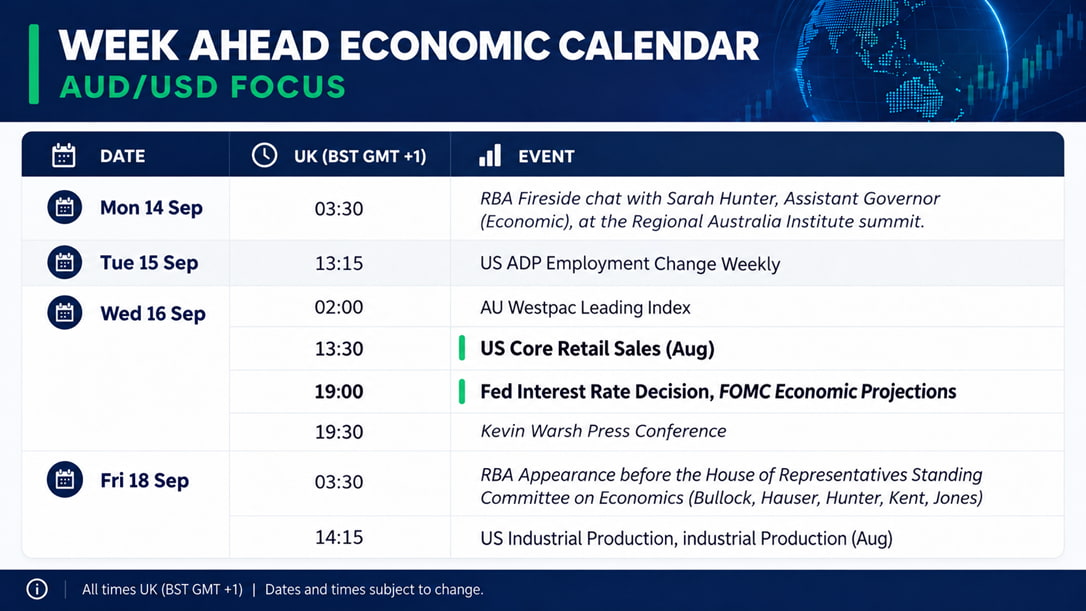
RBA Speakers Could Reinforce September Hike Expectations
While the Australian data calendar is quiet, the RBA has plenty of opportunity to reinforce a hawkish message. Monday’s fireside chat could serve as a warm-up for Friday’s testimony before the House of Representatives, where Governor Bullock and several senior officials will appear ahead of the 29 September meeting.
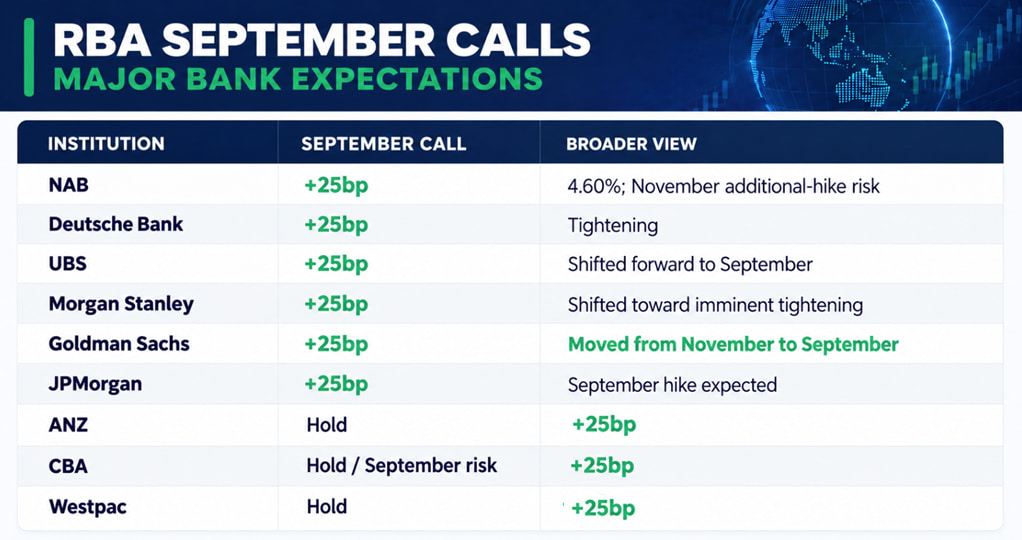
Several major banks have already brought forward their calls for a September hike, while even Westpac has abandoned its previous hold-through-2026 view in favour of a November increase. If officials remain hawkish and avoid pushing back against current pricing, more economists may be forced to bring their calls forward.
From that angle, a meaningful pushback against September hike expectations would now be more surprising than another round of hawkish guidance.
FOMC Projections Take Centre Stage
With markets pricing an 87% chance of a 25bp Fed hike this week, the focus is on the updated forecasts and dot plot, particularly with economists still more cautious than markets about how far tightening goes this year. The 2026–2027 median rate projections will take centre stage, with any upward shift reinforcing expectations that September is not a one-and-done hike.
I’d like to think Warsh will use the press conference to make this clear, but his early track record leaves me less confident that he will. Still, with crude oil above $100 and inflation well above target, the risks around the dots appear more hawkish than at the previous meeting.
This content was created by an affiliate of FOREX.com and represents the views and opinions of the author/speakers, not the views and opinions of FOREX.com, StoneX Group Inc., or its subsidiaries. The content has not been independently reviewed by FOREX.com.
AUD/USD Technical Analysis: Australian Dollar vs US Dollar
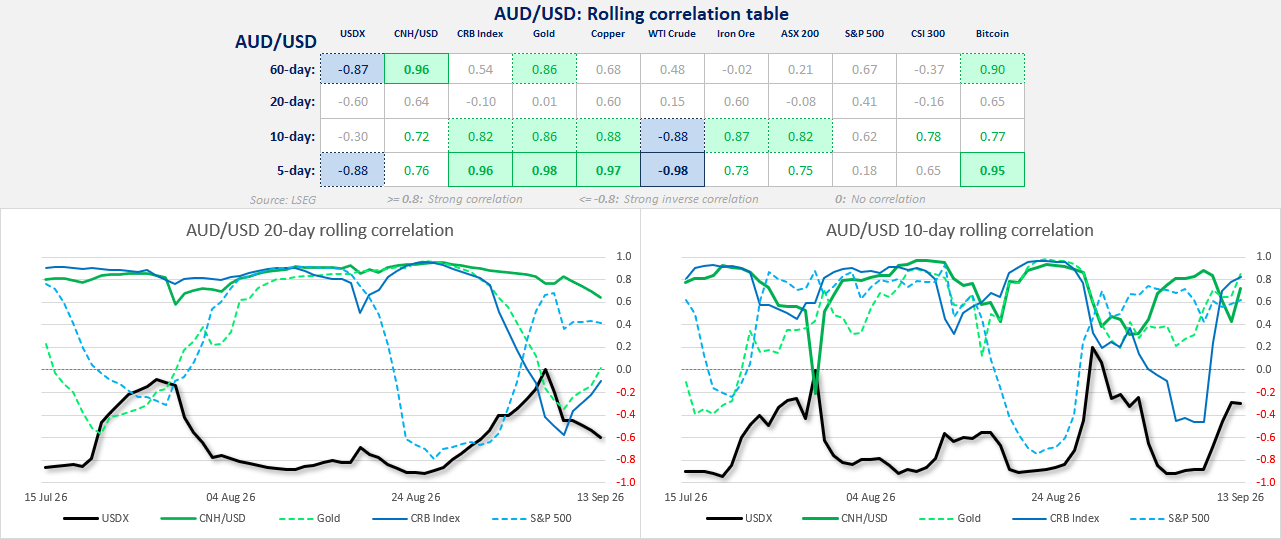
AUD/USD Correlations
- US dollar influence has weakened short term, suggesting AUD/USD is being driven by more than just broad USD moves.
- The yuan remains an important positive influence, keeping Chinese market sentiment relevant for AUD/USD traders.
- Commodity links remain supportive, with copper and gold providing useful confirmation for Australian dollar moves.
- Correlations are shifting across timeframes, so traders should treat them as confirmation rather than standalone AUD/USD signals.
Source: LSEG
AUD/USD Options Point to Near-Term Pullback Risk
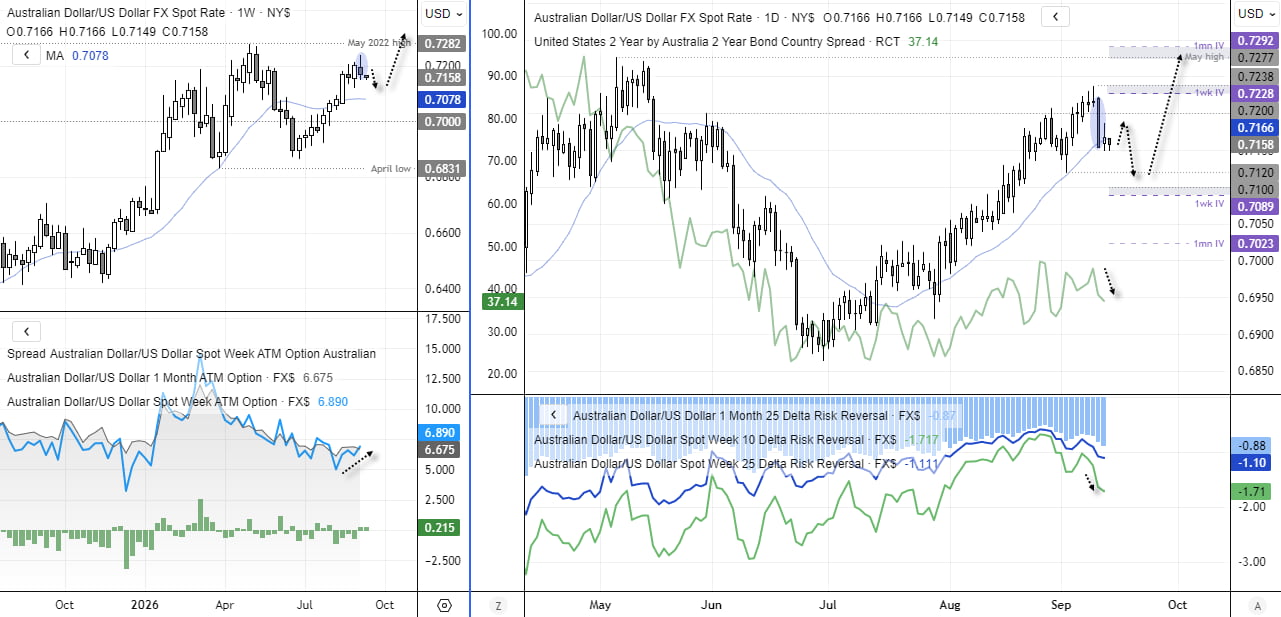
A small shooting star formed on the weekly chart, suggesting the 10-week rally is running out of steam around 0.7200. The daily chart shows the momentum shift more clearly, with Wednesday’s reversal following two small doji candles. This has kept 1-week implied volatility slightly above 1-month implied volatility for a second week.
Options traders are also pricing in the potential for a deeper pullback, with risk reversals moving lower. Bearish tail-risk pricing, represented by the 1-week 10-delta risk reversal, is now at its strongest in six weeks. The AU-US 2-year yield spread has also fallen to an eight-day low after forming a bearish divergence ahead of AUD/USD.
I am not looking for an excessively deep pullback in AUD/USD. But after a 10-week rally, with implied volatility perking up, risk reversals moving lower and the yield spread weakening, rallies could be capped and viewed as opportunities for bears over the near term. Note the 0.7120 and 0.7100 support levels, which could entice dip buyers if prices pull back that far.
Source: ICE, TradingView
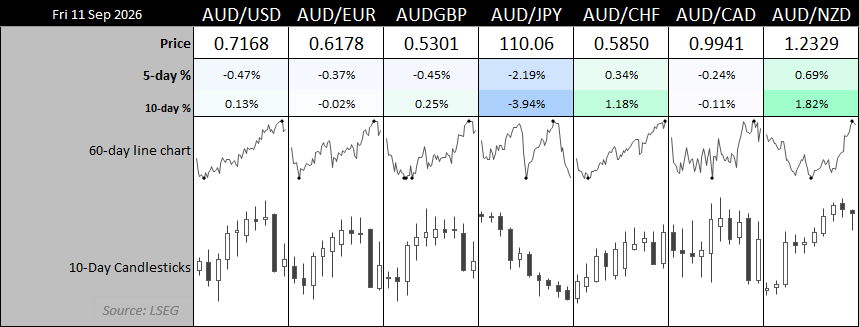
Australian Dollar Performance
Source: LSEG
Related tags:
Latest market news











Web Trader platform
Our sophisticated web-based platform is packed with features.
Open an account today
Experience award-winning platforms with fast and secure execution.
Economic calendar
Related articles

Gold Falters at Resistance, Grappling With PCE, Month-End Flows and Jackson Hole
Gold has pulled back from resistance after sticky PCE data, with month-end flows and Jackson Hole now shaping the near-term outlook.

AUD/USD Shorts Bear the Brunt of Hot CPI, Renewed RBA Hike Bets
Hot Australian CPI revives RBA hike bets, lifts bond yields and adds fresh pressure to crowded AUD/USD short positions.
AUD/USD forecast tilted to upside as focus turns to key data
The AUD/USD continues to grind higher - as it has done so ever since risk assets bottomed back in April 2025. The Aussie has benefitted from rising metals prices and a strong Chinese yuan. The US dollar meanwhile has had bouts of strength here and there, but not much against the Aussie. The recent bond market stress has further increased the US dollar debasement calls. The focus now is turning to key data from both Australia and the US, and the Jackson Hole symposium.