


Gold Update: XAU/USD Remains Directionless Despite Falling Yields
As the trading week continues to unfold, the lack of direction dominating gold price action remains a relevant theme in the short term. In fact, the average move over the last three trading sessions has resulted in a decline of barely 1.0%, highlighting that neither buyers nor sellers have been able to take control in a consistent manner.
Written by
Julian Pineda
Market Analyst
As the trading week continues to unfold, the lack of direction dominating gold price action remains a relevant theme in the short term. In fact, the average move over the last three trading sessions has resulted in a decline of barely 1.0%, highlighting that neither buyers nor sellers have been able to take control in a consistent manner. As a result, a phase of neutrality continues to gain traction across the market.
In broad terms, this indecisive environment is largely the result of gold's inability to benefit from the recent moderation in the bond market. Part of the capital flow appears to be finding more attractive opportunities elsewhere, while activity around the precious metal remains limited. This combination continues to reinforce a cautious tone that could remain an important feature of the market in the coming sessions.
Is Confidence in Gold Starting to Fade?
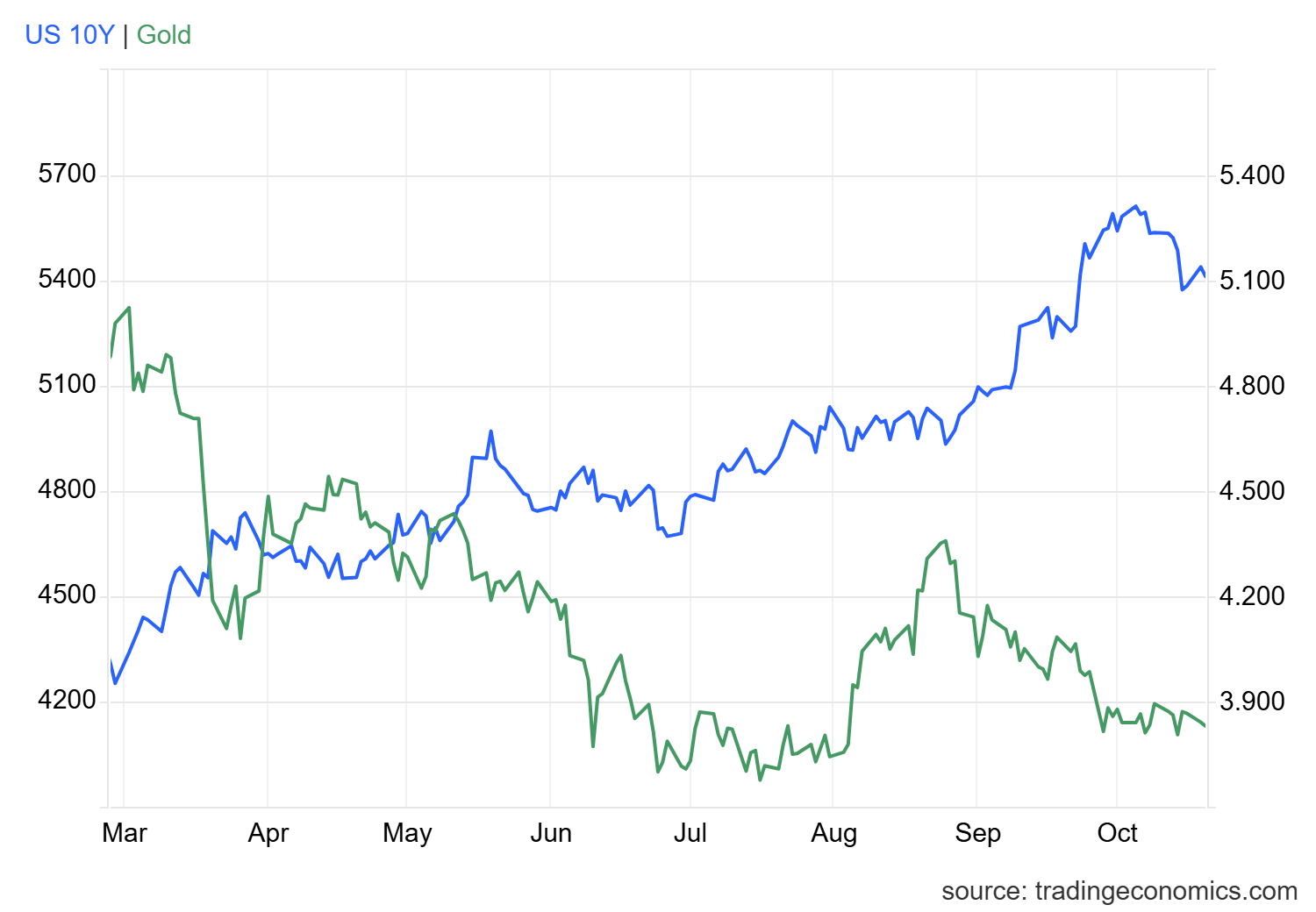
Recent sessions have revealed a trend that has not been seen for several months: a consistent decline in 10-year U.S. Treasury yields. Yields continue to develop within a bearish slope and are moving back toward the 5.0% area, reflecting a loss of relative attractiveness in one of the market's most important safe-haven assets.
What makes this situation particularly relevant is the historically competitive relationship between gold and bonds. When yields rise, gold often loses appeal due to the higher opportunity cost of holding a non-yielding asset. However, the interesting aspect of the current environment is that the recent decline in yields has not translated into a meaningful recovery for gold. In other words, even as the bond market loses some of its appeal, the precious metal continues to struggle to attract demand and remains trapped in a relatively cautious trading environment.
Source: TradingEconomics
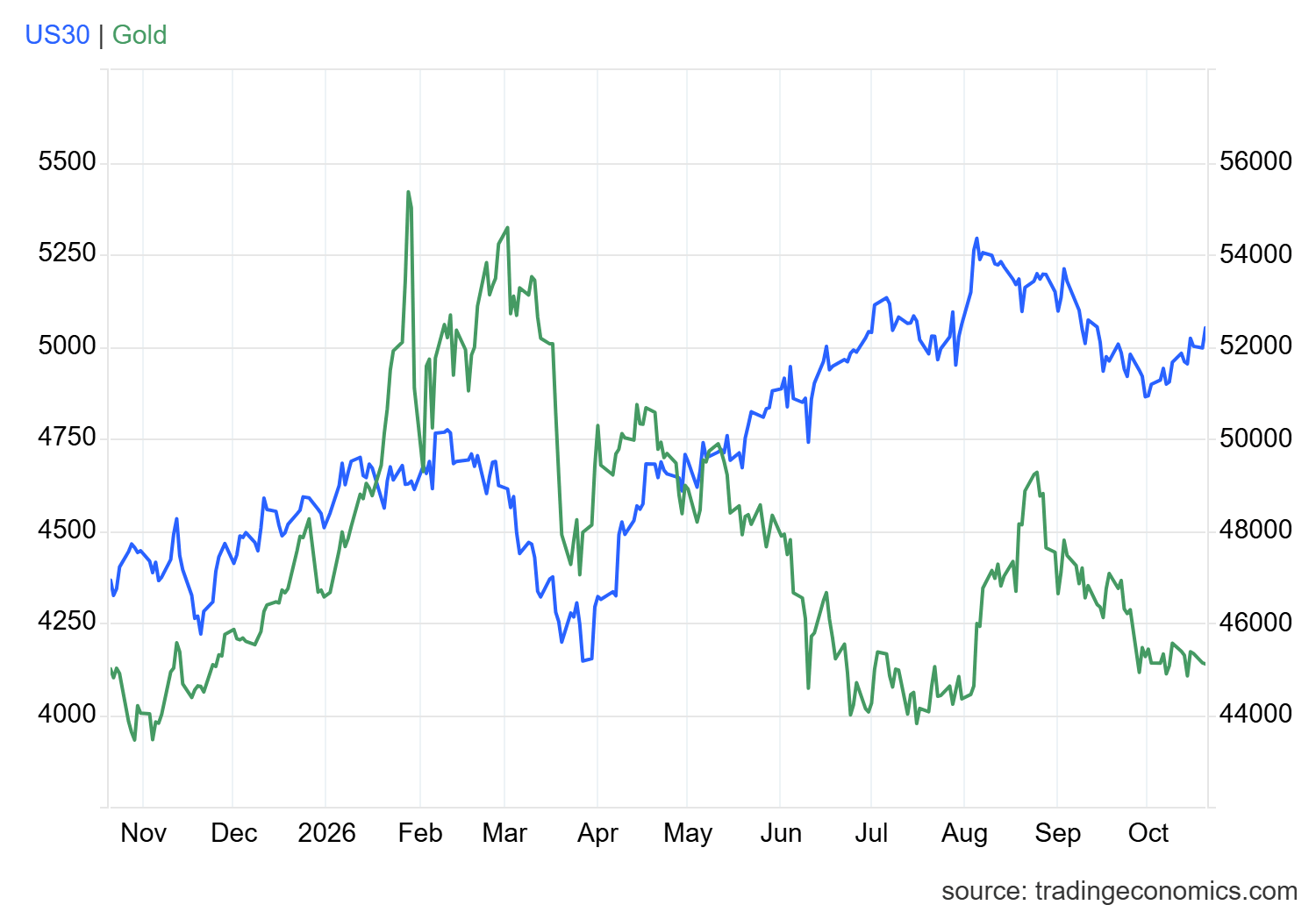
Another factor becoming increasingly relevant is gold's performance relative to other financial markets. Over recent sessions, an inverse dynamic between gold and the Dow Jones has become more evident. The Dow, one of the more stable U.S. equity indices due to its lower exposure to the technology sector, continues to display growing strength.
While gold remains stuck in a neutral phase, the Dow Jones has continued to advance and remains above the 52,000-point area, reaching levels not seen in previous weeks. This development is important because it suggests that part of the capital leaving the bond market is not flowing into gold, but instead toward more dynamic segments of the equity market.
As a result, a growing perception is emerging that gold is failing to attract significant interest either as a safe-haven asset or as a compelling short-term investment opportunity. This continues to limit its ability to regain momentum.
Source: TradingEconomics
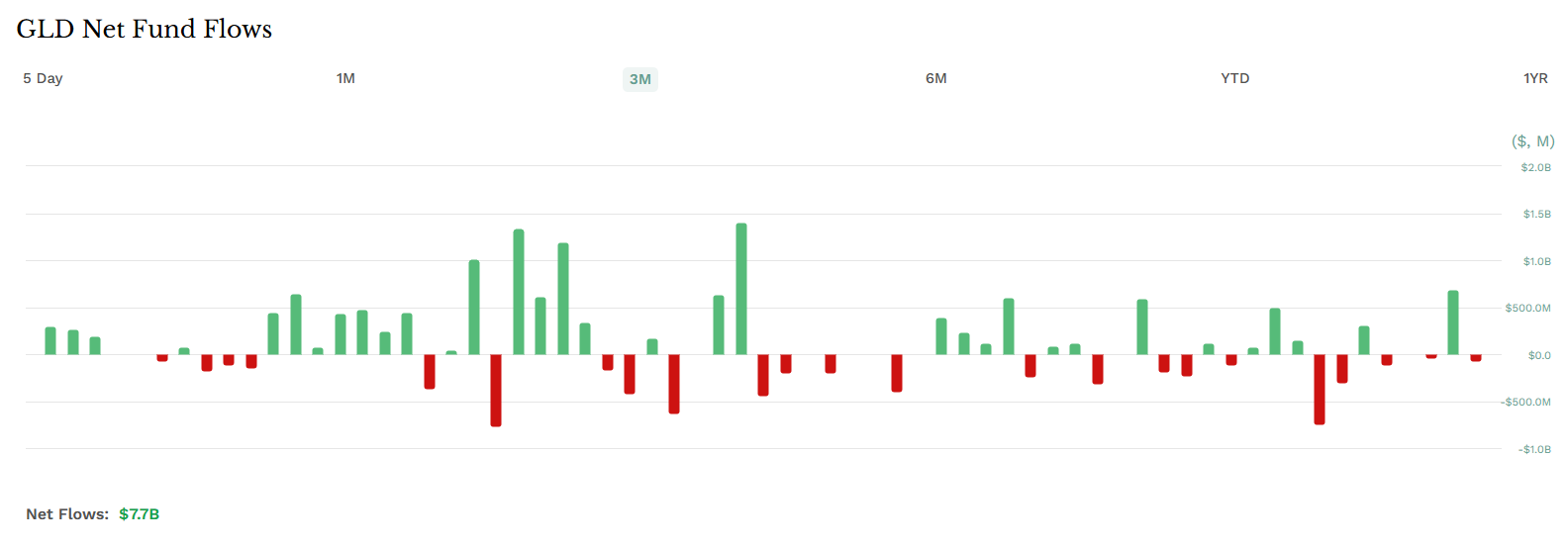
The same pattern can also be seen in the flows of the SPDR Gold Trust ETF, where a consistent trend of capital inflows has yet to develop. As of October 16, the fund recorded inflows of approximately $680 million, a figure that remains relatively modest compared to the levels observed several months ago.
This development reinforces the idea that activity around the gold market remains relatively subdued and that caution continues to play an important role in investment decisions related to the precious metal.
Source: ETF
Taking all of this into account, gold continues to face difficulties regaining activity and investor confidence, even in an environment where some competing markets have lost part of their appeal. This suggests that the metal is struggling to establish itself as a preferred destination for capital flows in the short term. As long as this lack of interest remains in place and investors continue finding opportunities in other assets, the current phase of indecision could remain a dominant feature of gold's price action.
Gold Technical Forecast
Source: StoneX, Tradingview
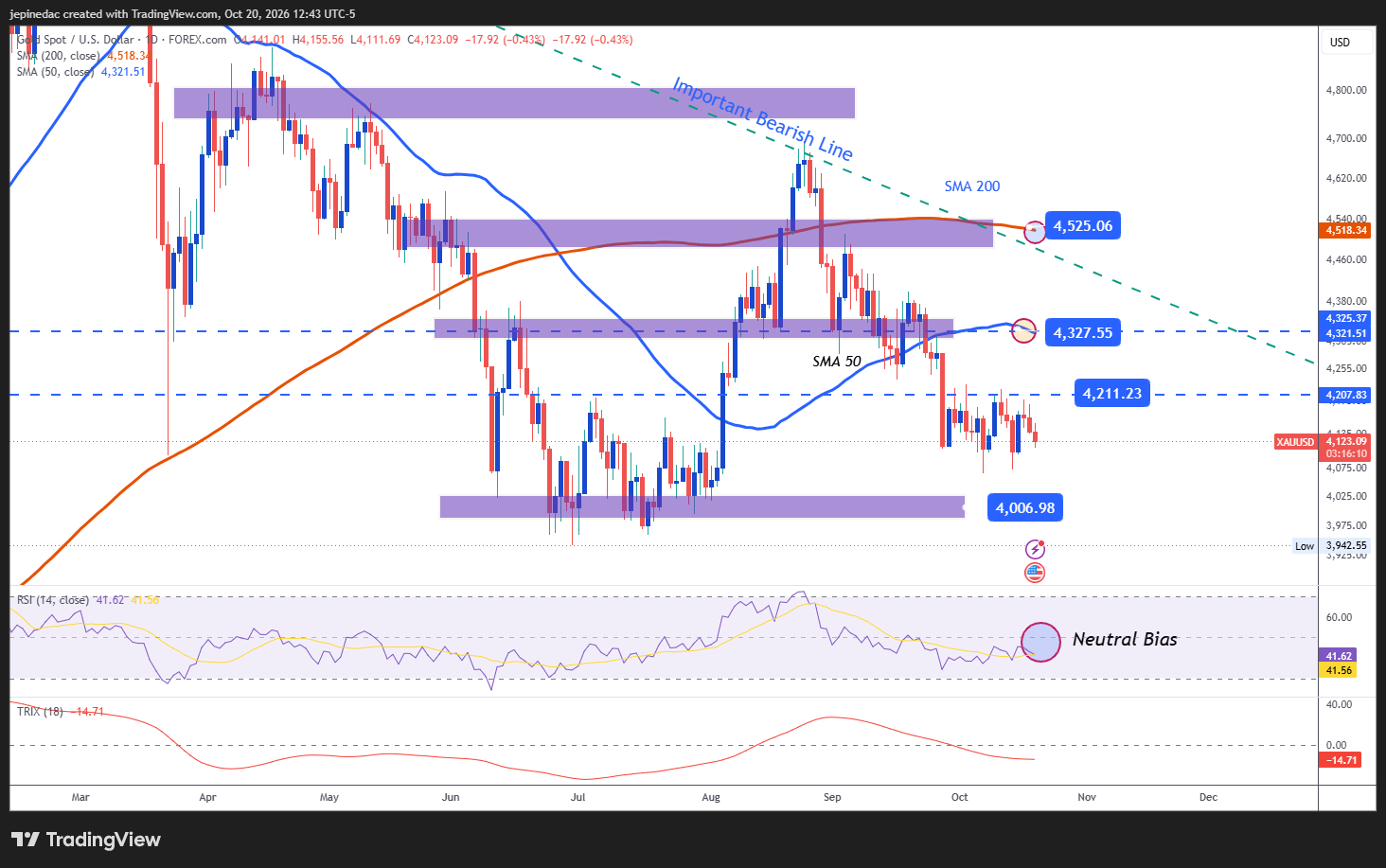
- The lack of direction is becoming increasingly relevant: Although gold has spent the past several months developing a sequence of lower lows that helped establish an important long-term bearish trendline, recent sessions have been characterized by limited activity and muted price movements. This reflects a loss of momentum within the prevailing trend and could open the door to a more established short-term trading range if the lack of direction continues to dominate.
- RSI: The RSI remains close to its neutral zone, reflecting a relatively balanced environment between buyers and sellers. This reading supports the view that a phase of indecision could continue to play an important role in the sessions ahead.
- TRIX: A similar picture can be observed in the TRIX indicator, whose line continues to fluctuate around the 0 neutral level. This reading reflects a relatively balanced dynamic within longer-term exponential moving averages and continues to support the idea of a broader neutral phase developing across the market.
Key Levels to Watch:
- $4,320 – Key Resistance: An important upside barrier that coincides with the most relevant highs on the chart and develops near the 50-period simple moving average. Price action that manages to consolidate above this level could challenge the dominant bearish structure and open the door to a more constructive bullish bias over the coming weeks.
- $4,200 – Near-Term Barrier: An area defined by recent retracements that remains the closest level to monitor and could become the primary target for any short-term bullish correction.
- $4,000 – Critical Support: A major support zone that also coincides with an important psychological level for the market. A return toward this area could restore selling pressure, bring an end to the recent neutral phase, and support a further extension of the dominant downtrend in the weeks ahead.
Written by Julian Pineda, CFA, CMT – Market Analyst
Follow him on: @julianpineda25
Latest market news











Web Trader platform
Our sophisticated web-based platform is packed with features.
Open an account today
Experience award-winning platforms with fast and secure execution.
Economic calendar
Related articles

Gold and S&P 500 analysis: What now after Warsh’s hawkish speech?
The dollar surged across the board after the Fed Chair Kevin Warsh surprised with a hawkish-leaning speech at the Jackson Hole summit. All the bearish dollar bets that had been accumulated since last Friday on the back of data weakness and bond market troubles had to be squared and that triggered a short squeeze rally for the dollar. Gold and silver dropped, as a result, as too did bitcoin, while US indices were giving back earlier gains.


Gold Falters at Resistance, Grappling With PCE, Month-End Flows and Jackson Hole
Gold has pulled back from resistance after sticky PCE data, with month-end flows and Jackson Hole now shaping the near-term outlook.


Gold forecast: XAU/USD retreats along with dollar debasement trade
Gold was down nearly 1.5% on the session, with US indices and Bitcoin also struggling. Is this a mere pause before more gains are seen, or have we already seen the end of the recent bullish advance?