


Nasdaq 100 Update Index retakes 29000 as tensions ease
After starting the session with a relevant bearish bias, the Nasdaq 100 has managed to regain short-term strength and is up more than 2.5% on the day. This move has brought back a mild bullish tone to the market, although the broader backdrop remains sensitive.
Written by
Julian Pineda
Market Analyst
After starting the session with a relevant bearish bias, the Nasdaq 100 has managed to regain short-term strength and is up more than 2.5% on the day. This move has brought back a mild bullish tone to the market, although the broader backdrop remains sensitive.
Recent buying pressure started to emerge after important updates confirmed the cancellation of US attacks against Iran. This has moderately improved short-term optimism across financial markets. Still, despite this recovery, the Nasdaq chart continues to reflect a possible phase of indecision. If optimism does not hold in a more consistent way, this phase could remain important in short-term price action.

Is the conflict easing?
During today’s session, updates from President Trump indicated that planned US attacks against Iran had been cancelled overnight. According to his comments, talks with the Iranian government were progressing better than expected, and the final points of a formal negotiation had already been approved by the parties involved. This has renewed hopes that a potential peace agreement could be reached in the short term.
Markets reacted quickly to the news. WTI crude oil is now down more than 4.00% and is moving closer to the 85-dollar-per-barrel area. This decline may be helping reduce concerns around more persistent inflationary pressures, while also lowering the risk premium and uncertainty that had dominated previous sessions.
The renewed optimism following the Middle East updates is already visible in the market Fear and Greed Index. The indicator paused its decline near the 29-point area and, although it remains in “fear” territory, it managed to avoid a deeper drop toward “extreme fear,” a zone it was approaching at the start of the session. This reflects an important short-term stabilization in market confidence, partly driven by the latest updates.
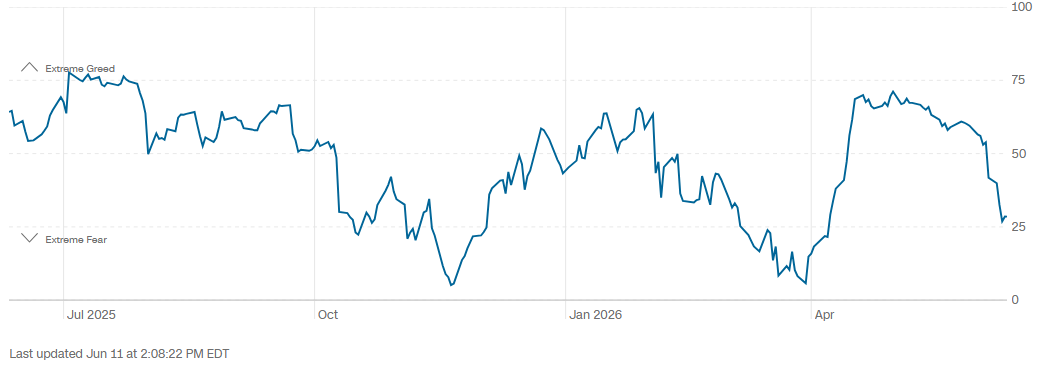
Source: CNN
This has been relevant for the Nasdaq, as stabilization in confidence can support stronger appetite for risk assets, especially in technology indexes such as the Nasdaq 100. Short-term demand has reacted across several of the index’s main components, with gains above 3.00% in Broadcom, more than 6.00% in Micron Technology, and also gains above 3.00% in Tesla. Several key companies within the index’s top 10 are now showing a meaningful recovery in short-term demand, likely tied to renewed optimism around the geopolitical situation that has weighed on market confidence over the past few months.
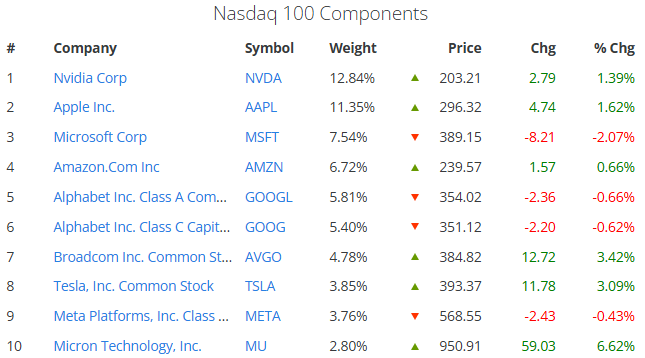
Source: Slickcharts
Overall, part of the uncertainty appears to be fading from markets, helping support demand for Nasdaq components in the short term. However, this buying pressure still seems to depend on further positive conflict updates or a potential peace agreement that could keep confidence on more stable ground. Any new sign of escalation could bring the Nasdaq’s recent indecision phase back into focus over the coming sessions.
Long-term confidence remains fragile
Although the latest updates have helped restore some short-term stability in market confidence, the longer-term picture remains fragile. According to the latest AAII Investor Sentiment Survey, as of June 10, bullish sentiment stood at 30.4%, neutral sentiment near 22.0%, and bearish sentiment at 47.7% regarding the stock market’s outlook over the next six months. This suggests that conditions may still not be strong enough to support consistent long-term demand in equities.

Source: AAII
This matters because, as long as long-term confidence does not recover more clearly, markets may continue to show doubts about the ability to sustain strong demand in equity indexes such as Nasdaq. If confidence indicators fail to improve in a more consistent way, a phase of indecision could continue to gain relevance in the index over the medium term.
Technical outlook for the Nasdaq 100
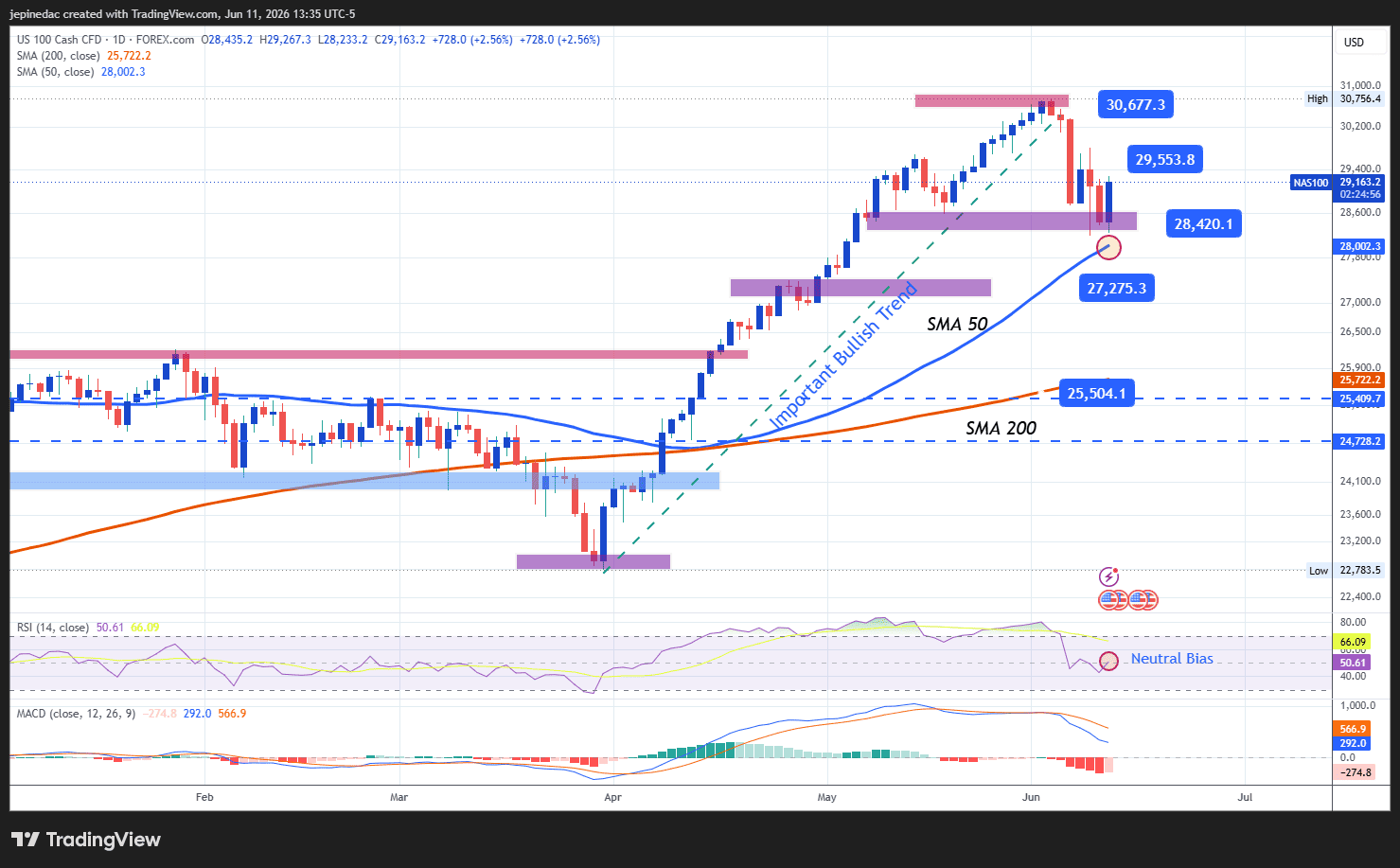
Source: StoneX, Tradingview
- Aggressive trendline loses relevance: In previous weeks, Nasdaq had maintained an aggressive bullish trendline in its price action. However, recent weakness pushed the index through that structure. Rather than confirming a dominant bearish bias, this move is starting to highlight a phase of indecision that could even lead to the formation of a short-term sideways range as the dominant pattern. This could remain the case if buying pressure does not recover more consistently over the next few sessions.
- MACD: Now, the MACD histogram has started to flatten, with slight moves below the 0 level. This suggests that the bearish momentum seen in previous sessions may be starting to fade. If the histogram continues to move closer to the neutral zone, a phase of indecision could become more relevant.
- RSI: A similar picture can be seen in RSI, as the indicator remains very close to the neutral 50 level. This suggests a balance between bullish and bearish impulses over recent sessions, also highlighting the possible importance of an indecision phase in Nasdaq.
Key levels:
- 30,600 points – Relevant resistance: Historical high area that currently works as the most important reference for bullish movements. Price action moving back toward this level could reinforce the importance of a new buying bias and revive the bullish trend that was relevant in previous sessions.
- 29,500 points – Near-term barrier: Relevant neutral zone that coincides with important short-term pullbacks. As long as the price continues to trade around this level, the indecision phase could remain important and open the door to a possible sideways range over the coming sessions.
- 28,420 points – Key support: Recent low area near the 50-period simple moving average. Sustained moves below this level could begin to show a dominant selling bias and open the door to more consistent selling pressure over the next few weeks.
Written by Julian Pineda, CFA, CMT – Market Analyst
Follow him on: @julianpineda25







Web Trader platform
Our sophisticated web-based platform is packed with features.
Open an account today
Experience award-winning platforms with fast and secure execution.
Economic calendar
Related articles

Gold and S&P 500 analysis: What now after Warsh’s hawkish speech?
The dollar surged across the board after the Fed Chair Kevin Warsh surprised with a hawkish-leaning speech at the Jackson Hole summit. All the bearish dollar bets that had been accumulated since last Friday on the back of data weakness and bond market troubles had to be squared and that triggered a short squeeze rally for the dollar. Gold and silver dropped, as a result, as too did bitcoin, while US indices were giving back earlier gains.


Nasdaq 100 Forecast: NDX slips ahead of Fed Chair Warsh’s speech
U.S. stocks are edging lower on Friday, giving back some of yesterday's gains after Nvidia's strong outlook revived the tech trade. The focus has now shifted firmly to Fed Chair Kevin Warsh's Jackson Hole speech, with investors looking for more clarity on the outlook for interest rates.


Jackson Hole Returns: Nikkei 225 and Nasdaq 100 Volatility in Focus
Historical Jackson Hole returns point to elevated Nikkei 225 volatility around Fed speech day, with Nasdaq 100 direction hinging on Kevin Warsh.
