


S&P 500 Forecast: SPX slips after a stellar Q2
U.S. futures are pointing to a slightly lower open on the final trading day of the month, quarter and first half of the year, as investors assess whether the AI-driven rally can extend into the third quarter and weigh the prospect of higher U.S. interest rates.
Written by
Fiona Cincotta
Senior Market Analyst
US futures
Dow futures -0.29%, S&P futures -0.23% & Nasdaq futures -0.83%
In Europe
FTSE -0.56% & DAX -0.07%
- U.S futures fall after strong gains in Q2
- Chip stocks led the S&P 500 to jump 15% in Q2
- Nike falls despite beating forecasts
- Oil drops $45 across the quarter
U.S. Futures Muted After Strong Quarter as Focus Shifts to Jobs Data
U.S. futures are pointing to a slightly lower open on the final trading day of the month, quarter and first half of the year, as investors assess whether the AI-driven rally can extend into the third quarter and weigh the prospect of higher U.S. interest rates.
The S&P 500 posted its strongest quarterly performance since 2020, rising almost 15% in Q2, while the Nasdaq surged 27.5%, also marking its best quarter in four years. Chipmakers once again led the gains, with the Philadelphia Semiconductor Index soaring almost 88% over the quarter.
However, investors are becoming increasingly selective. While enthusiasm for AI remains intact, attention is shifting towards whether the enormous investment in AI infrastructure can generate earnings growth quickly enough to justify elevated valuations. At the same time, expectations that the Federal Reserve could tighten policy further are raising discount rates and creating a more challenging backdrop for high-growth stocks.
On the data front, ADP employment rose by 98,000 in June, down from 122,000 previously and below forecasts of 110,000, pointing to a modest cooling in private-sector hiring. However, annual pay growth remained resilient at 4.4% for workers staying in their jobs and edged higher to 6.6% for job changers, suggesting wage pressures remain elevated.
The figures follow yesterday's JOLTS report, which showed job openings unexpectedly increased, while consumer confidence also improved, reinforcing the view that the U.S. labour market remains resilient.
Attention now turns to Federal Reserve Chair Kevin Warsh's speech at the ECB Forum in Sintra. While Walsh is unlikely to provide explicit forward guidance, investors will be looking for his assessment of the economy and whether recent data have strengthened the case for further tightening.
Markets are currently pricing around a 65% probability of a 25-basis-point rate hike in September. Tomorrow's non-farm payroll report, brought forward because of Friday's Independence Day holiday, will be the week's key event for interest-rate expectations.
Corporate Movers
Nike is falling more than 3% despite reporting better-than-expected fiscal fourth-quarter earnings and revenue. Growth in the wholesale business and a one-off tariff-related benefit helped support results, but investors focused instead on weaker guidance and continued pressure in the direct-to-consumer business. Sales in Greater China fell 12%, reinforcing concerns that the turnaround in one of Nike's key markets remains some way off.
Constellation Brands is rising 1.5% after beating expectations in its first-quarter earnings report. The company posted earnings per share of $3.43 versus expectations of $3.20, while revenue also exceeded forecasts. Full-year guidance was maintained, suggesting management remains confident despite softer consumer spending.
Memory chip stocks are weaker at the start of the third quarter as investors continue to lock in profits following an exceptional Q2. SanDisk is down 3.5%, while Micron Technology is off 2.5% after both stocks more than tripled in value during the second quarter.
S&P 500 Forecast – Technical Analysis
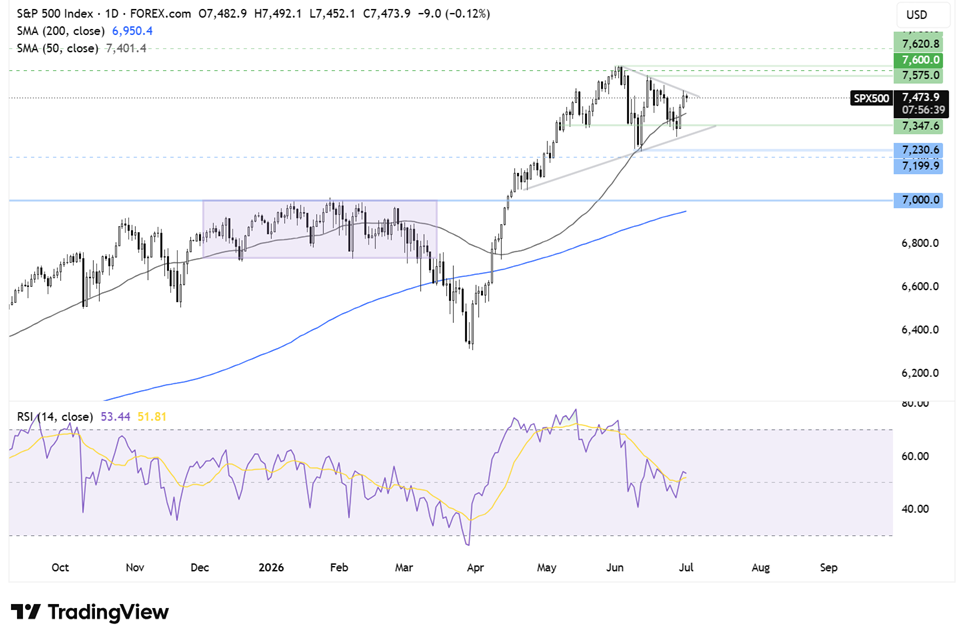
The S&P 500 continues to trade within a symmetrical triangle pattern.
The index recently rebounded from rising trendline support near 7,290 before reclaiming the 50-day SMA and testing resistance around 7,500 at the upper boundary of the pattern.
Should buyers break above 7,500, attention would turn to 7,575, the June high. A move above there would create a higher high and bring the record high at 7,620 into focus.
Immediate support lies at the 50-day SMA near 7,400, followed by horizontal support at 7,350 and rising trendline support at 7,290. A break below the trendline would complete a downside breakout from the triangle and expose the June low near 7,230.
FX Markets – USD Firms, Yen Remains on Intervention Watch
The U.S. dollar is strengthening, remaining close to a 13-month high as Treasury yields continue to rise. The 10-year Treasury yield has climbed to 4.47%, its strongest weekly rise in a month, supported by expectations that the Federal Reserve could raise interest rates again this year. Month-end positioning may also be providing additional support.
Markets are pricing around a 67% probability of a September rate hike.
EUR/USD is slipping after Eurozone inflation cooled by more than expected. Headline CPI eased to 2.8% year-on-year from 3.2%, below expectations of 3%, reducing expectations for a more aggressive ECB tightening cycle. Even so, markets still expect one further ECB rate hike before year-end. ECB President Christine Lagarde is due to speak later today at the Sintra Forum.
USD/JPY has climbed to a fresh 40-year high above 162.80, well beyond the levels that previously prompted intervention by Japanese authorities. The widening Fed-BOJ policy divergence continues to support the carry trade, although the risk of intervention is rising. With Friday's U.S. holiday likely to reduce market liquidity, conditions could become more favourable for official action. Bank of Japan Governor Kazuo Ueda is also due to speak later today at the Sintra Forum.
Oil Extends Quarterly Decline as Iran Talks Continue
Oil prices are down around 1% on Wednesday as negotiations between the U.S. and Iran continue in Doha and investors await U.S. inventory data.
Technical discussions are taking place with Pakistan acting as a mediator, following higher-level talks earlier this week.
Optimism that Middle Eastern supply will continue to normalise has helped Brent crude fall by around $45 during the second quarter, marking its largest quarterly decline since the global financial crisis in 2008. WTI has fallen by around $31 over the same period.
The sharp decline reflects the unwinding of the geopolitical risk premium as the ceasefire has held and shipping through the Strait of Hormuz has resumed. Unless negotiations deteriorate materially, the market is likely to remain focused on recovering supply and the pace of global demand rather than geopolitical disruption.






Web Trader platform
Our sophisticated web-based platform is packed with features.
Open an account today
Experience award-winning platforms with fast and secure execution.
Economic calendar
Related articles

Gold and S&P 500 analysis: What now after Warsh’s hawkish speech?
The dollar surged across the board after the Fed Chair Kevin Warsh surprised with a hawkish-leaning speech at the Jackson Hole summit. All the bearish dollar bets that had been accumulated since last Friday on the back of data weakness and bond market troubles had to be squared and that triggered a short squeeze rally for the dollar. Gold and silver dropped, as a result, as too did bitcoin, while US indices were giving back earlier gains.


Nasdaq 100 Forecast: NDX slips ahead of Fed Chair Warsh’s speech
U.S. stocks are edging lower on Friday, giving back some of yesterday's gains after Nvidia's strong outlook revived the tech trade. The focus has now shifted firmly to Fed Chair Kevin Warsh's Jackson Hole speech, with investors looking for more clarity on the outlook for interest rates.

S&P 500 Forecast: SPX after Nvidia revives confidence in the AI trade
U.S. stocks are heading higher on Thursday, with technology leading the move after Nvidia's stronger-than-expected outlook revived confidence in the AI trade.