


S&P 500 Forecast: SPX struggles on AI jitters & despite resilient retail sales
U.S. stocks are pointing to a mixed open on Thursday as weakness in semiconductor stocks offsets signs of a resilient U.S. consumer.
Written by
Fiona Cincotta
Senior Market Analyst
US futures
Dow futures 0.07%, S&P futures -0.30% & Nasdaq futures -0.89%
European futures
FTSE -0.49%, DAX -1%
- US stocks mixed as chip weakness offsets retail sales
- Chip stocks extend declines
- Retail sales rise 0.2% MoM as gasoline sales fall
- Oil steadies after jumping 12% this week
U.S. Stocks Mixed as Chip Weakness Offsets Solid Retail Sales
U.S. stocks are pointing to a mixed open on Thursday as weakness in semiconductor stocks offsets signs of a resilient U.S. consumer.
U.S. retail sales rose 0.2% month-on-month in June, following a 1% increase in May. The headline figure was held back by weaker gasoline sales as fuel prices declined. Excluding gasoline stations, retail sales rose 0.7%, suggesting consumer spending remained resilient heading into the summer.
Lower petrol prices have helped support household spending power, leaving consumers with more disposable income for discretionary purchases. The FIFA World Cup may also have provided a temporary boost to spending.
However, it remains unclear how long that support will last. Oil prices have surged around 12% this week following renewed hostilities between the U.S. and Iran, raising concerns that higher energy costs could feed back into inflation.
Those concerns have pushed Treasury yields higher despite this week's softer CPI and PPI reports, with investors increasingly viewing the inflation data as backward-looking given the recent jump in oil prices.
Markets have now largely ruled out a July Federal Reserve rate hike but continue to price around a 70% probability of a 25 basis point increase in September.
Meanwhile, chip stocks are extending yesterday's losses as investors continue rotating away from parts of the AI trade and towards mega-cap technology companies and banks following a strong start to earnings season.
Corporate Movers
Memory chip makers are among the weakest performers, with Western Digital and Seagate Technology falling around 7% and 5%, respectively. Semiconductor stocks have been among this year's biggest winners as investors positioned for accelerating AI infrastructure spending, leaving parts of the sector vulnerable to profit taking.
UnitedHealth is rising more than 7% after reporting stronger-than-expected second-quarter earnings. The health insurer posted EPS of $6.38 on revenue of $112.03 billion.
Taiwan Semiconductor Manufacturing (TSMC) is falling around 4% despite beating second-quarter earnings expectations and raising full-year capital expenditure guidance to $60-64 billion. The company also announced an additional $100 billion investment in Arizona, although investors appear to be focusing on the higher spending requirements.
United Airlines is down around 3% despite beating earnings estimates. The airline issued third-quarter EPS guidance of $2.50-$3.50, below the $3.53 consensus forecast, while also warning that higher fuel prices could add around $6 billion to costs.
S&P 500 Forecast – Technical Analysis
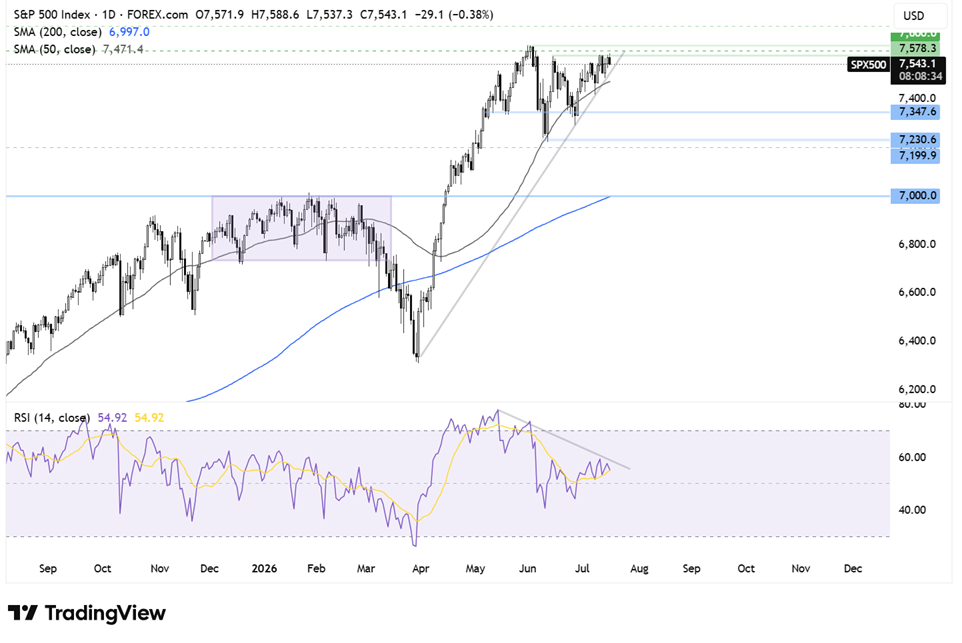
The S&P 500 continues to trade above its rising trendline and remains above both the 50-day and 200-day SMAs, keeping the broader technical outlook constructive.
However, bearish RSI divergence suggests upside momentum is beginning to fade and warrants some caution.
Initial support is located around 7,520, where the rising trendline converges with price support, followed by the 50-day SMA at 7,470.
A break below this area would expose 7,340, the mid-May swing low, followed by 7,225, the June swing low. A move below there would create a lower low and expose the 200-day SMA near 7,000.
On the upside, buyers will look for a move above 7,580, the July high, which would bring 7,620 and fresh record highs into focus.
FX Markets – Dollar Firms
The U.S. dollar is edging higher after falling to a monthly low earlier this week, tracking Treasury yields higher as renewed Middle East tensions revive inflation concerns.
Oil prices have risen around 12% this week, supporting yields and helping the dollar stabilise after recent weakness.
EUR/USD is easing back from a one-month high as the dollar recovers. However, hawkish comments from ECB policymakers have helped limit losses after Martin Kocher and Joachim Nagel reiterated that the ECB stands ready to act if necessary. The euro is also digesting yesterday's weaker-than-expected industrial production data.
GBP/USD is pulling back from yesterday's two-month high around 1.3550 after rallying almost 1%. Sterling has been supported by expectations that incoming Prime Minister Andy Burnham will appoint current Home Secretary Shabana Mahmood as Chancellor, a choice viewed by markets as fiscally disciplined. Better-than-expected UK GDP data, which showed the economy expanded 0.1% in May, has also underpinned the pound.
Oil Rises as U.S.-Iran Hostilities Escalate
Oil prices are holding near a monthly high, with WTI trading around $80 per barrel, as renewed tensions between the U.S. and Iran continue to support the market. The U.S. has reimposed a naval blockade on Iranian ports, while Tehran has threatened to disrupt regional energy exports, keeping geopolitical risks firmly in focus.
However, after this week's sharp rally, prices have steadied. Shipping through the Strait of Hormuz remains well below normal levels, while ongoing mediation efforts suggest investors are not yet pricing in a full-scale regional conflict.
Even so, a geopolitical risk premium remains embedded in crude prices. Any signs that Iran could use its Houthi allies in Yemen to disrupt shipping through the Bab el-Mandeb Strait would likely drive prices higher.
Looking ahead, oil could remain elevated into the fourth quarter if export flows recover only slowly. Conversely, easing tensions and a faster recovery in production could see crude fall back towards $60 per barrel by year-end.






Web Trader platform
Our sophisticated web-based platform is packed with features.
Open an account today
Experience award-winning platforms with fast and secure execution.
Economic calendar
Related articles

Gold and S&P 500 analysis: What now after Warsh’s hawkish speech?
The dollar surged across the board after the Fed Chair Kevin Warsh surprised with a hawkish-leaning speech at the Jackson Hole summit. All the bearish dollar bets that had been accumulated since last Friday on the back of data weakness and bond market troubles had to be squared and that triggered a short squeeze rally for the dollar. Gold and silver dropped, as a result, as too did bitcoin, while US indices were giving back earlier gains.


Nasdaq 100 Forecast: NDX slips ahead of Fed Chair Warsh’s speech
U.S. stocks are edging lower on Friday, giving back some of yesterday's gains after Nvidia's strong outlook revived the tech trade. The focus has now shifted firmly to Fed Chair Kevin Warsh's Jackson Hole speech, with investors looking for more clarity on the outlook for interest rates.

S&P 500 Forecast: SPX after Nvidia revives confidence in the AI trade
U.S. stocks are heading higher on Thursday, with technology leading the move after Nvidia's stronger-than-expected outlook revived confidence in the AI trade.