

USD/JPY, AUD/JPY: Central Bank Divergence Creates Two-Way Risk
USD/JPY eyes a breakout above 160, while AUD/JPY faces further losses as Fed, RBA and BoJ interest rate expectations diverge.
Written by
Matt Simpson
Market Analyst
The Japanese yen has found some support despite Japan's disappointing GDP figures, as traders weigh the prospect of further Bank of Japan (BoJ) rate hikes against increasingly hawkish expectations for the Federal Reserve.
However, the outlook for yen crosses is far from uniform. While I suspect USD/JPY could eventually break above 160, the prospect of the RBA having reached peak interest rates, alongside further BoJ tightening, could favour bearish continuation for AUD/JPY.
Why Central Bank Divergence Could Split USD/JPY and AUD/JPY
Japan's Weak GDP Complicates the BoJ's Hawkish Outlook
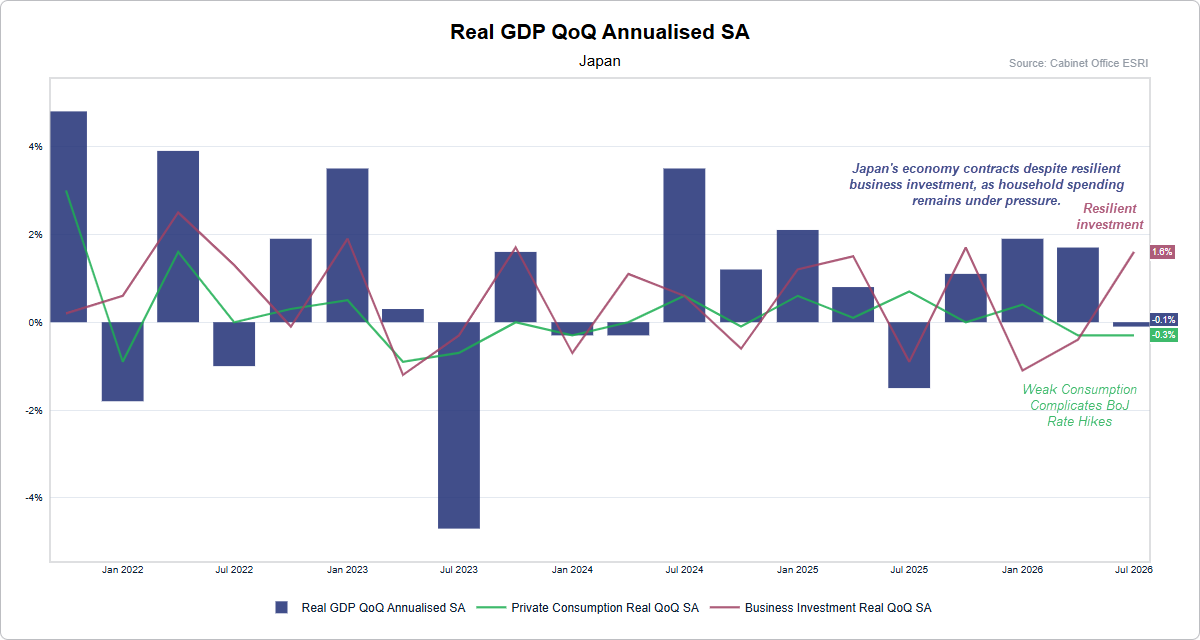
Japan's economy unexpectedly contracted by 0.1% annualised in Q3, compared with expectations for 0.3% growth. Household consumption fell 0.3% over the quarter, highlighting the pressure inflation continues to place on consumers. However, business investment rose 1.6%, partly supported by resilient AI-related spending.
This presents an awkward backdrop for the BoJ, which is expected to raise interest rates again in December despite signs of weakness in domestic demand.
Hawkish board member Hajime Takata reinforced the case for further tightening on Monday, calling for relatively swift rate hikes towards the midpoint of the BoJ's estimated neutral-rate range of 1.1%–2.5%. Although Takata was already advocating higher rates in October, his comments reinforce the central bank's determination to contain inflation.
Market pricing continues to favour a December hike, with OIS-derived estimates around 82%–84% as of Monday.
Fed-BoJ Rate Divergence Supports USD/JPY, While AUD/JPY Faces Pressure
Yet the yen's performance will also depend on how quickly other central banks tighten policy. Markets expect further hikes from both the Fed and BoJ, although the US is projected to retain a sizeable interest-rate advantage through 2027.
The Fed is widely expected to deliver another 25bp hike in December, with stronger inflation and employment data supporting the US dollar. That could keep USD/JPY supported even if the BoJ raises rates next month.
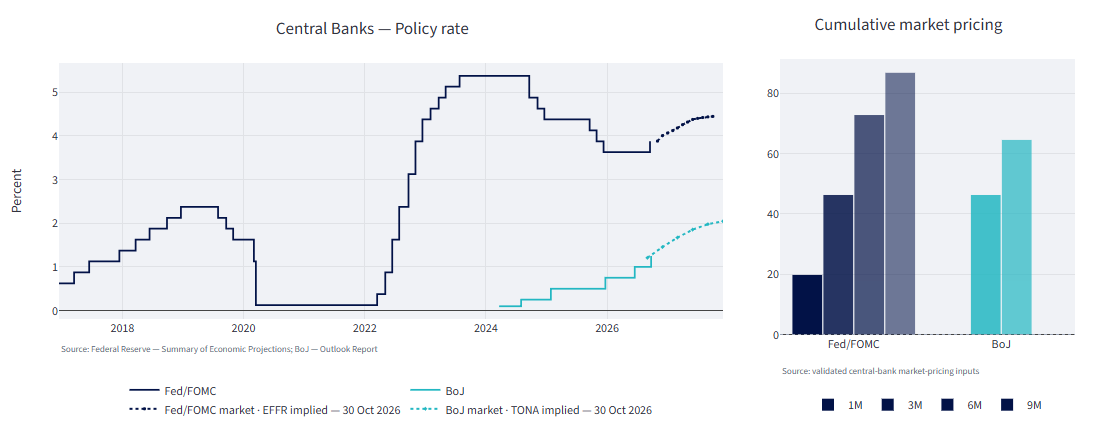
Conversely, the RBA's November hike to 4.85% may prove to be its last, particularly if Australia's labour market continues to soften. With the BoJ still expected to tighten, the relative policy outlook could become increasingly favourable for the yen against the Australian dollar.
This divergence in interest-rate expectations helps explain why I favour different outcomes for USD/JPY and AUD/JPY.
USD/JPY and AUD/JPY Technical Analysis
USD/JPY Bulls Eye Fresh Highs, But Patience May Pay Off
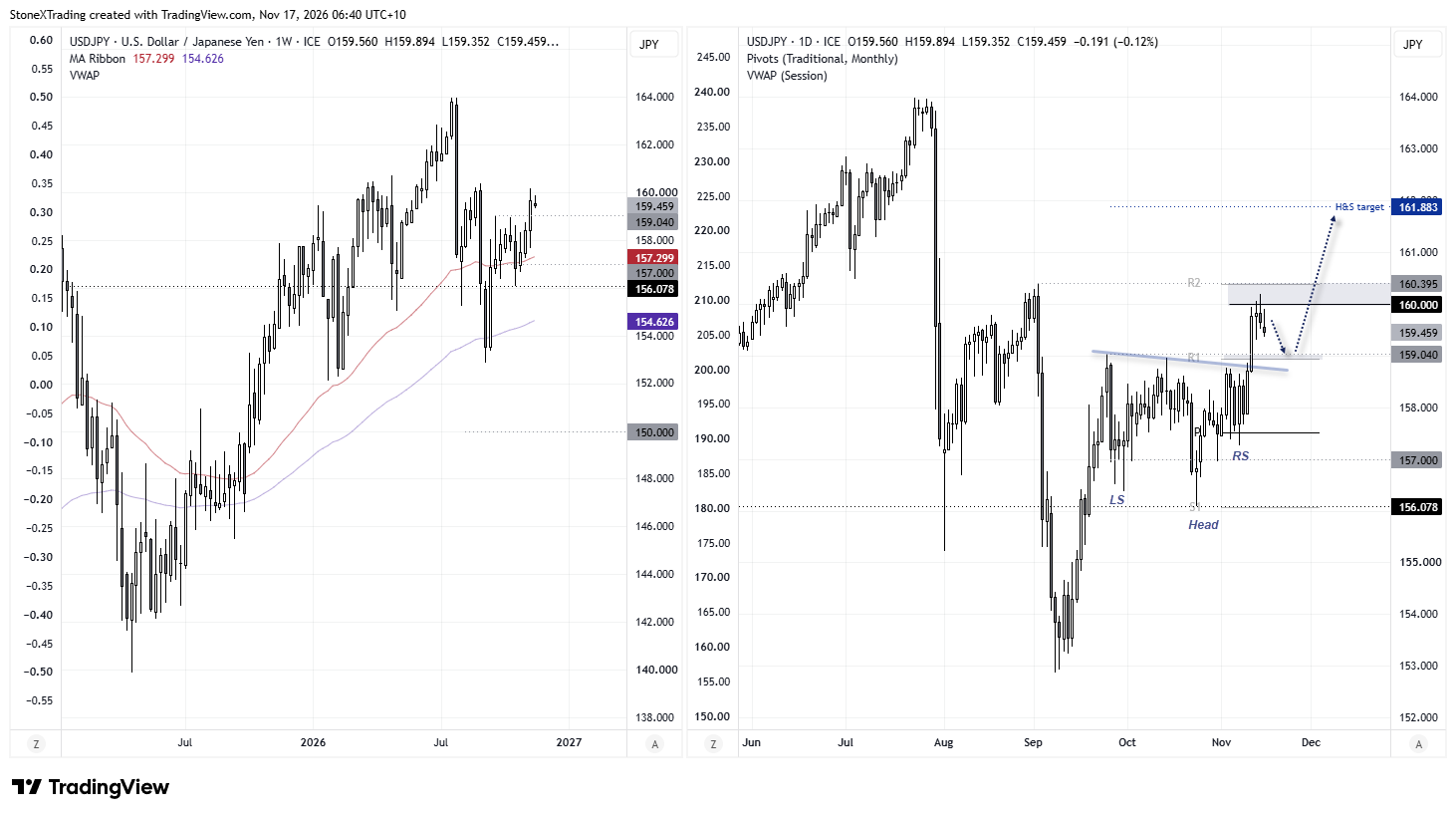
Price action on the USD/JPY daily chart appears increasingly bullish, although bulls may be seeking more favourable prices before recommitting. The 160 handle is the obvious fly in the ointment for now, but a pullback towards 159 could help bulls position themselves for a more attractive reward-to-risk ratio.
Interestingly, an inverted head and shoulders pattern has formed, with the head at 156 and the right shoulder around 157. If successful, the pattern projects an approximate target of 161.88, although USD/JPY would first need to break above 160.40 to confirm the bullish breakout. It would also need to hold above the neckline around 159 for the pattern to remain in play.
Source: ICE, TradingView
AUD/JPY Bears Target 106 as Topping Pattern Confirms Downside Break
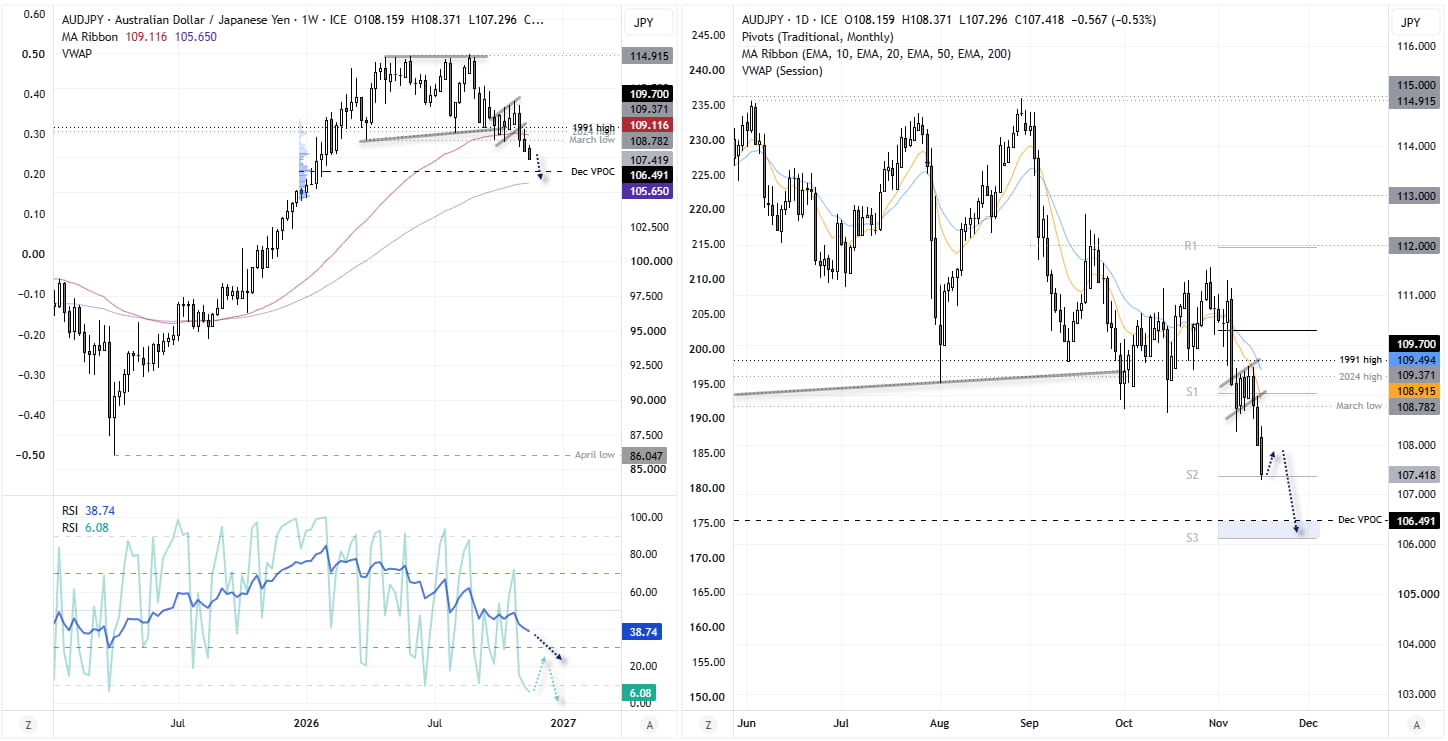
The weekly chart shows AUD/JPY has broken down from its multi-month topping pattern and now appears to be trending towards the December volume point of control (VPOC) at 106.49 or the 100-week EMA (105.65).
The weekly RSI (14) is trending lower alongside prices, but is neither oversold nor showing signs of bullish divergence. The weekly RSI (2) is oversold, warning of near-term downside overextension. However, price structure and RSI (14) suggest bears may be looking to fade rallies.
The daily chart shows AUD/JPY broke down from a bear flag last week, having respected the 10-day EMA as resistance. Bears have retained control for a third day, although prices remain above the monthly R2 pivot point for now.
Regardless, my bias remains to fade rallies, with 106 in sight. The 107 handle and 106.49 VPOC could provide interim support along the way.
Source: ICE, TradingView
Related tags:
Latest market news










Web Trader platform
Our sophisticated web-based platform is packed with features.
Open an account today
Experience award-winning platforms with fast and secure execution.
Economic calendar
Related articles

USD/JPY Weekly Outlook: AI earnings could overshadow the Fed and BoJ
AI sentiment has become a major driver of US Treasury yields and USD/JPY. With Microsoft, Alphabet and Amazon reporting this week, central bank decisions may have competition for traders' attention.


Gold and S&P 500 analysis: What now after Warsh’s hawkish speech?
The dollar surged across the board after the Fed Chair Kevin Warsh surprised with a hawkish-leaning speech at the Jackson Hole summit. All the bearish dollar bets that had been accumulated since last Friday on the back of data weakness and bond market troubles had to be squared and that triggered a short squeeze rally for the dollar. Gold and silver dropped, as a result, as too did bitcoin, while US indices were giving back earlier gains.


EUR/USD forecast: All eyes on Warsh at Jackson Hole - Forex Friday
For much of this week, the EUR/USD has been edging lower with the US dollar regaining some ground after last week’s sell-off that was triggered, in part, by the bond market worries. Investors have been unwilling to bet further against the US dollar so far this week ahead of Kevin Warsh’s keynote speech at the Jackson Hole summit, due later today.