


USD/JPY Dips Still Being Bid into Jackson Hole
The dual intervention last month is fading as USD/JPY buyers get more and more aggressive, bidding dips at higher lows as we approach what could be a massive event at Jackson Hole.
Written by
James Stanley
Sr. Strategist
USD/JPY, Japanese Yen Talking Points:
- Last week Scott Bessent had a comment when asked about Japanese Yen intervention along the lines of ‘what do I know that the market doesn’t know,’ which begs the question as to what might happen or be announced in the coming weeks pertaining to the USD/JPY saga.
- On the fundamental side the skew remains to the long side, with US inflation at 3.4% and Japanese inflation coming in at 1.9% last week. Even with the rumor of a September rate hike from the BoJ, markets seem unconvinced that the decisively one-sided carry is in danger as longer-term bulls are holding on and shorter-term bulls continue to pounce on pullbacks.
This content was created by an affiliate of FOREX.com and represents the views and opinions of the author/speakers, not the views and opinions of Forex.com, StoneX Group Inc., or its subsidiaries. The content has not been independently reviewed by FOREX.com.
Markets tend to follow the path of least resistance, pun intended, and of late in the USD/JPY market with the pair below the 160 handle that has been higher.
To be sure, there is the overriding fear of intervention and we have seen a degree of jumpiness since the dual intervention in late-July. The abhorrent NFP print in the US led to a spike down in the pair, as did the CPI and PPI print a week later.
And then last week, another shock hit on the announcement from the US Treasury that buybacks would be increased on long dated Treasuries. But, to date, each of those have served as an opportunity for longs to get in at support, and we saw another of those to start this week with a short-term dip to the 38.2% Fibonacci retracement that has so far set the low for early-week trade.
USD/JPY Daily Chart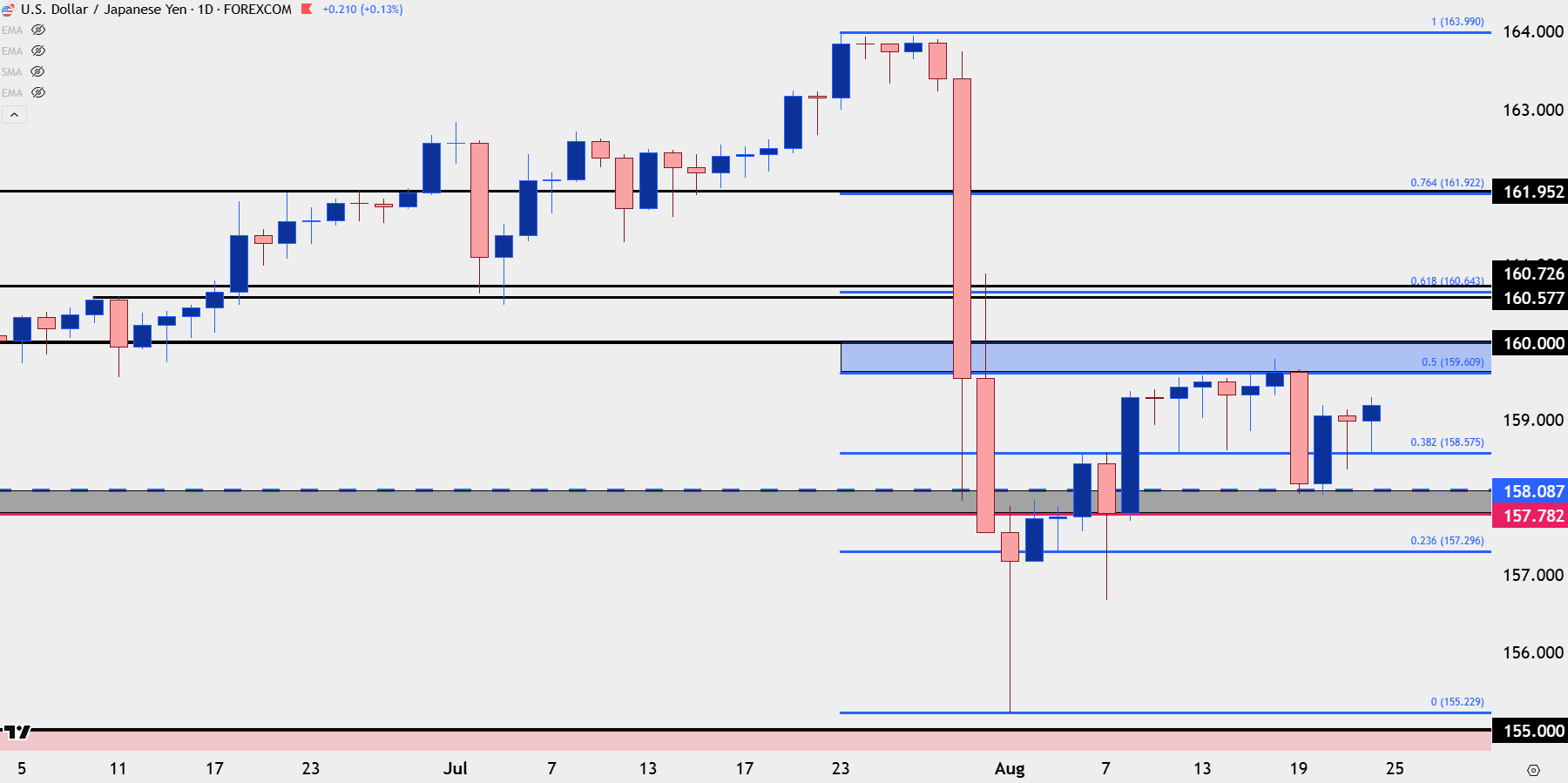
Chart prepared by James Stanley; data derived from Tradingview
USD/JPY: What Kind of Curveballs Might be Ahead?
As a former trader for George Soros’ Quantum Fund and a hedge fund manager in his own right, Scott Bessent understands the importance of communication through the media to move economic markets. After all, the intervention itself was largely driven by a rate check, which is simply a phone call from the New York Fed at the request of the Treasury Department which is often seen as a precursor to an intervention. And then, of course, there was the follow-up to that on Friday after the Fed in which there was a direct threat of action.
The following weekend, Scott Bessent wrote on a notepad that was going to be seen by journalists that his ‘to do’ list was to buy Japanese Yen. This surely wasn’t a mistake, and instead, a threat to markets to try to squeeze JPY shorts.
It worked, for a little while, as the following Monday followed through with the sell-off in USD/JPY but as I had said in the video that weekend, USD/JPY at or around 155 still held some degree of attraction because the carry was still positive, and it seemed unlikely that we would get even more intervention.
In the weeks since, buyers have continued to shy away from resistance and the 160.00 handle, but they’ve repeatedly pressed at higher-lows after pullbacks.
This sets the course for a possible showdown, at some point, as markets will continue to test until they’re forced to follow another path. As we’ve looked at in past episodes, declining US data could be enough to frighten longs to the point of creating a reversal setup, but that hasn’t really come to pass. Much stronger Japanese inflation could, in essence, do the same, but that also hasn’t taken place.
So, perhaps the big question is what else might Scott Bessent have in store?
With Japan as the largest international holder of Treasuries it makes sense as to why he might prefer that they didn’t intervene by selling Treasuries in order to buy JPY. But if there is no action and markets creep up to and past 160, there’s probably a plethora of stop orders on short positions that light on fire with a topside breach, bringing more demand and a continued breakout at that big figure.
So when Bessent said last week after the Treasury buyback announcement, regarding the Japanese Yen intervention, ‘what do I know that the market doesn’t know,’ the question must be asked, what else might he have in store? The full quote from the interview on Thursday August 20th with Sara Eisen on CNBC is below:
“People have bad information. I have asymmetric information, so I think that the market should think, well, why would we have joined the Japanese in the intervention at this time? Do we know something the market doesn’t know that, in terms of being willing to do you know what I would call a Treasury twist here in terms of the bond market? What do I know that the market doesn’t know? So I think the market’s probably gotten a little ahead of itself, a lot of people not much to do in August.”
At this point, that curiosity may not be enough to drive a short stance. But it could be enough to shy away from topside breakouts for fear of what might happen after. Until then, dips can remain as attractive as there’s higher-low support structure over the past few weeks that’s simply led to more higher-lows.
USD/JPY Four-Hour Chart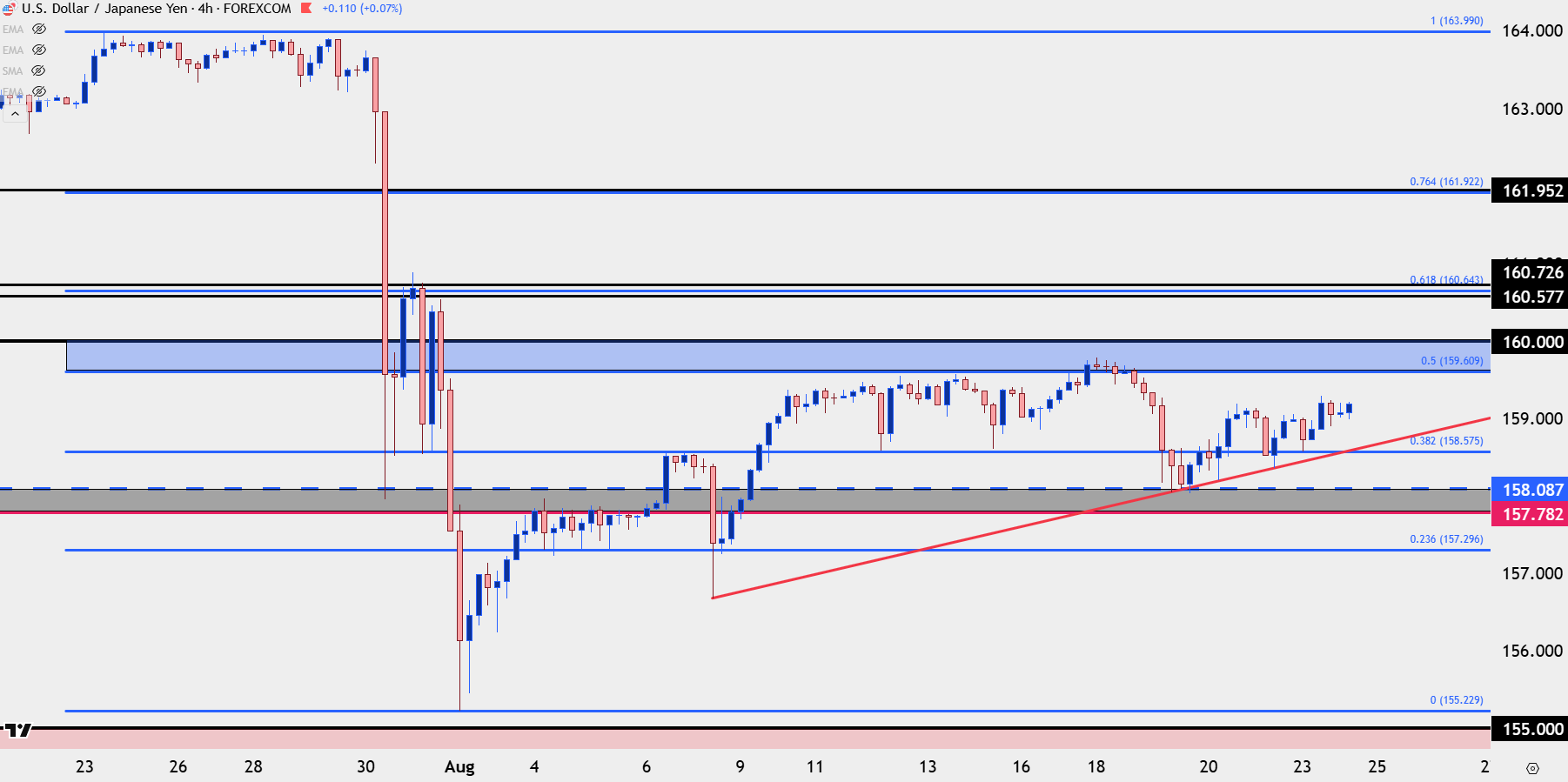
Chart prepared by James Stanley; data derived from Tradingview
--- written by James Stanley, Senior Market Analyst, Global Macro
Related tags:








Web Trader platform
Our sophisticated web-based platform is packed with features.
Open an account today
Experience award-winning platforms with fast and secure execution.
Economic calendar
Related articles

Japanese Yen Forecast: USD/JPY Survives 5% Intervention Plunge – Uptrend at Risk 8 25 2026
USD/JPY remains perched above major trend support as intervention risk and Jackson Hole raise the stakes for the next directional move.

FX Futures Positioning: USD Falls, CAD Strengthens, JPY Shorts Return | COT Report
USD weakness, rising CAD demand and renewed JPY shorts shape this week’s COT report ahead of Jackson Hole.


USD/JPY weekly outlook: Bessent, Warsh and a very confused curve
Treasury is fighting market forces just as Warsh wants them to do more of the work. The battle over who sets long-term borrowing costs could be the defining driver for USD/JPY this week.
