


USD/JPY Outlook: BOJ sticks to the script as Nikkei rips to record highs
Today's BOJ hike wasn't the story. The real question was whether officials would blink on QT after weeks of media speculation.
Written by
David Scutt
Market Analyst
- BOJ lifts rates to 1%, as expected
- JGB QT taper pace unchanged, defying media speculation
- USD/JPY still marginally favours buying dips
- Nikkei 225 hits record high above 70000.
Highest since 1995
The Bank of Japan (BOJ) raised rates to 1% in June, taking its key policy rate to the highest level since 1995 in a move that markets had all but fully priced beforehand. The real questions were elsewhere. Would policymakers signal any discomfort with further normalisation? And after weeks of speculation in the Japanese media, would they slow the pace of quantitative tightening, or QT?
On the first question, there were hints of caution. In his first meeting on the board, Toichiro Asada dissented in favour of keeping policy rates steady, arguing that downside risks to production and employment stemming from developments in the Middle East outweighed upside risks to prices. The dissent gave the decision a slightly dovish tinge, even if it did little to alter the broader message.
More broadly, the BOJ statement reiterated that "if the outlook for economic activity and prices presented in the Outlook Report will be realised, the Bank will continue to raise the policy interest rate and adjust the degree of monetary accommodation". Given inflation is the Bank's sole mandate, that guidance matters. The bank also noted that underlying CPI inflation should continue to rise gradually and warned there remains a risk that underlying inflation could "deviate upward to a level above the price stability target of 2 percent".
Following the decision, swaps continue to see a 25bp hike by October as a coin flip, while a December hike remains around 85% priced, broadly unchanged from before the meeting.
No QT pivot
With the June hike essentially fully priced and another highly favoured this year, the more consequential question for markets today was the future of the BOJ's balance sheet.
Speculation heading into the meeting was that the Bank could slow that pace of its balance sheet reduction, or pause it altogether. Instead, the BOJ stuck to the script. The quarterly step down in JGB purchases was left unchanged at ¥200bn per month through to April 2027, exactly as flagged last year. There was only one dissent on the decision, coming from noted hawk Naoki Tamura who argued the reductions should extend into 2028.
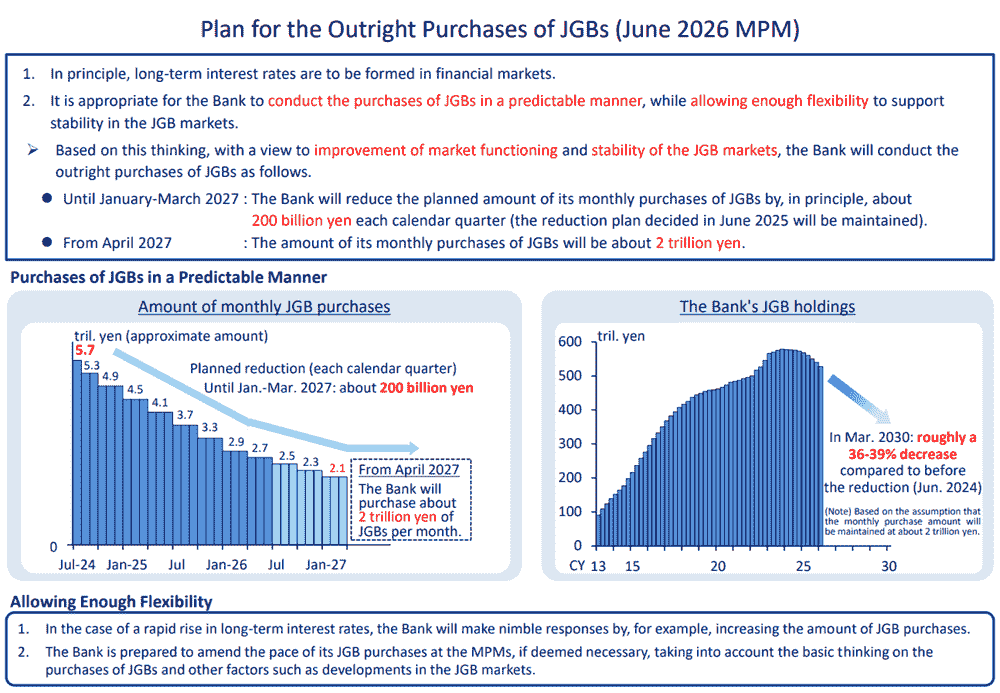
Source: BOJ
That likely helps explain why the Japanese yield curve has marginally bear steepened following the decision, with yields further out the curve rising by more than those at the front end. Had the BOJ slowed QT, or paused it altogether, it would likely have capped yields and put further pressure on the yen. Instead, with the status quo retained, moves in the yen have been relatively modest so far.
With the policy decision now out of the way, attention will turn to Deputy Governor Shinichi Uchida's press conference at 3:30pm JST. With few surprises in the statement itself, traders will be listening for nuance around the inflation outlook, the conditions that may warrant further rate hikes, along with persistent weakness in the yen.
USD/JPY dip buyers retain the edge

Source: TradingView
USD/JPY continues to grind higher within the shallow uptrend established in the middle of May, continuing to absorb offers whenever they arrive on probes beneath it. We've now seen two such probes on the H4 timeframe either side of the weekend, coinciding with steep declines in crude prices. However, neither has stuck. With the BOJ failing to hand yen bulls fresh ammunition, the preference marginally remains to buy dips rather than sell rallies.
Overhead, 160.43 is a minor resistance level to watch ahead of last week's high at 160.59 and the year-to-date peak of 160.72. All could come into play should buyers retain control.
On the downside, the mid-May uptrend remains the key area of focus, with the dips beneath it becoming sequentially more shallow. The most recent probe bottomed around 159.75, making it the immediate focus if we were to see another break beneath the trendline, marking the beginning of a broader support zone extending down to 159.38. Beyond that, minor support at 159.11 and the 50-day moving average should be on the radar if we were to see a sustained downside break of the uptrend.
Like the buoyant price action, the momentum picture continues to favour a bullish bias, with RSI (14) trending higher above 50 while MACD looks set to deliver an imminent crossover of the signal line to reinforce the message.
Nikkei 225: Record highs, same playbook

Source: Tradingview
The Nikkei 225 briefly tagged 70,000 for the first time immediately following the BOJ decision before pulling back a touch. However, with the index continuing to print higher highs and higher lows within a well-established uptrend, the broader picture remains constructive.
The former record high at 68,818 may now flip to offering support should the pullback extend further, making it a decent entry level for longs if price can hold above it. Beyond that, 70,000 is now the key level overhead. A sustained break above the psychologically important big figure carries the potential to pull even more bulls off the sidelines.
The price action is reinforced by the fact the index continues to trade comfortably above its 50, 100 and 200-day moving averages, all of which remain positively sloped. Until proven otherwise, that continues to argue for treating pullbacks as buying opportunities rather than reasons to fade strength.
Momentum indicators are broadly supportive of that view. RSI (14) remains in bullish territory above 50 but has yet to confirm the latest push to fresh highs, suggesting there may be a question mark hanging over the sustainability of the most recent leg higher. However, with MACD having just staged a bullish crossover of the signal line, it's not a major concern for the moment.






Web Trader platform
Our sophisticated web-based platform is packed with features.
Open an account today
Experience award-winning platforms with fast and secure execution.
Economic calendar
Related articles

Euro Short-term Outlook: EUR/USD Pullback Nears Pivotal Uptrend Support 8 28 2026
Warsh's comments accelerated the EUR/USD selloff, raising the stakes as buyers look to stabilize the broader recovery.


Gold and S&P 500 analysis: What now after Warsh’s hawkish speech?
The dollar surged across the board after the Fed Chair Kevin Warsh surprised with a hawkish-leaning speech at the Jackson Hole summit. All the bearish dollar bets that had been accumulated since last Friday on the back of data weakness and bond market troubles had to be squared and that triggered a short squeeze rally for the dollar. Gold and silver dropped, as a result, as too did bitcoin, while US indices were giving back earlier gains.


EUR/USD forecast: All eyes on Warsh at Jackson Hole - Forex Friday
For much of this week, the EUR/USD has been edging lower with the US dollar regaining some ground after last week’s sell-off that was triggered, in part, by the bond market worries. Investors have been unwilling to bet further against the US dollar so far this week ahead of Kevin Warsh’s keynote speech at the Jackson Hole summit, due later today.