

USD/JPY Weekly Outlook: Yen Carry Unwind Risks Flash Red
A historic Nasdaq 100 selloff has revived fears of a disorderly yen carry trade unwind. Yet futures positioning, options pricing and Thanksgiving seasonality suggest the biggest threat to USD/JPY could come from the Fed itself.
Written by
David Scutt
Market Analyst
- Yen carry trade unwind risks are mounting
- Fed repricing threatens further USD/JPY downside
- Positioning and volatility challenge the panic narrative
- Thanksgiving rebound hopes offer a potential reprieve
For the first time in a while, there are genuine concerns about the risk of a disorderly unwind of yen carry trades, with a near-perfect storm of factors working against them. Equity volatility is surging, US-Japan yield spreads have compressed sharply, and US asset prices, where significant carry trade flows are believed to have been deployed, are coming under extreme pressure. With the yen also beginning to strengthen against the US dollar, there are signs that pressure on these trades may already be forcing liquidation.
But just because these forces have converged doesn't mean a disorderly unwind is inevitable. Speculative positioning in yen futures is already skewed towards yen strength, making this episode different from those in the past, while the week ahead is devoid of major economic data that could deliver another substantial market shock.
As such, perhaps the greater threat comes from an abrupt dovish repricing of the Fed rate outlook, something markets are already speculating about. History suggests rapid compression in front-end US-Japan yield differentials can trigger steep declines in USD/JPY, creating a potential Catch-22 situation should the Fed attempt to ride in and rescue markets like a white knight, especially during a holiday-impacted week.
The carry trade is under the pump
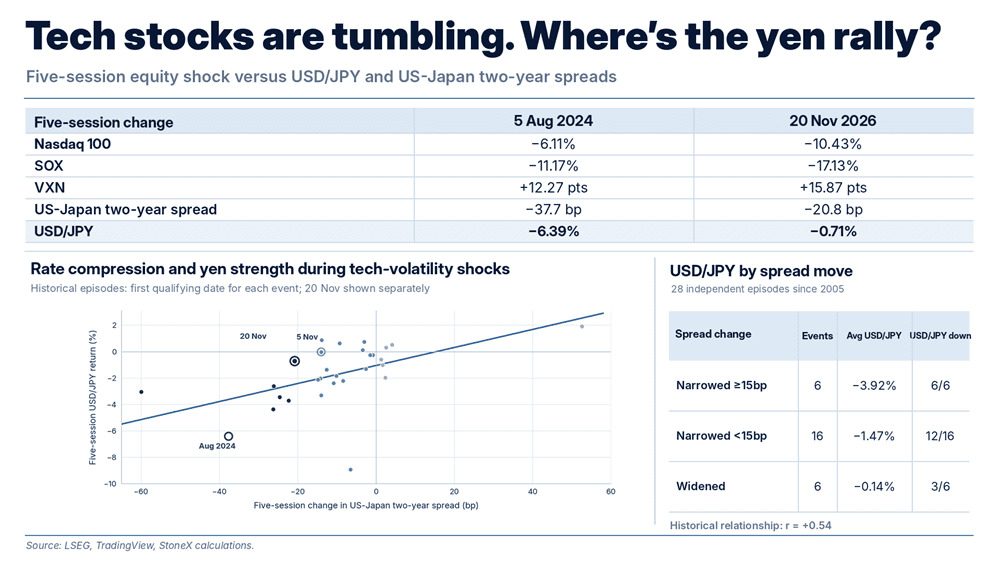
The turbulence seen across markets last week won't be forgotten quickly. The Nasdaq 100 slumped 10.4%, its 11th-largest weekly decline since 1985, triggering a sharp pickup in cross-asset volatility, including in FX markets.
US-Japan two-year yield spreads also compressed by 21 basis points, with much of that move occurring late in the week, helping the yen strengthen to two-week highs following a notable rally on Friday.
Whether carry trade liquidation is already underway is impossible to know. But as experienced traders have witnessed across different market cycles, such episodes can snowball quickly, often leading to severe dislocation in markets.
What we do know is that previous episodes of rapid yen strengthening during periods of US equity market volatility have been accompanied by abrupt compression in front-end US-Japan yield differentials, making that something to watch closely in the days ahead.
A Fed rescue could backfire
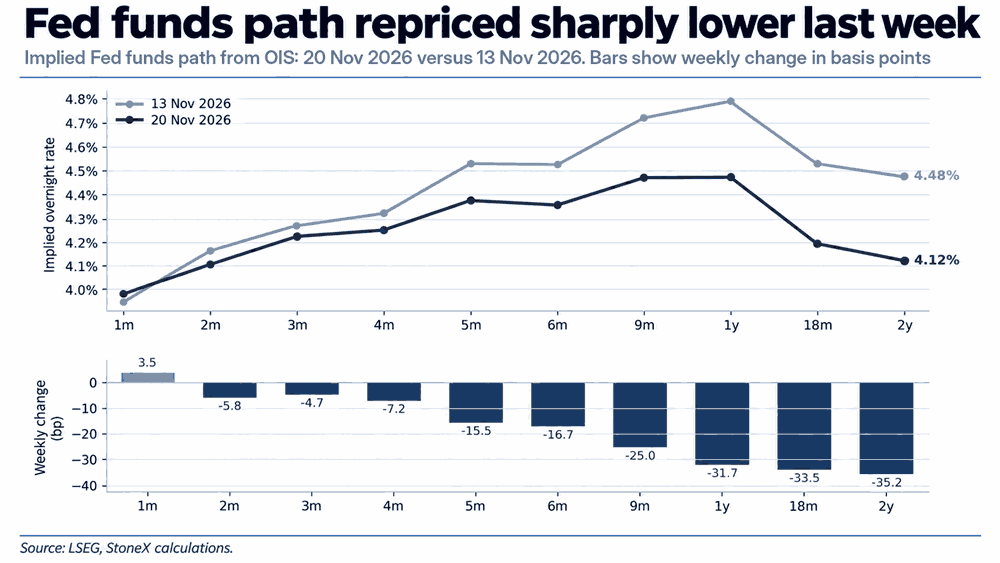
Having seen the Fed abruptly pivot in the past when market turbulence was elevated, STIR traders aren't even waiting for officials to verbally signal such a move. Analysis of the USD OIS curve shows the implied Fed funds path had more than a full rate hike stripped out of it last week, with even larger declines further out the curve.
At this stage, though, traders have merely reduced the amount of tightening they expect rather than pricing the risk of actual rate cuts. A hike in December remains heavily favoured, although no longer fully priced, while the prospect of a second by January is now seen as a 50-50 bet.
Source: LSEG
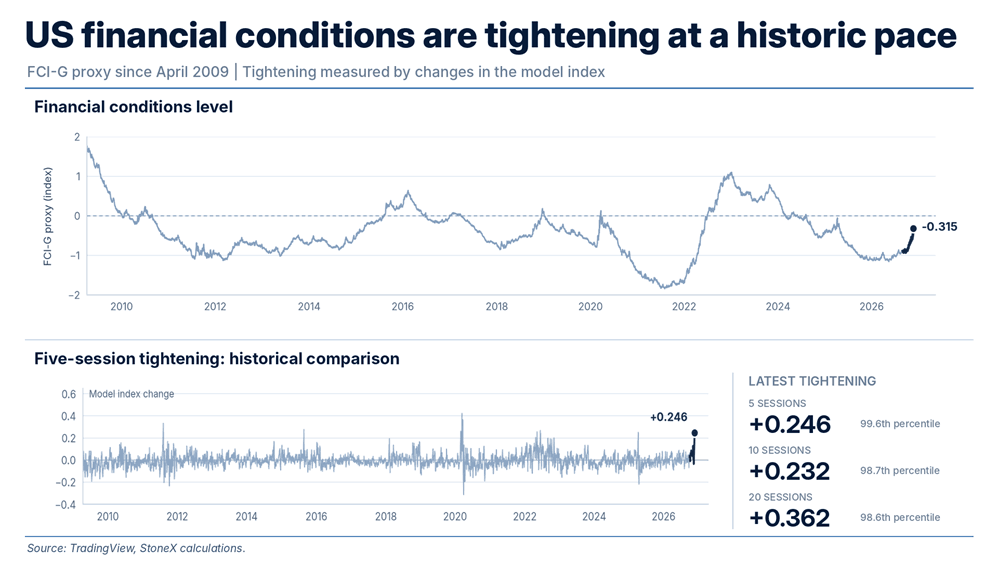
The reason for the tempering of hawkish bets was what we witnessed last week in US financial conditions. Our internal model, designed to replicate the Fed's Financial Conditions Index, recorded a five-session increase ranking in the 99.6th percentile of all comparable observations going back to 2009. Even though conditions remain accommodative, it's the speed at which accommodation is being withdrawn that has been extreme, helping explain the volatility we've seen across markets.
Source: TradingView
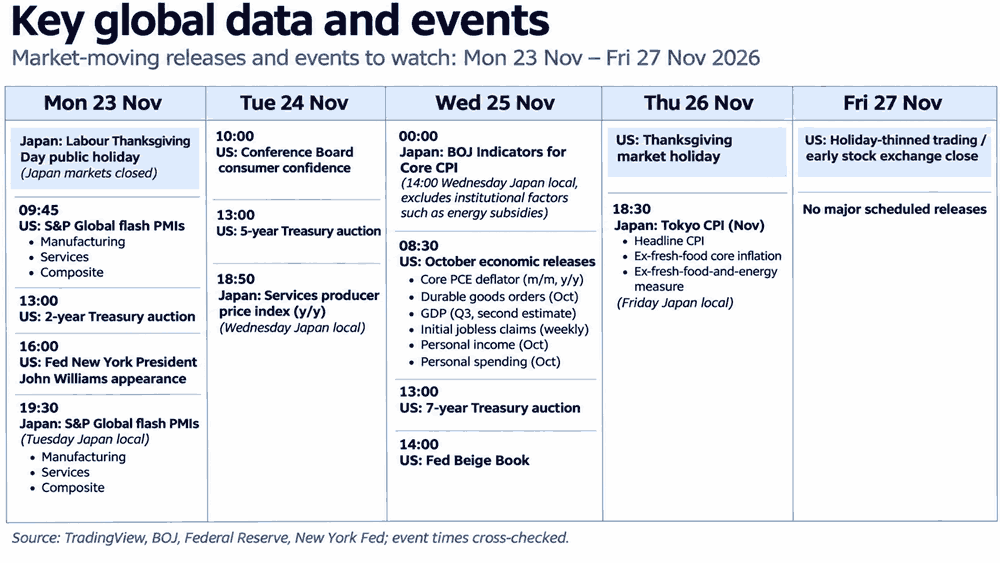
The question is how much more market carnage the Fed will need to see before abandoning its hawkish stance. New York Fed President John Williams, who has typically leaned dovish relative to the broader FOMC recently, will speak on Monday, providing an early opportunity to gauge whether last week's price action is already impacting the thinking of policymakers. Details of other scheduled appearances are scant, but traders should remain alert to the risk of unscheduled Fed commentary during the week.
Market volatility, Fed speak matter more than data
Source: TradingView
Looking at known event risk in the week ahead, there's almost nothing on the calendar that stands out as a catalyst for an abrupt compression in yield spreads. Yes, we have the core PCE deflator, the Fed's preferred inflation measure, but it's so well mapped by economists using CPI and PPI data released earlier in the month that it rarely delivers a surprise, let alone generates volatility.
That leaves the flash PMIs, personal income and spending figures, and the second estimate of US GDP as the events more likely to deliver such an outcome, particularly if they point to an abrupt slowdown in the US economy. But with positive US economic surprises at levels not seen in years, the risk of such an outcome appears remote.
In Japan, the BOJ's own underlying inflation measures and November's Tokyo CPI report should be on the radar, particularly the latter's strong leading relationship with nationwide inflation released three weeks later. With a December BOJ hike already heavily favoured, it would likely take a significant surprise in either direction to meaningfully influence the yen.
Ultimately, how markets perform following last week's volatility and what Fed officials say, if and when they speak, look far more important than scheduled economic releases. With Japan observing a public holiday on Monday and the US celebrating Thanksgiving on Thursday, thinner liquidity could also amplify market moves.
Positioning tells a different story
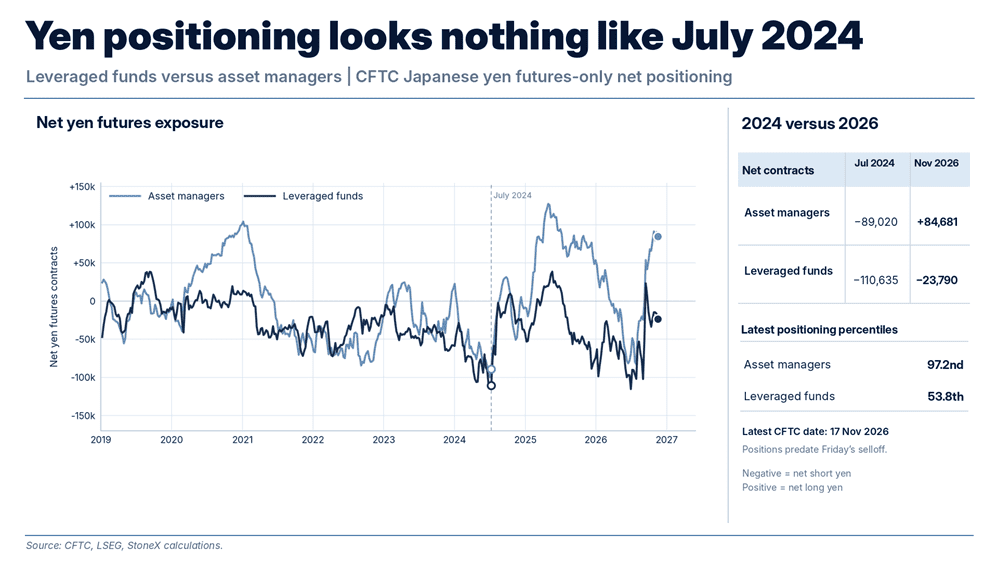
When assessing the risk of an unruly carry trade unwind, any evidence on positioning is useful. While futures positioning doesn't reflect the entire market, what makes this period stand out from previous episodes is that real money accounts are already heavily positioned in favour of the yen. Fast money accounts, such as leveraged funds, remain short based on the latest snapshot from Tuesday last week, but the scale of those positions is far less extreme than earlier this year or during previous carry trade unwinds.
Source: LSEG
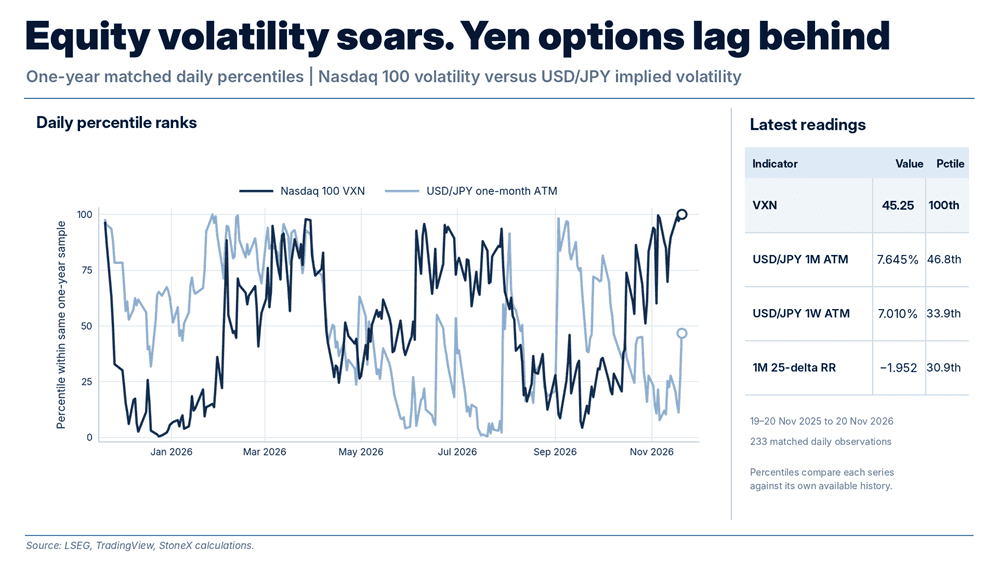
Nor are we seeing evidence that extreme volatility in equities is spilling over into similar expectations for the yen. While Nasdaq 100 implied volatility is at its highest level in 12 months, one-month USD/JPY implied volatility sits around the 47th percentile over the same period. One-week volatility is even lower at the 34th percentile, while one-month risk reversals show relatively modest demand for USD/JPY downside protection.
In a nutshell, tech stocks are expected to remain wild, but the yen is not. That could change quickly, of course, but for now, that's what these implied volatility measures are telling us.
Source: TradingView, LSEG
Thanksgiving may offer a lifeline
While the threat of a disorderly carry trade unwind appears obvious, historical studies suggest that if one does take place, it may have to come from factors outside US equities. Past performance is no guarantee of future returns, but in the 12 previous instances since 1985 when the Nasdaq 100 fell 10% or more in a week, it rebounded the following week on 10 occasions.
That historical tendency is perhaps strengthened further heading into Thanksgiving, a week traditionally associated with positive equity market seasonality. It's only what history and seasonality point to, not what will happen, but there's clearly potential for a relief rally of some form.
Source: TradingView, LSEG
Should that occur, it could ease pressure on carry trades. However, if the recovery is driven by an abrupt Fed pivot, the resulting compression in front-end spreads could still put USD/JPY under pressure. Analysis of previous equity volatility shocks has found that when two-year spreads between the US and Japan compressed by at least 15 basis points over five sessions, USD/JPY declined on every occasion, averaging a fall of 3.92%.
USD/JPY technicals
Source: TradingView
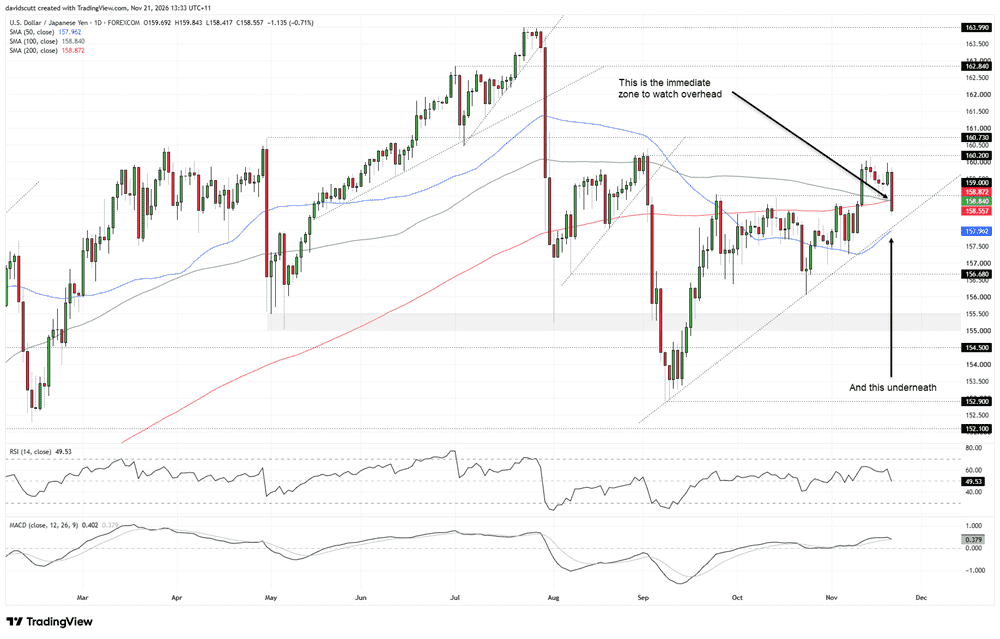
Friday's abrupt compression in front-end yield spreads coincided with USD/JPY losing the horizontal range it had traded in over the prior two weeks, with the price slicing beneath support at 159 along with a confluence of the 100 and 200-day moving averages around 158.85. That zone now becomes the immediate focal point overhead.
On the downside, the uptrend in place from the lows hit in September is located just above 158, strengthened by the 50-day moving average, which is running almost parallel to it. Probes beneath that moving average were bought in October and early November, adding to its importance. Beneath that, 156.68 is the next downside level of note before a more pronounced support zone between 155.50 and 155.
It goes without saying that if an unruly carry trade unwind were to take place, those levels, and potentially others at 154.50 and 152.90, may become almost irrelevant when assessing trade setups.
On the upside, should the price reclaim the former support zone around 158.85–159, 160.20 is the next level of note, having capped gains in August, September and again earlier this month.
The message from the oscillators is more neutral than outright bearish or bullish, although there's been an abrupt loss of upside momentum. RSI (14) has slipped slightly beneath the neutral 50 level, while MACD is converging on its signal line and is on the cusp of a bearish crossover, albeit in positive territory. I wouldn't put too much weight on either indicator at this stage, but at the very least, they're warning bulls that momentum may be shifting towards the bears.
Latest market news










Web Trader platform
Our sophisticated web-based platform is packed with features.
Open an account today
Experience award-winning platforms with fast and secure execution.
Economic calendar
Related articles

USD/JPY Weekly Outlook: AI earnings could overshadow the Fed and BoJ
AI sentiment has become a major driver of US Treasury yields and USD/JPY. With Microsoft, Alphabet and Amazon reporting this week, central bank decisions may have competition for traders' attention.

Bitcoin Forecast: BTC/USD Back to $80K Ahead of Warsh’s Jackson Hole Speech
After surging over $15,000 in the past 10 days alone, there is risk of a near-term pullback if Warsh says anything remotely hawkish at Jackson Hole - what are the levels to watch from here?


PCE hype now rarely matches market moves
PCE may still matter to policymakers at the Fed, but for traders looking for a genuine volatility event, CPI has been the far more reliable release.