


AUD/USD Nears 72c as AU and US CPI, Jackson Hole Loom
AUD/USD is closing in on 72c as Australian and US inflation reports collide with Jackson Hole, setting the stage for a potentially volatile end to the week.
Written by
Matt Simpson
Market Analyst
AUD/USD enters a potentially pivotal stretch within striking distance of 72c, with Australian CPI, US inflation and Jackson Hole putting RBA and Fed policy expectations firmly in focus.
View related analysis:
Australian CPI, US Inflation and Jackson Hole Put AUD/USD in Focus
While markets are really waiting for the Fed Chair to speak at Jackson Hole on Friday, they have two key inflation reports to chew. Australia’s July CPI report lands at a particularly important time for the RBA, after minutes from its August meeting revealed that several board members considered another rate hike before ultimately voting to hold at 4.35%.
Australian CPI Tests the RBA’s Hawkish Bias
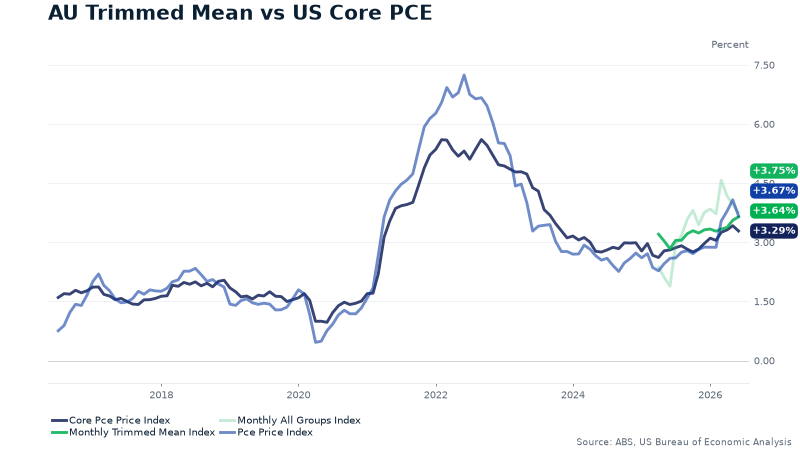
Inflation has cooled from its recent peak to 3.8% and trimmed mean inflation undershooting expectations, yet at 3.6% it remained well above the RBA’s 1-3% target band. Today’s release therefore provides another test of whether inflation is genuinely losing momentum or simply pausing. A softer headline number is widely expected due partly to base effects, which makes the trimmed mean and underlying details arguably more important for markets. A stronger-than-expected reading could revive expectations of another RBA hike and support the Australian dollar, while further evidence of cooling inflation could push tightening expectations further out.
Source: ABS, BEA
US Core PCE Sets the Stage for Jackson Hole
US core PCE is equally important for Fed watchers, with the central bank maintaining a hawkish bias even though rates are expected to remain on hold at its next meeting. Today’s release could also shape Kevin Warsh’s messaging when he delivers his first Jackson Hole speech as Fed Chair on Friday, where markets will be looking for greater clarity on the Fed’s policy direction.
Core PCE is the Fed’s preferred inflation gauge and was running at 3.3% year on year in June, well above its 2% target. That leaves little room for another upside surprise after several Fed officials warned that persistent inflation could require further tightening. A hotter print would strengthen the case for another hike, potentially lifting US yields and the dollar, while a softer reading would ease some of those concerns and could reinforce the recent pressure on the greenback.
US Dollar Volatility Recedes Ahead of Jackson Hole and Inflation
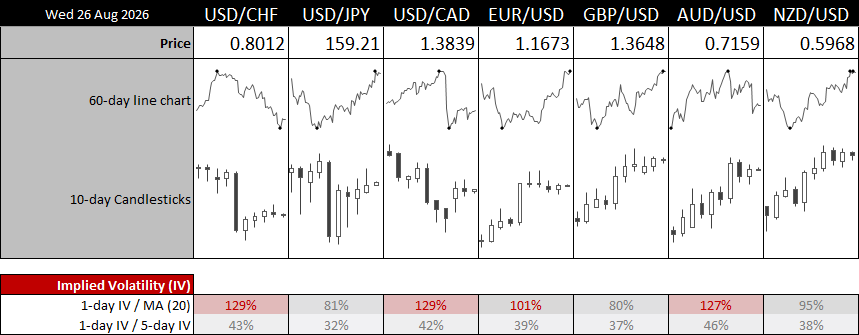
The US dollar index was a touch lower on Tuesday to break its two-day retracement, forming a small shooting star reversal candle around the 99 handle. This pattern was mimicked by USD/CHF around its January high resistance, and USD/CAD, which met resistance around its 10-day EMA. Meanwhile, EUR/USD, GBP/USD and AUD/USD formed small bullish inside days beneath their cycle highs, though volatility was low overall.
This is a pattern I highlighted in Monday’s article, noting that volatility tended to recede heading into the Jackson Hole speech before erupting on the day. Perhaps that is why one-day implied volatility for AUD/USD is only moderately elevated at 127% of its 20-day average, despite incoming inflation reports of interest to both the RBA and Fed.
Source: LSEG
Jackson Hole Historically Delivers Volatility, Not Direction
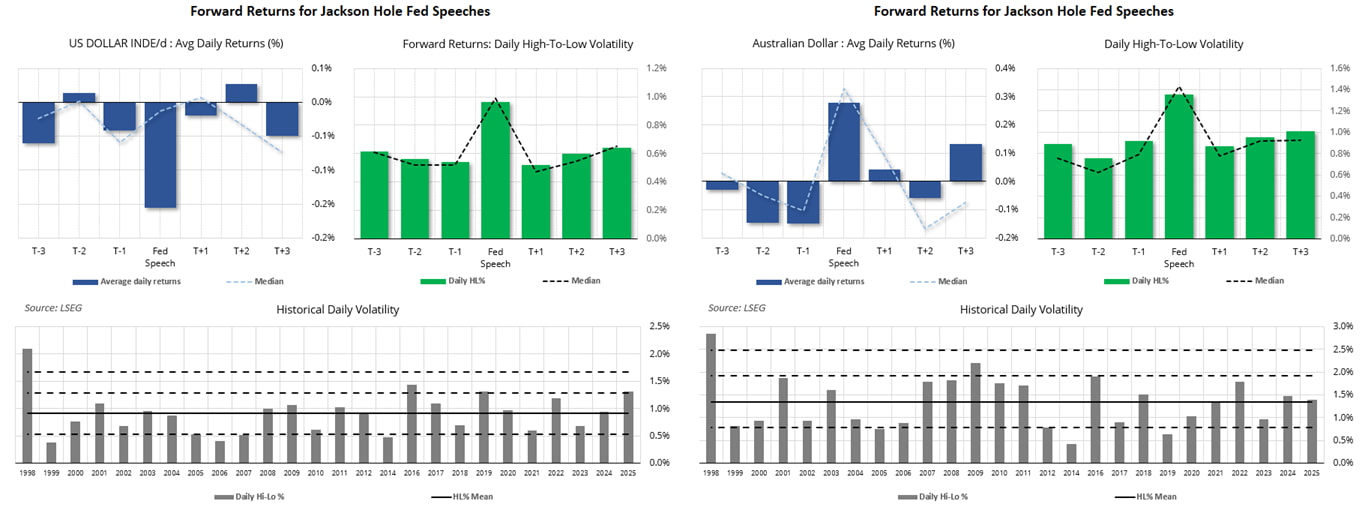
Jackson Hole has historically been more reliable as a volatility event than a directional one. DXY volatility tends to ease in the days leading into the Fed Chair’s speech before rising sharply on the day itself, with the average daily range increasing to around 0.9%. Direction is far less consistent, with average DXY returns slightly negative on speech day but the median effectively flat.
AUD/USD shows a similar volatility pattern but a somewhat clearer directional bias. The pair has historically softened ahead of the speech before generating an average gain of around 0.3% on the day, while its average high-to-low range jumps to roughly 1.3%. As highlighted in my Jackson Hole FX returns and volatility preview, that suggests the event has been more dependable for delivering a larger trading range than predicting direction — particularly with AUD/USD already sitting close to key resistance
Source: LSEG
AUD/USD Technical Analysis: Australian Dollar vs US Dollar
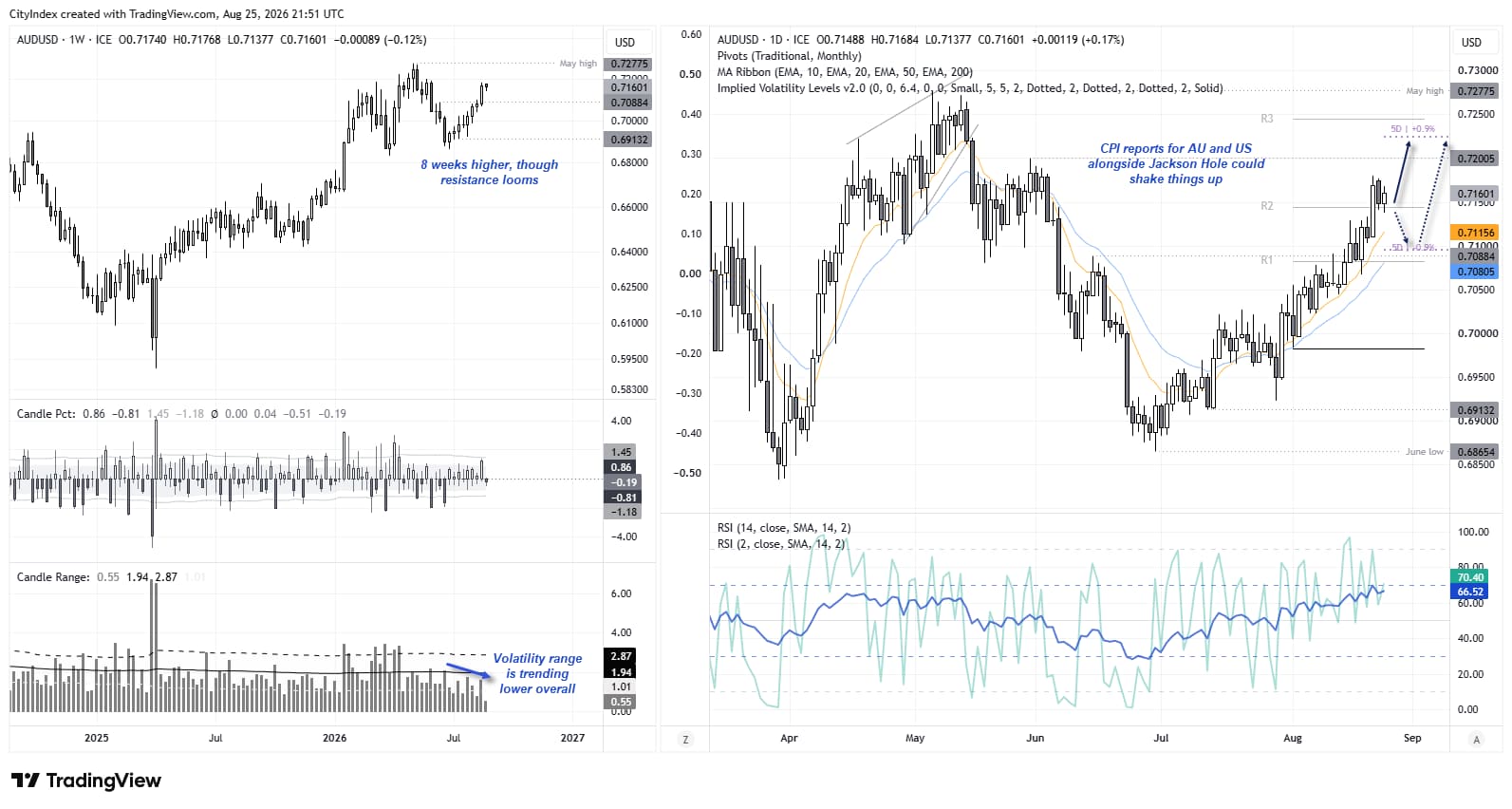
Depending on which feed you follow, the Aussie has risen for eight consecutive weeks (according to Reuters) or five (via ICE). In either case, the rally has been impressive, and it is also accelerating — given last week’s rise was its most bullish in 18 weeks. That said, the broader trend in weekly volatility remains lower, while resistance looms around 72c and the May high — the latter of which seems likely to provide a decent level of resistance initially, if tested.
The daily chart shows AUD/USD resting on the monthly R2 pivot with a small bullish candle, as bulls ponder another crack at 72c while they await Australia’s inflation report. And should it come in hot, a move to 72c seems feasible. That said, if inflation were to soften even slightly and be followed by a slightly firmer US PCE report, then a break of Wednesday’s low would also clear the monthly R2 pivot and potentially see AUD/USD retrace towards its 10-day EMA (0.7115). Note that the 1-week implied volatility band suggests a 0.9% move in either direction with a 68% probability.
Source: ICE, TradingView
Related tags:





Web Trader platform
Our sophisticated web-based platform is packed with features.
Open an account today
Experience award-winning platforms with fast and secure execution.
Economic calendar
Related articles

Euro Short-term Outlook: EUR/USD Pullback Nears Pivotal Uptrend Support 8 28 2026
Warsh's comments accelerated the EUR/USD selloff, raising the stakes as buyers look to stabilize the broader recovery.


Gold and S&P 500 analysis: What now after Warsh’s hawkish speech?
The dollar surged across the board after the Fed Chair Kevin Warsh surprised with a hawkish-leaning speech at the Jackson Hole summit. All the bearish dollar bets that had been accumulated since last Friday on the back of data weakness and bond market troubles had to be squared and that triggered a short squeeze rally for the dollar. Gold and silver dropped, as a result, as too did bitcoin, while US indices were giving back earlier gains.


EUR/USD forecast: All eyes on Warsh at Jackson Hole - Forex Friday
For much of this week, the EUR/USD has been edging lower with the US dollar regaining some ground after last week’s sell-off that was triggered, in part, by the bond market worries. Investors have been unwilling to bet further against the US dollar so far this week ahead of Kevin Warsh’s keynote speech at the Jackson Hole summit, due later today.