

AUD/USD Remains Vulnerable Despite US Dollar Weakness Amid Midterms
AUD/USD struggles despite a weaker US dollar and falling Treasury yields, as Democratic sweep expectations fuel volatility and Wall Street risk aversion.
Written by
Matt Simpson
Market Analyst
The Australian dollar has failed to capitalise on a weaker US dollar and falling Treasury yields as prediction markets price in a near-certain Democratic sweep of Congress. With Wall Street futures under pressure, bearish AUD/USD options positioning and narrowing yield spreads suggest risk aversion remains the dominant force.
Why AUD/USD Is Struggling as US Midterms Weigh on the Dollar
US Midterms: Democrats Near Sweep as Dollar and Yields Slip
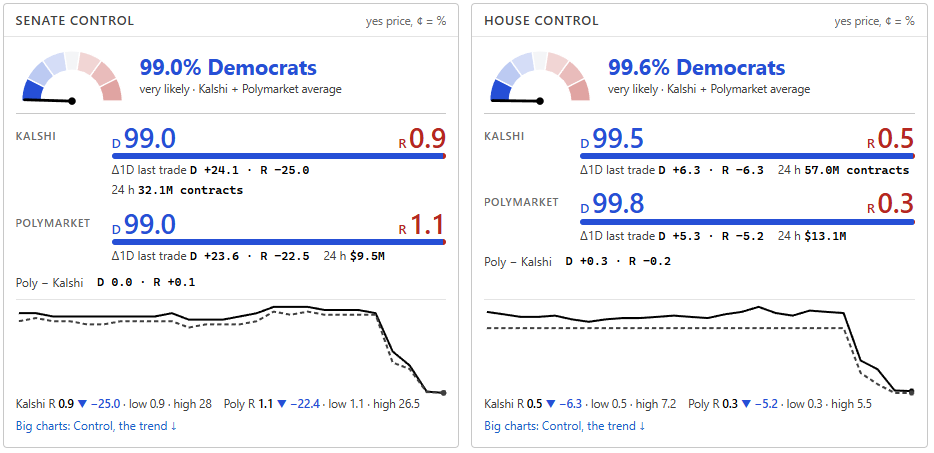
Prediction markets are pricing a near-certain Democratic sweep of Congress following early US midterm election results. Bloomberg's aggregation of Kalshi and Polymarket shows Democrats with a 99% probability of taking the Senate and 99.6% for the House. While the overall results are yet to be confirmed, a Democratic-controlled Congress would significantly constrain President Trump's legislative agenda over the remaining two years of his presidency.
Source: Traderinput.com
US Dollar: Fiscal Gridlock Weighs on Yields
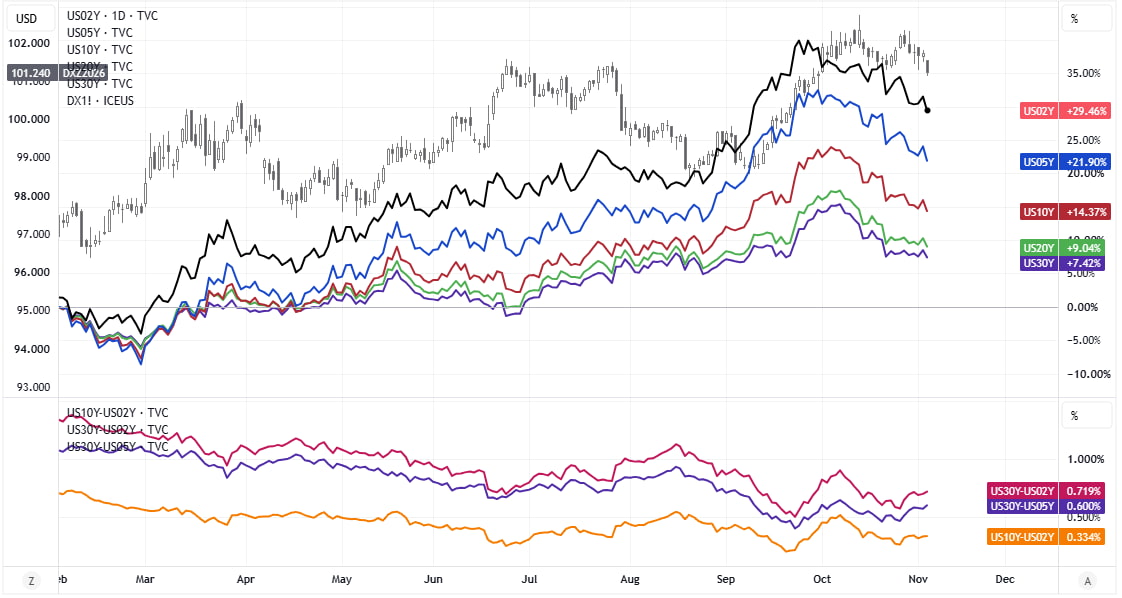
A Democratic sweep would make further fiscal expansion and tax cuts more difficult to implement, potentially reducing government borrowing expectations and Treasury yields. This removes a potential source of support for the US dollar, with the US dollar index (DXY) already down 0.4% during today's session.
Treasury yields have also retreated across the curve, with the 10-year yield falling around four basis points. Shorter-dated yields have led the decline from their October highs, allowing the yield curve to steepen modestly. The 10-year/2-year spread has widened to around 33 basis points, while the 30-year/2-year spread sits near 72 basis points.
Source: TradignView
Fed Rate Pricing Still Points to Further Tightening
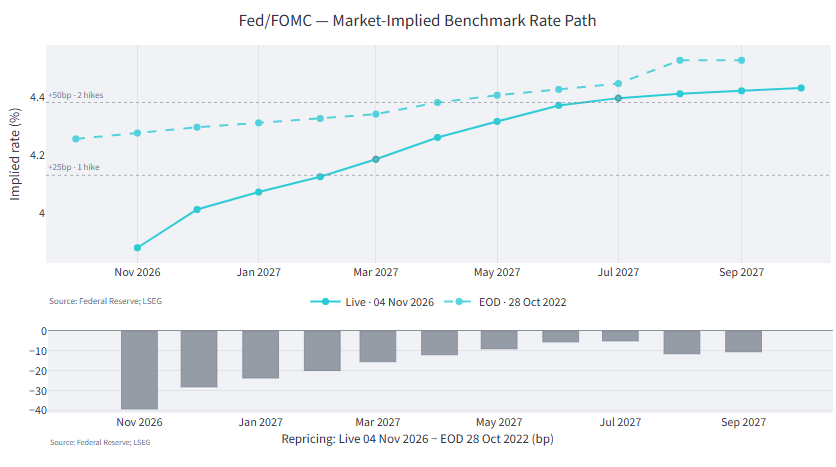
Fed expectations have also shifted lower. The market-implied rate path is now around 40 basis points below last week's levels for November, with the difference narrowing to around 25–30 basis points in early 2027. However, markets are still pricing further tightening into next year, suggesting a reassessment of the pace of future hikes rather than a shift towards rate cuts.
With a Democratic sweep now heavily priced in, further dollar weakness may require a sustained decline in Treasury yields and additional dovish repricing of Fed expectations.
This content was created by an affiliate of FOREX.com and represents the views and opinions of the author/speakers, not the views and opinions of FOREX.com, StoneX Group Inc., or its subsidiaries. The content has not been independently reviewed by FOREX.com.
Wall Street: Mixed Implications for Equities
Political gridlock could limit further fiscal stimulus and slow Trump's deregulation agenda, while increased congressional scrutiny could weigh on technology and AI-related stocks.
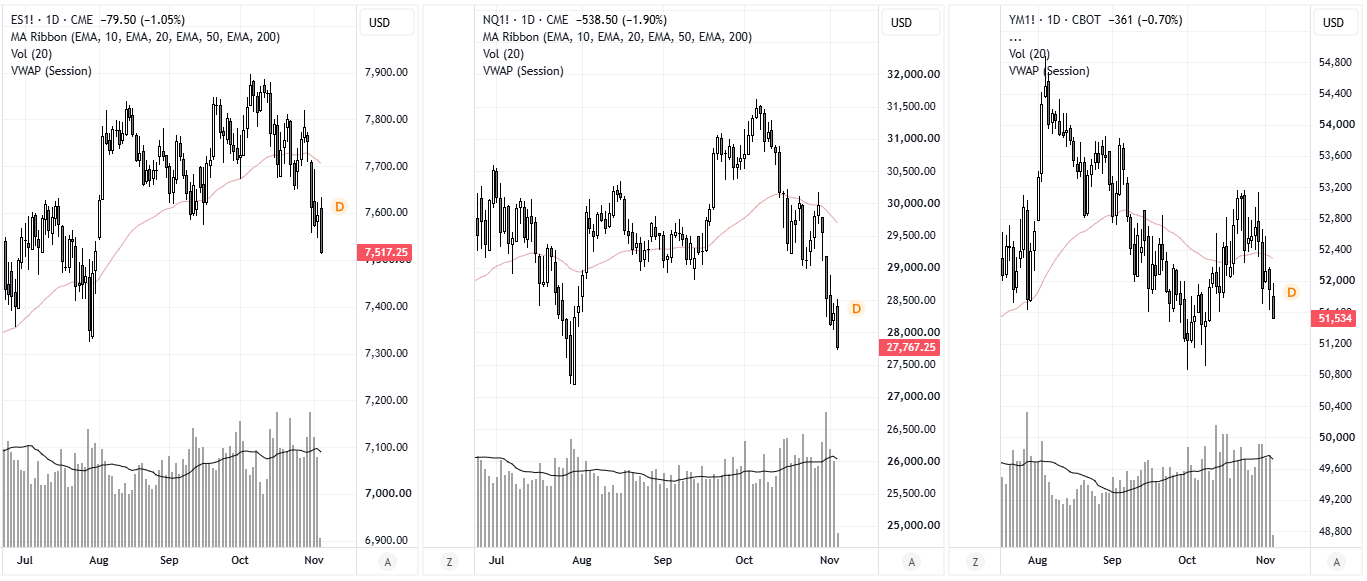
However, lower Treasury yields could support equity valuations, particularly growth stocks. For now, risk-off sentiment appears to be dominating, with Nasdaq 100 futures down 1.9%, the S&P 500 down 1.1% and Dow Jones down 0.7%. All three are trading below their respective 50-day EMAs, suggesting the recent selloff could extend further.
Beyond the elections, Wall Street's direction is likely to remain driven by corporate earnings, economic growth and developments in the AI investment cycle.
AUD/USD Fails to Capitalise on Weaker US Dollar
The Australian dollar has struggled to capitalise on broad US dollar weakness, despite falling Treasury yields and a dovish repricing of Fed expectations.
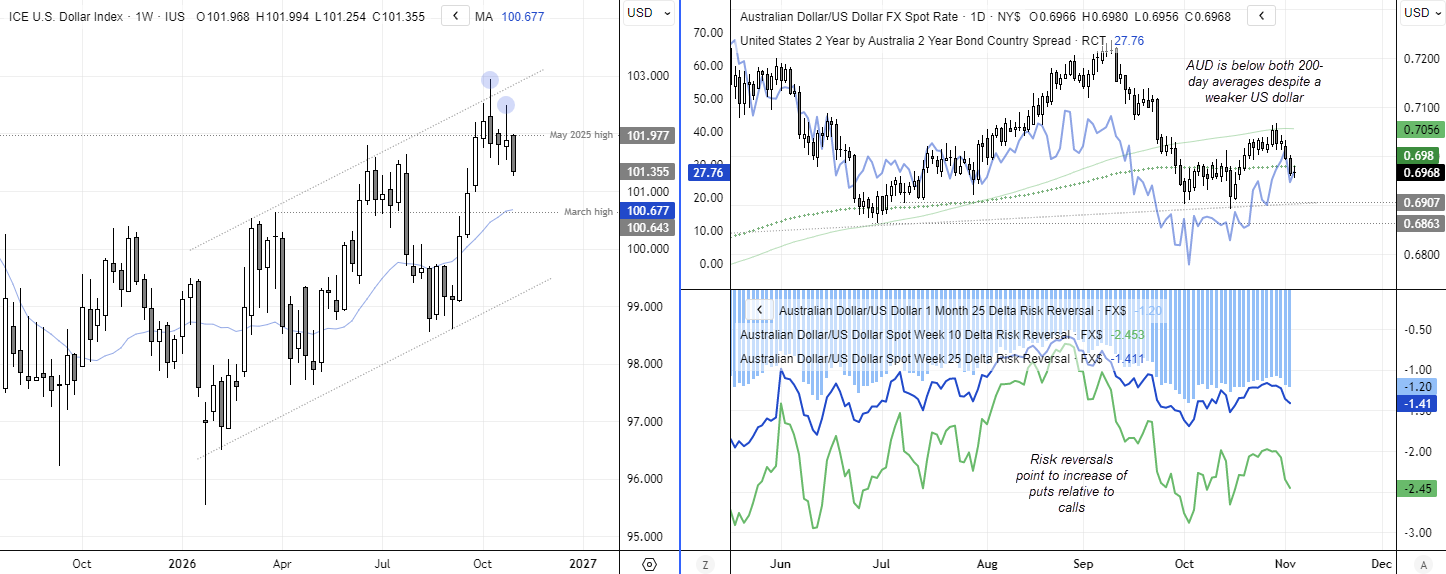
Instead, risk-off sentiment appears to be dominating, with the sharp selloff across Wall Street futures weighing on risk-sensitive currencies such as AUD. The Aussie's failure to rally against a weaker greenback suggests underlying demand remains fragile, despite the RBA's recent rate hike. Note that risk reversals are pointing lower as options traders demand for puts outpaces demand for calls. While the AU-US2yr spread remains elevated, it too has curled lower.
Unless risk appetite improves, AUD/USD could remain vulnerable to further downside, particularly if the US dollar begins to recover.
Source: ICE, TradingView
With a Democratic sweep now largely priced in, the next move in financial markets may depend more on Treasury yields and risk appetite than the election results themselves.
Further declines in US yields could provide opportunities to sell into US dollar rallies, particularly if markets continue to scale back Fed tightening expectations. However, continued weakness on Wall Street could favour defensive currencies over the Australian dollar, making AUD/USD a less straightforward expression of USD weakness.
Related tags:
Latest market news









Web Trader platform
Our sophisticated web-based platform is packed with features.
Open an account today
Experience award-winning platforms with fast and secure execution.
Economic calendar
Related articles

EUR/USD forecast: All eyes on Warsh at Jackson Hole - Forex Friday
For much of this week, the EUR/USD has been edging lower with the US dollar regaining some ground after last week’s sell-off that was triggered, in part, by the bond market worries. Investors have been unwilling to bet further against the US dollar so far this week ahead of Kevin Warsh’s keynote speech at the Jackson Hole summit, due later today.


DAX and EUR/USD forecast: Lower energy prices, yields offer support
But the question, of course, is how much further oil prices and bond yields can fall. For now, the combination is supportive of risk assets and is helping to sustain a relatively benign decline in the dollar. The focus today will be on US core PCE inflation, due for release shortly, while Nvidia’s second-quarter earnings will provide another test for risk appetite after the US markets close – not just for US indices but for global tech-heavy indices given the influence Nvidia has over the global tech and AI names.

AUD/USD Shorts Bear the Brunt of Hot CPI, Renewed RBA Hike Bets
Hot Australian CPI revives RBA hike bets, lifts bond yields and adds fresh pressure to crowded AUD/USD short positions.