

AUD/USD slips as DXY ignores the playbook
The US dollar moved against its recent macro playbook on Monday. AUD/USD paid the price, although bulls still hold the upper hand.
Written by
David Scutt
Market Analyst
- DXY rallies despite falling long-end Treasury yields
- TGA may fund expanded long-dated buybacks
- Iran sanctions keep dollar-system exclusion risk alive
- AUD/USD reverses after fresh multi-month highs
- RBA minutes arrive with markets pricing minimal September hike risk
Falling US Treasury yields, weakness in energy prices, and avoidance of a worst-case scenario when it came to the so-called economic D-Day sanctions on Iran implemented by the United States sounds like a toxic mix for the US dollar. But it proved to be anything but on Monday, with the DXY managing to rally.
The Aussie dollar was one of the chief casualties of the unusual move.
TGA funding could fund expanded buybacks
The main catalyst driving back-end yields lower during the session was a CNBC report suggesting Treasury could tap the TGA to fund increased buybacks of long-dated securities announced last Wednesday, avoiding the need to issue a similar amount of shorter-dated bills to finance the purchases.
The TGA, or Treasury General Account, is akin to the government’s transactional account at the Federal Reserve.
While the TGA holds roughly $950 billion, which is large by historical standards, it obviously can’t all be deployed for buybacks. More importantly, it does nothing to address the underlying reasons long-end yields have been moving higher: persistent strength in energy prices, massive US budget deficits, and debt levels that continue to accumulate.
It comes across as another measure akin to putting a Band-Aid on a bullet wound. But it also continues to feed the narrative that Treasury is willing to be very interventionist in the bond market to lower long-term yields.
On a relative rates basis, that would normally create headwinds for the US dollar. But not on Monday.
No firm date for broader Iran sanctions
Then we get to the so-called economic D-Day announcement from US Treasury Secretary Scott Bessent, which avoided the worst-case scenario for markets, with no immediate implementation of the flagged secondary sanctions on countries, companies and banks doing business with Iran.
Importantly, Bessent said countries would need to cut business ties with Iran or risk being shut out of the US dollar-based financial system but stopped short of identifying who would be targeted and when the sanctions would take effect. He did announce sanctions on 60 individuals, entities and vessels, but the broader threat remains an open one.
China is the obvious target given it is the biggest buyer of Iranian crude, making it a key economic lifeline for Tehran. But with no implementation date and Trump and Xi due to meet next month in Washington, it reeks of a potential TACO in the making.
Even so, the threat of being locked out of the US dollar system and losing access to dollar funding is still there. If you’re forewarned that access to dollar funding may be at risk, that may explain why the dollar found an unexpected bid during the session.
This content was created by an affiliate of FOREX.com and represents the views and opinions of the author/speakers, not the views and opinions of FOREX.com, StoneX Group Inc., or its subsidiaries. The content has not been independently reviewed by FOREX.com.
Dollar strength jars with rates and crude
While you have to be very careful trying to definitively label the cause of a market move over just one session, the dollar move was interesting given it ignored what has been driving its movements recently.
Source: TradingView, FOREX.com
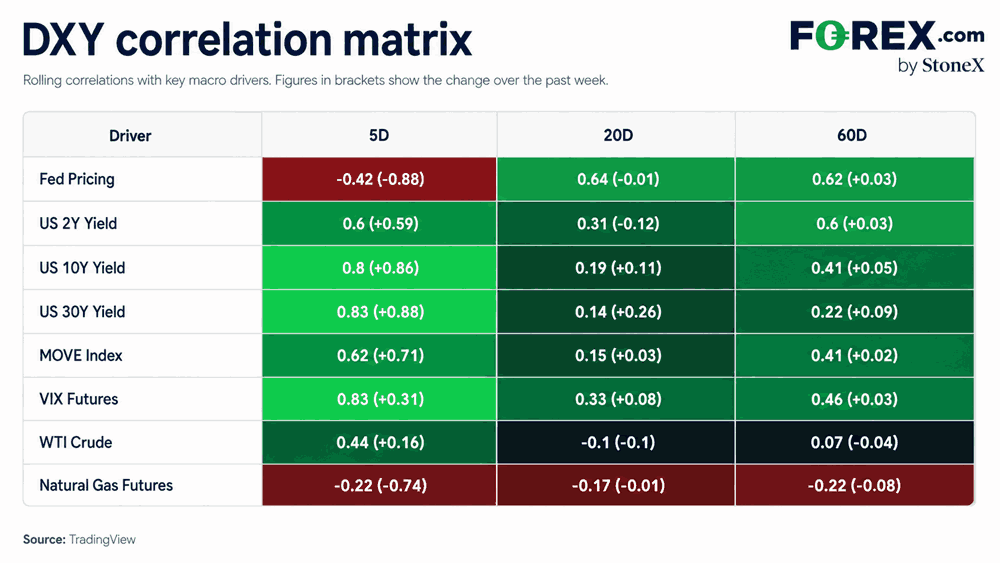
As seen in the correlation matrix above, the US dollar index has been all about fluctuations in the US Treasury curve over the past week, with the strongest relationships at the back end of the curve.
At the same time, we’ve also seen strong positive correlations with broader risk appetite measures such as the MOVE Index and VIX futures, along with a moderately strong relationship with crude prices.
Yet despite yields falling, no meaningful pickup in volatility during the session, and sharply lower crude prices, the dollar still managed to find a bid.
DXY squeeze already evident
Source: TradingView
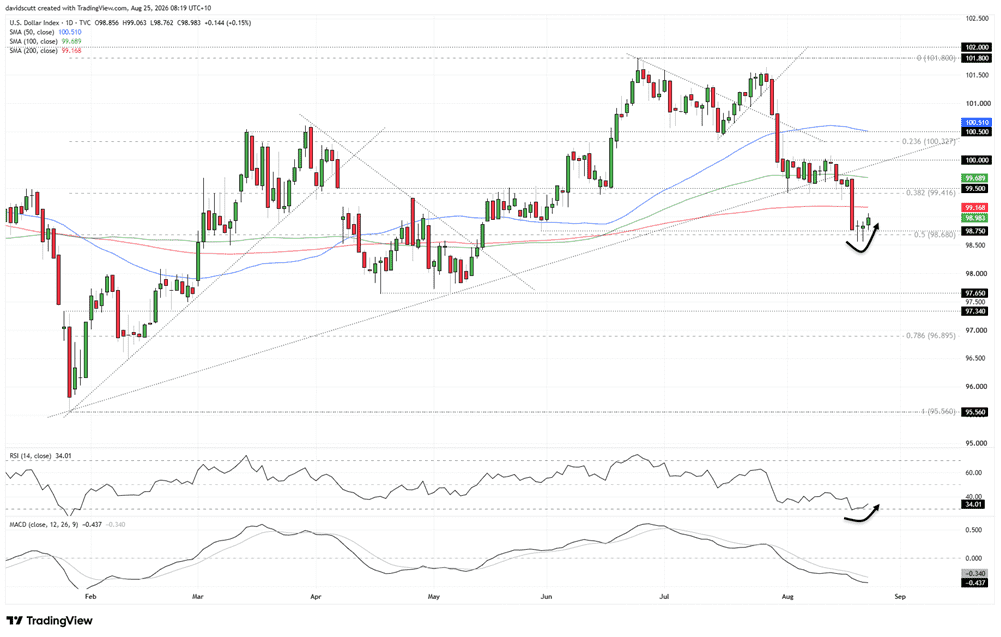
The DXY price action leading into Monday had already been warning about the potential for some form of short-term squeeze.
A dragonfly doji followed by a hammer in the prior two sessions came from beneath the 50% retracement of the January to June bull move and 98.75, the low set on May 29. With DXY pushing higher on Monday, it adds to the view that, for now, the lows may be in.
The oscillators are still broadly bearish, but RSI (14) has started to turn higher from oversold territory, suggesting the strength of the downside move may already have peaked.
Aussie reverses from multi-month highs
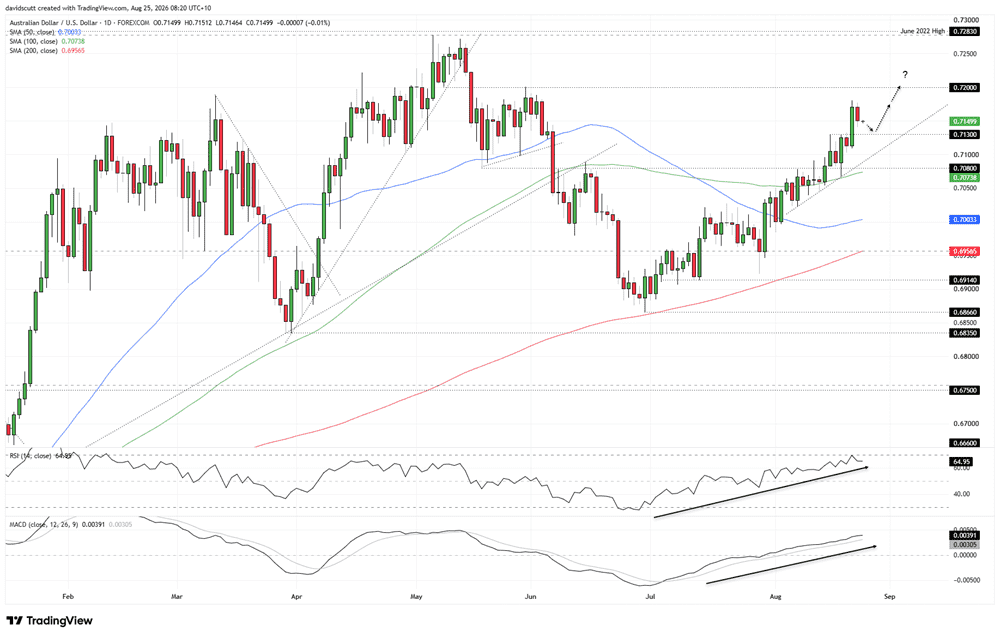
As seen in the next chart, AUD/USD was one of the main casualties of the renewed bid in the buck, pulling back after hitting fresh multi-month highs late last week despite continued gains in other markets it had previously been rallying in unison with, such as gold and crypto.
Source: TradingView
While it wasn’t a uniformly strong performance across the commodity complex, and there was a dash of risk-off tone in some pockets of the US equity market, the pullback in the Aussie was notable nonetheless.
Right now, the pair sits in no-man’s land, with 0.7130, Friday’s breakout level, underneath and 0.7180, Friday’s session high, above. That’s the immediate range to focus on today.
Despite the pullback, the message from the oscillators remains uniformly bullish. RSI (14) continues to trend higher and is not yet overbought, while MACD is also moving higher in positive territory above the signal line. More broadly, that points to building upside strength that favours buying dips.
As such, pullbacks towards 0.7130 would make for an appealing entry point for longs, allowing positions to be set above the level with a tight stop beneath for protection, initially targeting Friday’s high at 0.7180 and then 0.7200.
A break above the latter would open the path for a potential run towards 0.7283, where the price stalled in April this year.
An extension of Monday’s reversal beneath 0.7130 would put the minor uptrend from the low set in early August, 0.7080 support and the 100-day simple moving average just underneath at 0.7074 in focus. A break beneath the bottom of that support zone would question the merits of retaining a bullish bias.
RBA minutes may look hawkish relative to market pricing
From a fundamental perspective, the focus today for the Aussie will be on the release of the RBA’s August monetary policy minutes, from a meeting where the board voted unanimously to keep the cash rate steady at 4.35%.
A hawkish undertone is likely given the board did not discuss cutting rates at the meeting, only keeping policy steady or hiking. But with markets pricing only around a 4% chance of a September hike, there may be some room for the minutes to come across as more hawkish than current pricing implies.
Latest market news








Web Trader platform
Our sophisticated web-based platform is packed with features.
Open an account today
Experience award-winning platforms with fast and secure execution.
Economic calendar
Related articles

Gold and S&P 500 analysis: What now after Warsh’s hawkish speech?
The dollar surged across the board after the Fed Chair Kevin Warsh surprised with a hawkish-leaning speech at the Jackson Hole summit. All the bearish dollar bets that had been accumulated since last Friday on the back of data weakness and bond market troubles had to be squared and that triggered a short squeeze rally for the dollar. Gold and silver dropped, as a result, as too did bitcoin, while US indices were giving back earlier gains.


EUR/USD forecast: All eyes on Warsh at Jackson Hole - Forex Friday
For much of this week, the EUR/USD has been edging lower with the US dollar regaining some ground after last week’s sell-off that was triggered, in part, by the bond market worries. Investors have been unwilling to bet further against the US dollar so far this week ahead of Kevin Warsh’s keynote speech at the Jackson Hole summit, due later today.

Bitcoin Forecast: BTC/USD Back to $80K Ahead of Warsh’s Jackson Hole Speech
After surging over $15,000 in the past 10 days alone, there is risk of a near-term pullback if Warsh says anything remotely hawkish at Jackson Hole - what are the levels to watch from here?