
EUR/USD Forecast: Euro Struggles to Find Support Even After U.S. PCE Data
The euro continues to face a challenging environment in the short term. The currency has struggled to regain ground against a U.S. dollar that remains firmly supported, a dynamic reflected in EUR/USD, which has now recorded three consecutive losing sessions and a decline of roughly 0.6%.
Written by
Julian Pineda
Market Analyst
The euro continues to face a challenging environment in the short term. The currency has struggled to regain ground against a U.S. dollar that remains firmly supported, a dynamic reflected in EUR/USD, which has now recorded three consecutive losing sessions and a decline of roughly 0.6%. More importantly, selling pressure has persisted even after the latest U.S. inflation data was released, suggesting that the market continues to favor the dollar over the euro. As long as this backdrop remains in place, bearish pressure could continue to play an important role in EUR/USD price action over the coming sessions.
PCE Takes Center Stage
One of the most important events of the trading session was the release of the U.S. Core Personal Consumption Expenditures (Core PCE) report, one of the Federal Reserve's preferred inflation gauges and a key indicator of consumer price trends.
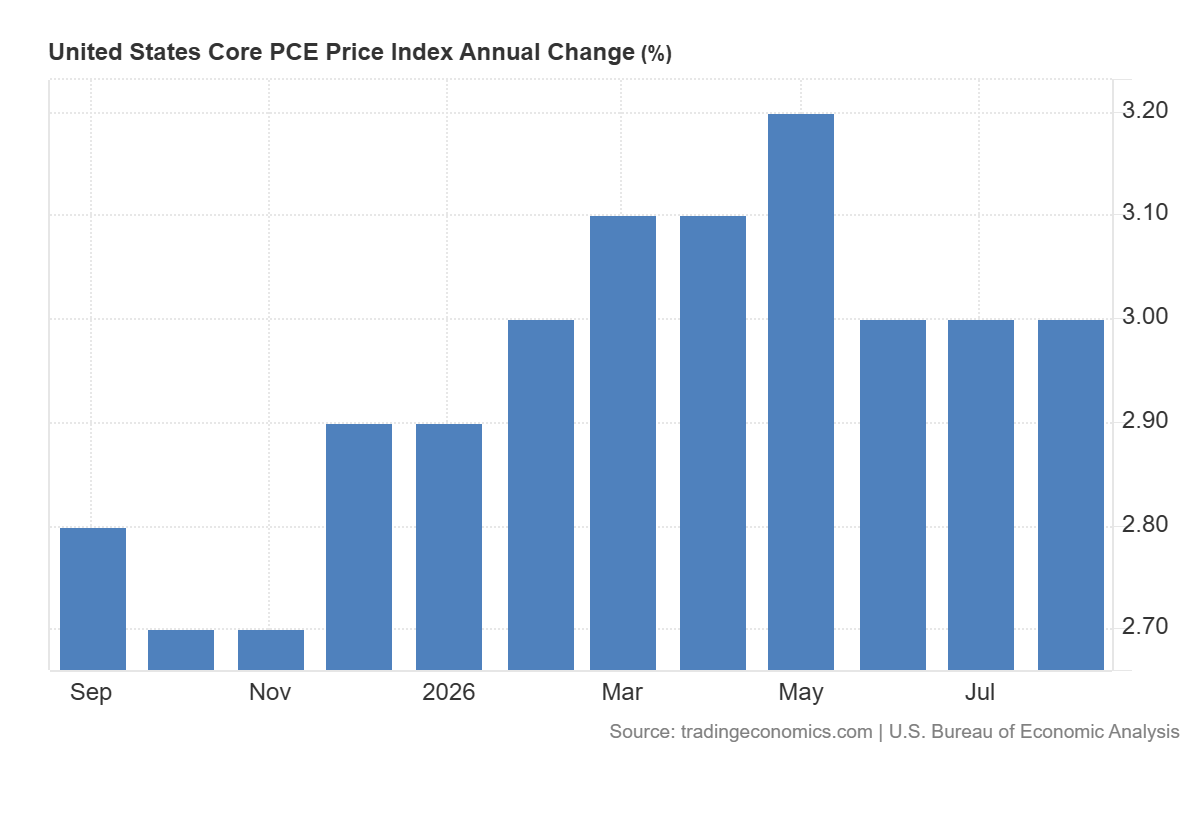
The monthly reading came in at 0.2%, below market expectations of 0.3%. At first glance, this provided some relief by suggesting a modest easing in short-term inflation pressures. However, the annual measure remains close to 3.0%, a level that has shown little change since June. While inflation is no longer accelerating significantly, it also remains well above the Federal Reserve's long-term target.
As a result, markets have slightly reduced expectations of a more aggressive Fed. According to CME Group probabilities, there is now roughly a 60% chance that interest rates will remain unchanged at 4.00% during the October 28 meeting.
Source: TradingEconomics
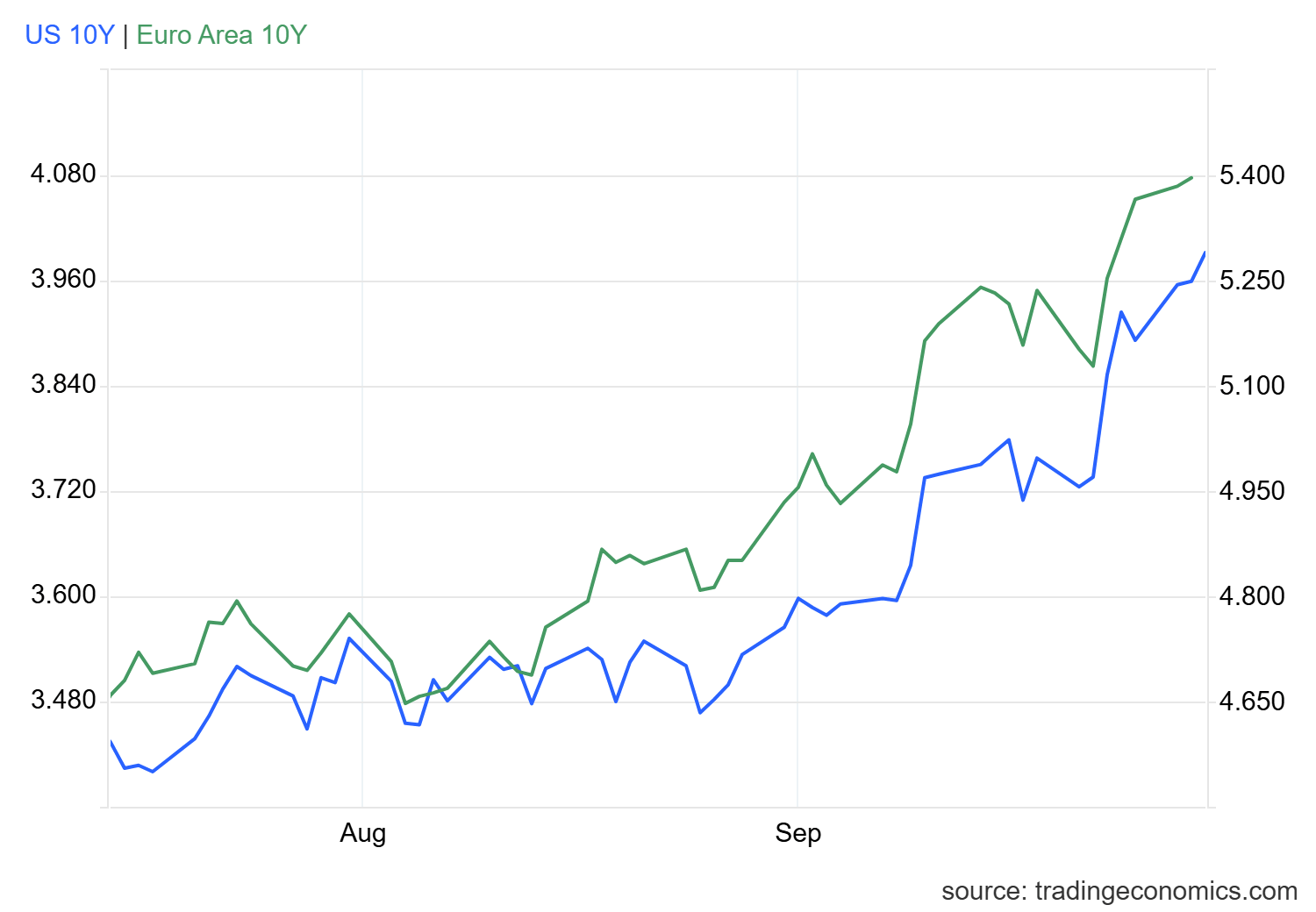
Even so, the positive impact on the euro has been limited because the U.S. bond market continues to show remarkable strength. Despite the moderation in rate expectations, 10-year Treasury yields continue to move higher and are now approaching the 5.3% area, levels not seen in decades. Meanwhile, European bond yields have also recovered recently, but they remain significantly lower, trading closer to 4.0%.
This yield differential continues to support the relative attractiveness of U.S. assets and helps explain why demand for the dollar remains strong despite the softer inflation release.
Source: TradingEconomics
Against this backdrop, the euro continues to face a difficult environment. Although the inflation data partially reduced expectations of a more aggressive Federal Reserve, the bond yield differential continues to favor the United States. As long as this situation remains unchanged, the euro may continue to struggle to attract consistent demand, leaving the current selling pressure around EUR/USD in place over the coming sessions.
Is the ECB Still Relevant?
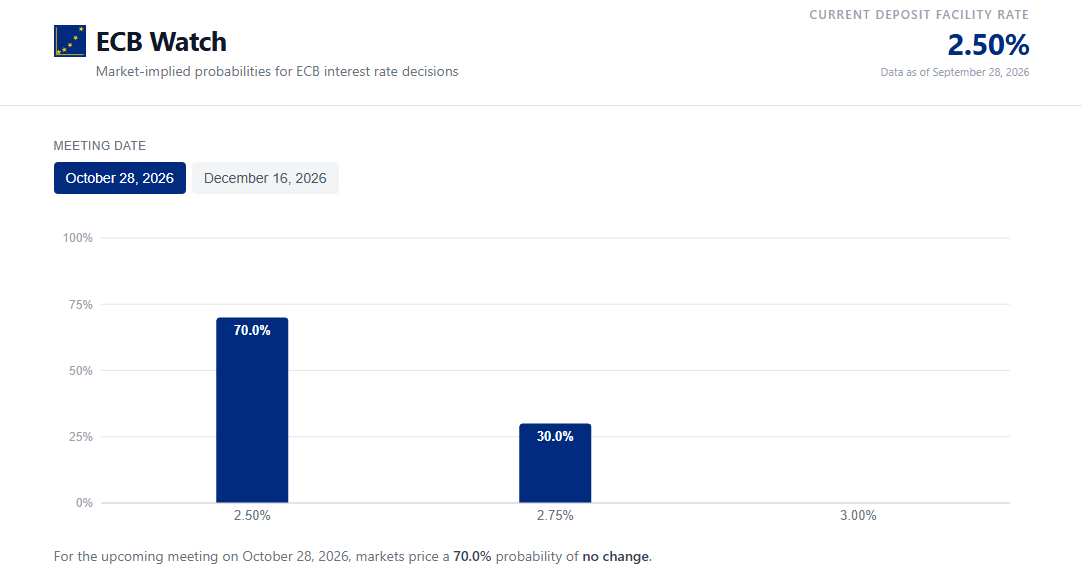
It is also important to monitor developments surrounding the European Central Bank (ECB). Current market probabilities continue to reflect a relatively neutral stance from policymakers. Expectations for the October 28 meeting indicate roughly a 70% probability that the ECB's deposit rate will remain unchanged at 2.5%.
These expectations are largely driven by the fact that inflation pressures across Europe have not been strong enough to justify another aggressive tightening cycle. In addition, ECB officials have maintained a relatively cautious tone in recent weeks, reinforcing expectations of policy stability.
Source: ECBWATCH
This remains important because part of the dollar's recent strength continues to be supported by the interest-rate differential between the United States and Europe. Unless markets begin to see signs of a more hawkish ECB willing to narrow that gap, dollar-denominated assets may continue to retain a meaningful relative advantage. Under this scenario, the euro could remain under pressure, leaving EUR/USD vulnerable to further downside in the near term.
EUR/USD Technical Forecast
Source: StoneX, Tradingview
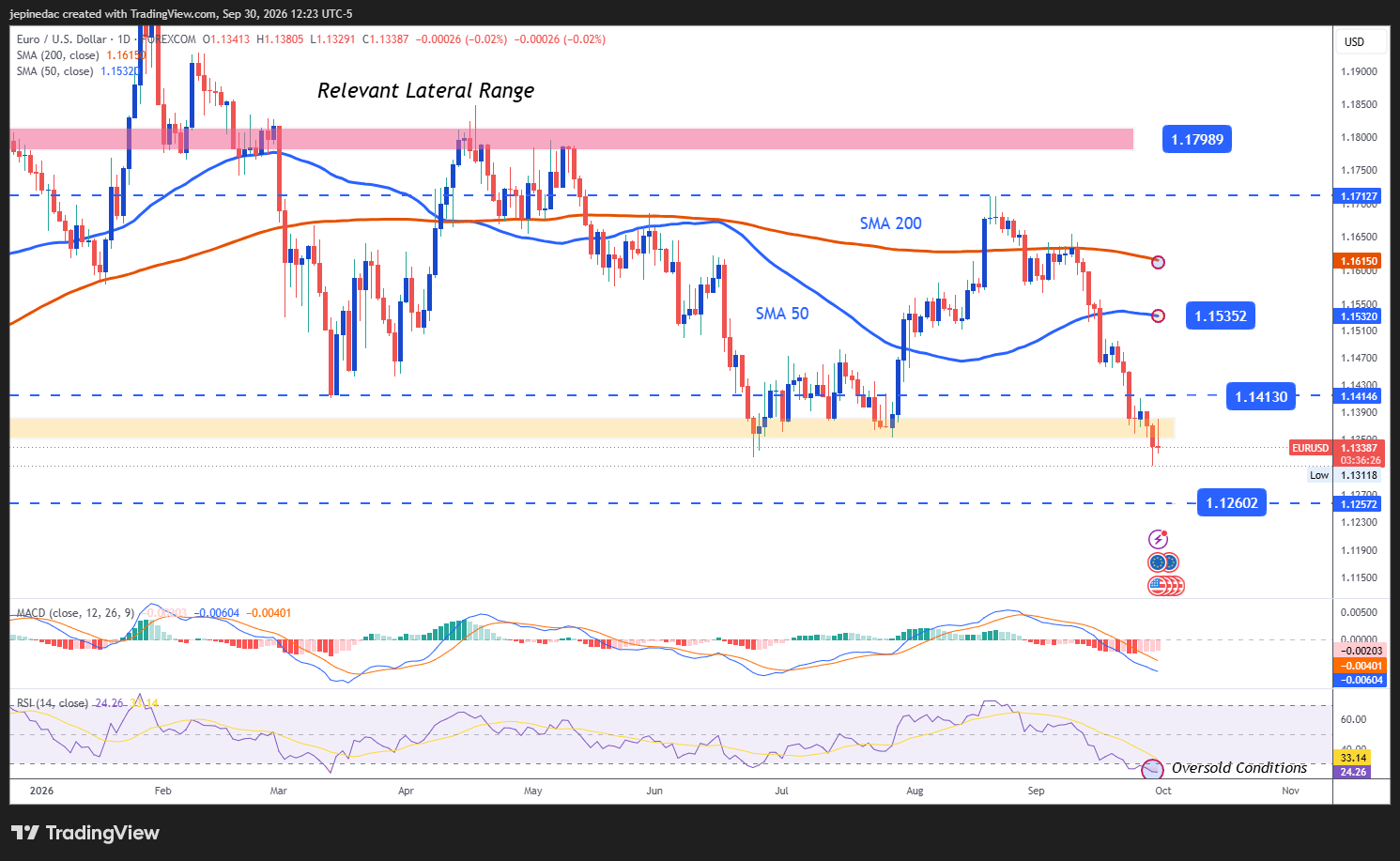
- The broad trading range is entering a risk zone: For much of 2026, EUR/USD has traded within a wide consolidation range that has dominated price action and prevented the development of a sustained directional trend. However, recent weakness has placed the lower boundary of that structure under increasing pressure. If selling pressure continues to build, a bearish breakout could emerge and open the door to a more established downward trend.
- MACD: The MACD histogram continues to trade below the 0 neutral line, indicating that short-term moving-average strength remains biased to the downside. As long as this behavior persists, selling pressure may continue to dominate.
- RSI: A similar picture can be observed in the RSI, which remains below the 50 neutral level. This reading reinforces the relevance of bearish momentum within the market. However, the indicator is now also trading below the 30 oversold threshold, suggesting that recent selling pressure may have become excessive and could create room for short-term bullish corrections.
Key Levels:
- 1.15352 – Key Resistance: This level coincides with the 50-period simple moving average and represents the most important barrier for recovery attempts. Price action returning toward this area could reinforce the importance of the broad trading range that has dominated much of the year and restore a more neutral tone to the chart.
- 1.14130 – Near-Term Barrier: A key retracement area observed over recent weeks that could become the primary reference to monitor in the event of short-term bullish corrections.
- 1.12602 – Critical Support: A level not seen since May 2025 that represents the most important downside barrier below the current trading range. Sustained moves toward this area could confirm the end of the broader consolidation structure and open the door to a more established bearish trend.
Written by Julian Pineda, CFA, CMT – Market Analyst
Follow him on: @julianpineda25
Latest market news











Web Trader platform
Our sophisticated web-based platform is packed with features.
Open an account today
Experience award-winning platforms with fast and secure execution.
Economic calendar
Related articles

Nasdaq 100 Forecast: NDX slips ahead of Fed Chair Warsh’s speech
U.S. stocks are edging lower on Friday, giving back some of yesterday's gains after Nvidia's strong outlook revived the tech trade. The focus has now shifted firmly to Fed Chair Kevin Warsh's Jackson Hole speech, with investors looking for more clarity on the outlook for interest rates.


EUR/USD forecast: All eyes on Warsh at Jackson Hole - Forex Friday
For much of this week, the EUR/USD has been edging lower with the US dollar regaining some ground after last week’s sell-off that was triggered, in part, by the bond market worries. Investors have been unwilling to bet further against the US dollar so far this week ahead of Kevin Warsh’s keynote speech at the Jackson Hole summit, due later today.


Bitcoin Forecast: BTC/USD Back to $80K Ahead of Warsh’s Jackson Hole Speech
After surging over $15,000 in the past 10 days alone, there is risk of a near-term pullback if Warsh says anything remotely hawkish at Jackson Hole - what are the levels to watch from here?