

Gold Analysis: XAU/USD Remains Under Pressure After Fed Rate Decision
Gold continues to face challenging conditions in the short term, with the precious metal already recording three consecutive losing sessions and posting a decline of nearly 2.3%. This price action continues to highlight a bearish bias that has become increasingly relevant within the market.
Written by
Julian Pineda
Market Analyst
Gold continues to face challenging conditions in the short term, with the precious metal already recording three consecutive losing sessions and posting a decline of nearly 2.3%. This price action continues to highlight a bearish bias that has become increasingly relevant within the market. The downside pressure seen over recent sessions has maintained its intensity even after the Federal Reserve meeting, a factor that continues to limit gold's recovery potential in an environment of elevated interest rates. For now, this remains the market's main catalyst and could keep selling pressure around XAU/USD in place over the coming sessions.
Is the Fed Limiting Confidence in Gold?
Today's trading session has been particularly important for broader market sentiment following the latest decision from the Federal Reserve. As widely expected, the central bank raised interest rates to 4.00%, up from the previous 3.75% benchmark rate. This decision marks the Fed's first rate increase of 2026 and received unanimous support from policymakers. In its official statement, the central bank emphasized that economic activity remains resilient, the labor market continues to show strength, and inflationary pressures remain elevated, factors that ultimately supported the rate increase.
However, the most significant development came after the decision itself. During the press conference, Federal Reserve Chair Kevin Warsh reiterated that inflation remains too high and persistent, noting that recent economic data has failed to show a clear and sustained slowdown. He also highlighted that inflation continues to run above the 3.00% area, still well above the Fed's 2.00% target. While he stopped short of committing to a specific rate path, his comments reinforced the perception that the Federal Reserve has adopted a more restrictive stance than many other central banks.
Market expectations have already begun to reflect this shift. Investors are increasingly pricing in a more aggressive Federal Reserve over the coming months, something that is becoming evident in the implied probabilities for future monetary policy meetings. For the October 28 meeting, markets currently assign a probability above 50% that interest rates could rise further toward the 4.25% level. Those probabilities increased following the Fed decision, reinforcing expectations that policymakers may remain hawkish in the months ahead.
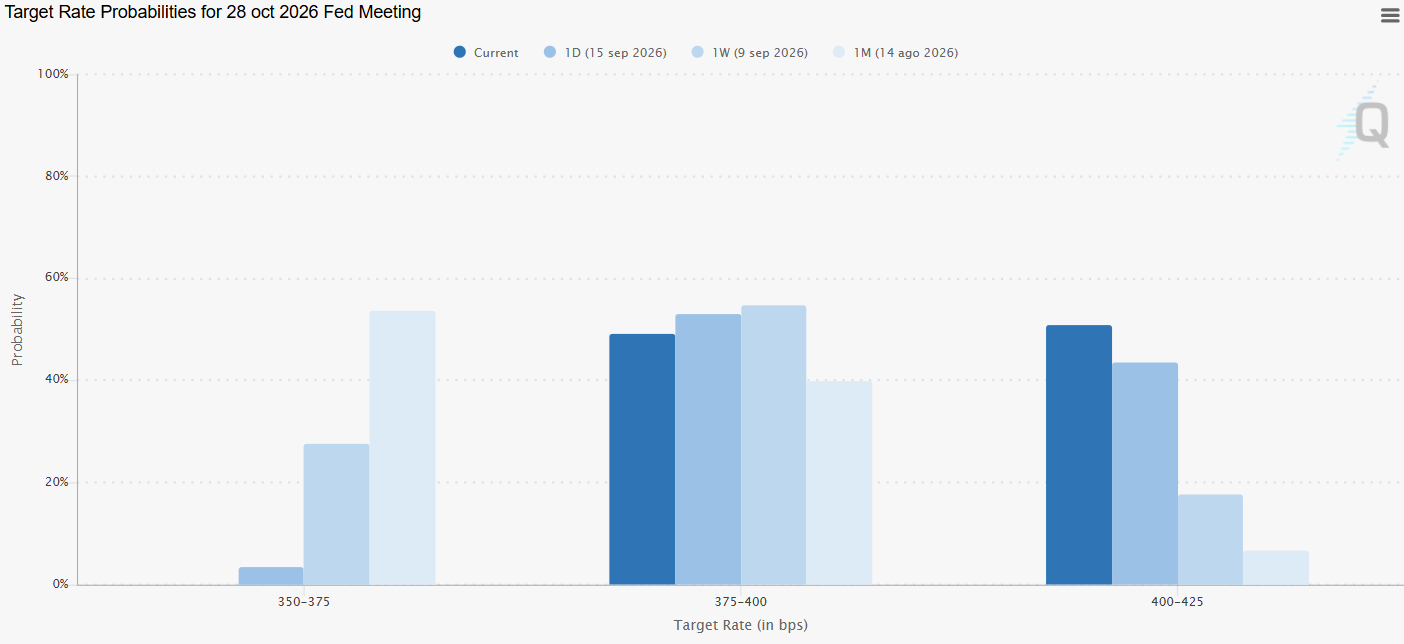
Source: CMEGROUP
The key issue for gold is that this environment is not particularly favorable. The reason lies in gold's closest alternative within the safe-haven space: the bond market. Both bonds and gold are traditionally viewed as defensive assets, and periods when one becomes more attractive can often reduce demand for the other. This appears to be one of the main factors weighing on the precious metal right now. Unlike bonds, gold does not generate yield, which means it tends to lose relative appeal when fixed-income returns increase.
That is precisely what has been unfolding recently. Even after the Fed decision, U.S. Treasury yields have continued to move higher, with the 10-year Treasury yield remaining above the 5.00% mark, a level not seen in years. This reflects the market's growing preference for fixed-income instruments, supported by expectations of a more aggressive Federal Reserve. As a result, part of the available capital flow may continue favoring the bond market over gold.
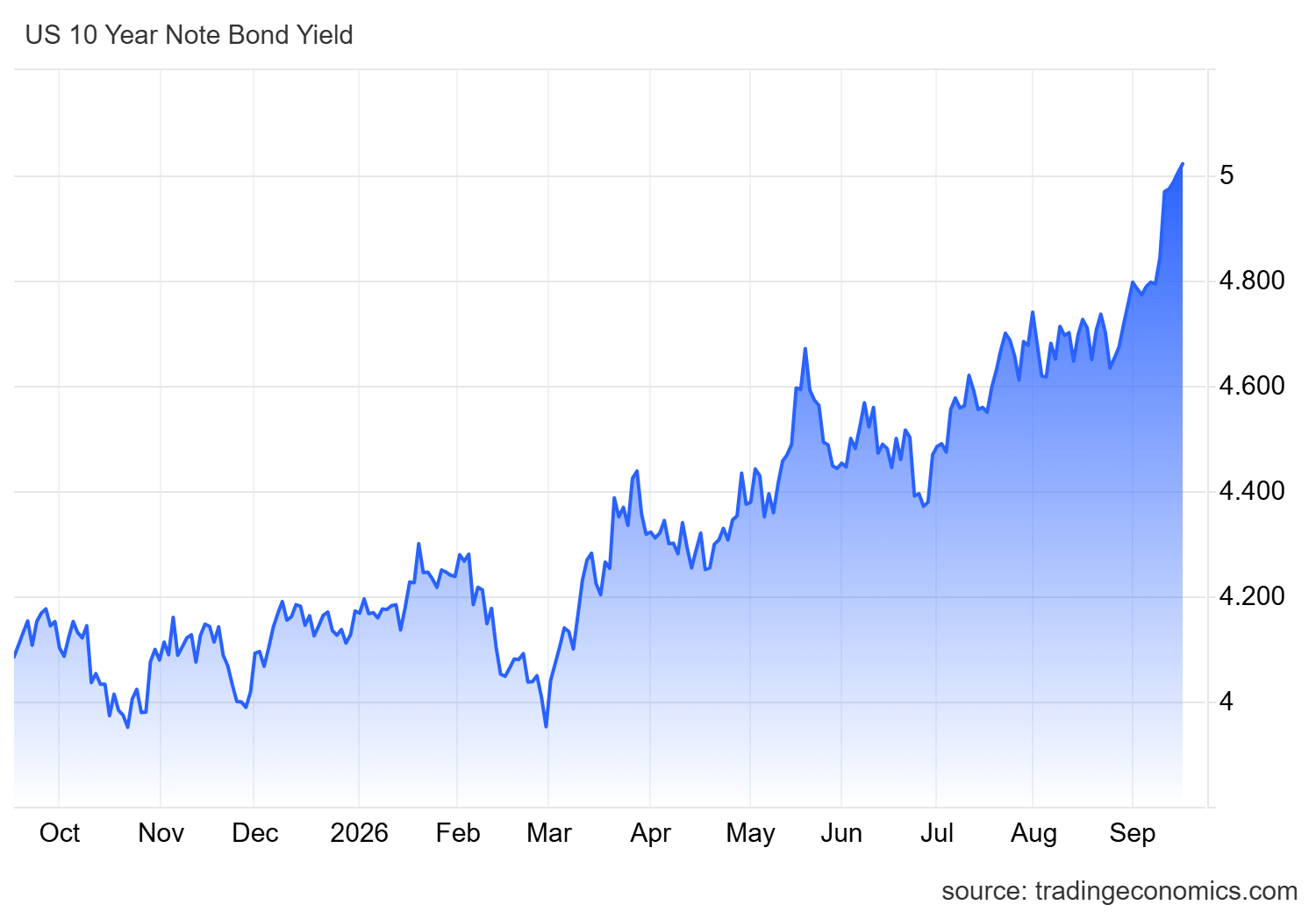
Source: TradingEconomics
Taking all of this into account, the outlook for gold demand remains challenging. As long as bond yields stay elevated, capital may continue flowing toward fixed-income markets, reducing the appeal of gold and making a sustained recovery more difficult. In broad terms, the Federal Reserve's decision has not been particularly supportive for gold and, while the bond market remains strong, selling pressure could continue to play a relevant role in XAU/USD price action.
Gold Technical Forecast
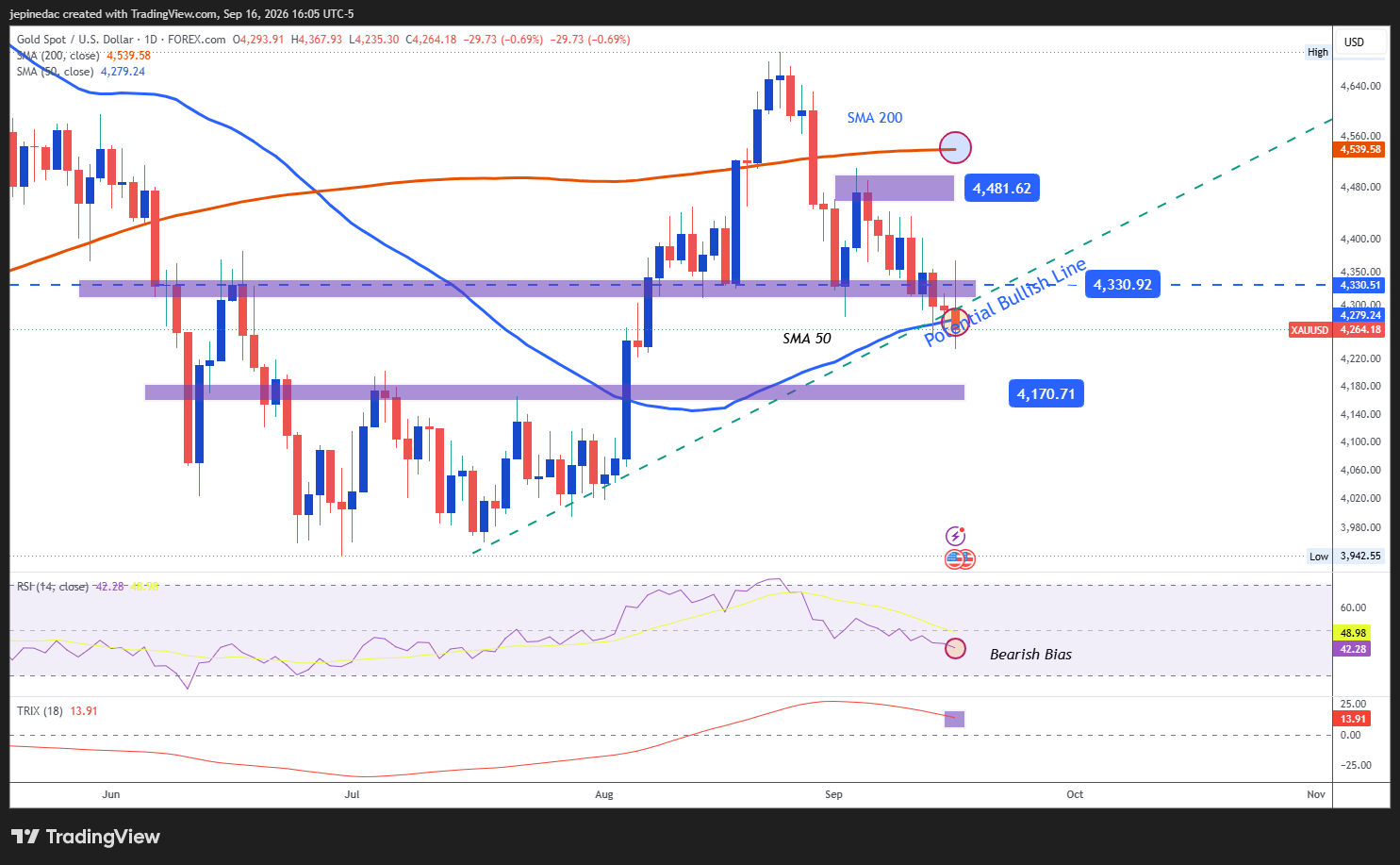
Source: StoneX, Tradingview
- Bullish trendline begins to lose momentum: Although an upward trendline remained the dominant technical structure on the daily chart until just a few sessions ago, recent price action has strengthened the case for a meaningful bearish move. If selling momentum continues to gain traction in the short term, it could not only mark the end of the bullish trend observed in recent weeks but also open the door to a more established bearish structure in the weeks ahead.
- RSI: The RSI is now trading below the 50 neutral level, a reading that reflects growing downside momentum across the chart. As long as this dynamic remains intact, the bearish bias could continue strengthening in the near term.
- TRIX: The TRIX indicator remains above its neutral level but continues to develop along a clear downward slope. This suggests a meaningful slowdown in the strength of longer-term exponential moving averages, reflecting exhaustion in the buying momentum accumulated over previous weeks and leaving room for more sustained weakness across the chart.
Key Levels to Watch:
- $4,480 – Critical resistance: A key barrier for bullish price action that aligns with recent highs and partially coincides with the 200-period simple moving average. A move back toward this level could begin to restore relevance to a bullish bias and revive the upward trendline seen in previous weeks.
- $4,330 – Near-term barrier: The main equilibrium zone on the chart and a level that was respected multiple times throughout last week. As long as prices continue to trade near this area, a sense of neutrality may persist and a more evident consolidation phase could begin to develop.
- $4,170 – Critical support: This level coincides with an important retracement zone observed months ago and sits just below the chart's main moving averages and bullish trendline. Price action moving back toward this area could reaffirm the dominance of the current bearish bias and potentially open the door to a more consistent bearish structure over the coming weeks.
Written by Julian Pineda, CFA, CMT – Market Analyst
Follow him on: @julianpineda25
Latest market news










Web Trader platform
Our sophisticated web-based platform is packed with features.
Open an account today
Experience award-winning platforms with fast and secure execution.
Economic calendar
Related articles

Gold and S&P 500 analysis: What now after Warsh’s hawkish speech?
The dollar surged across the board after the Fed Chair Kevin Warsh surprised with a hawkish-leaning speech at the Jackson Hole summit. All the bearish dollar bets that had been accumulated since last Friday on the back of data weakness and bond market troubles had to be squared and that triggered a short squeeze rally for the dollar. Gold and silver dropped, as a result, as too did bitcoin, while US indices were giving back earlier gains.


Bitcoin Forecast: BTC/USD Back to $80K Ahead of Warsh’s Jackson Hole Speech
After surging over $15,000 in the past 10 days alone, there is risk of a near-term pullback if Warsh says anything remotely hawkish at Jackson Hole - what are the levels to watch from here?


Gold Falters at Resistance, Grappling With PCE, Month-End Flows and Jackson Hole
Gold has pulled back from resistance after sticky PCE data, with month-end flows and Jackson Hole now shaping the near-term outlook.
