

Gold forecast: Metal unable to shake off macro concerns
The near-term risks remain tilted to the downside for our gold forecast. That said, continued central bank buying, haven demand and inflation hedging all mean that the longer-term outlook is still quite compelling.
Written by
Fawad Razaqzada
Market Analyst
Gold rose modestly during Asia trade but it was coming off highs when Europe got underway. The metal had closed slightly lower on Friday, giving back some of the gains made from Thursday. The multi-week bearish trend may have lost some momentum, but there is no compelling evidence that the metal has bottomed out yet. Thus, the near-term risks remain tilted to the downside for our gold forecast. That said, continued central bank buying, haven demand and inflation hedging all mean that the longer-term outlook is still quite compelling.
Gold stuck between competing macro forces
Indeed, gold has been caught between a rock and a hard place. Renewed inflation concerns from both hard and soft data, as well as rising oil prices, have raised concerns that central banks will have to tighten their policies further in the coming months. This has kept global yields near recent highs despite a bit of moderation in recent days. With the US 10-year yield still holding above the key 5.00%-5.05% area, and given the renewed surge in oil prices, those concerns are unlikely go away. Investors have shown some preference to bonds due to their relatively higher yields compared to equities and zero-yielding gold and silver.
That said, it is not all doom and gloom. Providing support for gold has been continued buying by central banks, including from the People’s Bank of China. This has cushioned the downside risks to some degree. But will this be enough to prevent gold from going for at least a temporary breakdown below the $4K level? I am not so sure.
Oil rally revives the risk premium
he sharp move higher in oil towards the end of Friday’s session highlights inflation risks. Concerns over a potential US attack on Iran has been swirling. With crude supplies already impacted due to the situation at the Strait of Hormuz, the geopolitical risk premium is increasing in oil prices.
While the risk of military escalation remains, so does the political incentive to avoid a direct confrontation ahead of mid-terms. Iran, meanwhile, could also have an incentive to keep tensions elevated. Higher oil prices put additional pressure on global consumers and complicate the inflation outlook, potentially giving Tehran some leverage, albeit at a significant economic cost.
Stronger Chinese data has had limited impact
China provided some encouraging data overnight. The world’s second-largest economy grew 4.5% year on year in the third quarter, above expectations of 4.4% and second-quarter growth of 4.3%. Industrial production (5.5% y/y), retail sales (1.1% y/y) and employment data also beat expectations.
But Chinese demand is only one part of the equation. Continued purchases by the People’s Bank of China and other central banks remain an important structural source of support, with little evidence so far that official-sector demand is about to disappear as we head into the final months of the year.
If those purchases remain strong, investors may look to position ahead of that underlying demand through ETFs, spot and futures markets. That could cushion gold even if the short-term technical picture remains fragile.
A though on gold’s bearish momentum
Indeed, gold fell 0.67% last week, thus resuming its multi-week slide. Over the past eight weeks, the metal has only managed two weekly gains. It therefore remains vulnerable to another leg lower. When the prevailing momentum is bearish, you have to be extra careful not to pre-empt any reversals, even if the metal is still holding a major support area around $4100. We need a confirmed bullish signal in this macro environment for the bulls to trade more confidently.
Technical gold forecast and levels to watch
Gold staged a decent recovery from the $4,075-$4,100 area in mid last week. This area marks the base of the rally that began in early August. Friday’s small reversal lower, however, suggests that the bounce may have run its course. The bearish trend line has held firm for now.
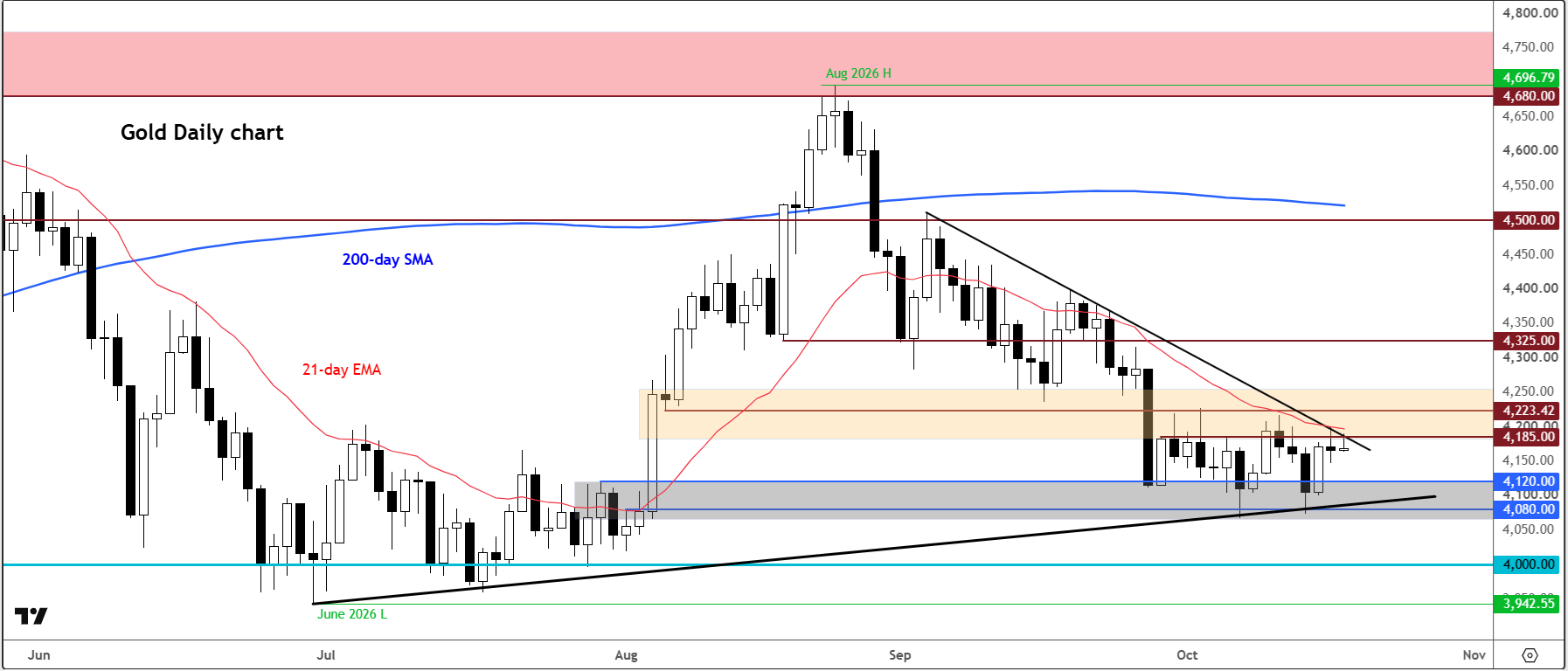
Gold needs to break this trend line before the technical picture starts to improve. Even then, resistance around $4,223-$4,260 would need to be cleared before there is enough evidence to confirm that a more meaningful bottom is in place.
Until then, another bout of selling remains possible for the gold price this week, particularly if oil stays elevated and yields resume their climb. In the longer-run, though, the gold forecast is still bullish.
Related tags:
Latest market news








Web Trader platform
Our sophisticated web-based platform is packed with features.
Open an account today
Experience award-winning platforms with fast and secure execution.
Economic calendar
Related articles

Gold and S&P 500 analysis: What now after Warsh’s hawkish speech?
The dollar surged across the board after the Fed Chair Kevin Warsh surprised with a hawkish-leaning speech at the Jackson Hole summit. All the bearish dollar bets that had been accumulated since last Friday on the back of data weakness and bond market troubles had to be squared and that triggered a short squeeze rally for the dollar. Gold and silver dropped, as a result, as too did bitcoin, while US indices were giving back earlier gains.

EUR/USD forecast: All eyes on Warsh at Jackson Hole - Forex Friday
For much of this week, the EUR/USD has been edging lower with the US dollar regaining some ground after last week’s sell-off that was triggered, in part, by the bond market worries. Investors have been unwilling to bet further against the US dollar so far this week ahead of Kevin Warsh’s keynote speech at the Jackson Hole summit, due later today.

Nasdaq 100 forecast: Tech stocks shine as Nvidia results underpin AI trade
Much of this week’s attention has been on Nvidia’s earnings, and the chipmaker delivered the sort of numbers of investors had been hoping for. US index futures initially wobbled before moving higher overnight, with the results providing a fresh lift to the AI trade