


Gold Update Can XAUUSD Hold Above 4500
As trading comes to a close this week, one of the most relevant themes across financial markets continues to be the strength displayed by gold in the short term. Over the last three trading sessions, the precious metal has gained nearly 7%, highlighting the return of a meaningful bullish bias within the market.
Written by
Julian Pineda
Market Analyst
As trading comes to a close this week, one of the most relevant themes across financial markets continues to be the strength displayed by gold in the short term. Over the last three trading sessions, the precious metal has gained nearly 7%, highlighting the return of a meaningful bullish bias within the market. For now, one of the key factors supporting this move remains the recent weakness in the U.S. dollar, which has allowed gold to recover ground in a consistent manner. As long as this relationship remains in place, buying pressure could continue to play an important role during the upcoming trading sessions.
Is the U.S. dollar starting to lose its dominance?
Several developments this week have continued to reinforce the view of a weaker U.S. dollar. One of them was the release of the Federal Reserve's meeting minutes. Although the document reiterated some concerns regarding inflation, it stopped short of confirming a fully aggressive policy stance for the months ahead. This interpretation continues to be reflected in market expectations for future Federal Reserve decisions, where probabilities currently remain around 60% and 46% that interest rates will remain unchanged at the meetings scheduled for September and October. As a result, the prospect of stable interest rates is regaining traction, a scenario that could be reducing part of the relative appeal of dollar-denominated investments.
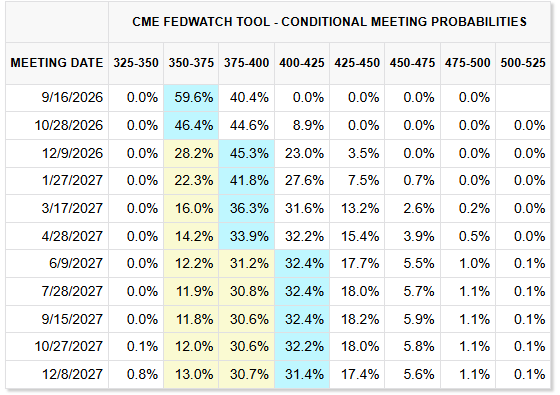
Source: CMEGROUP
Another development that has not been particularly favorable for the U.S. currency was the recent announcement of Treasury buybacks focused on longer-dated bonds. Following the announcement, 30-year Treasury yields temporarily declined toward the 5.00% area. Although yields later recovered part of the lost ground, the dollar has not followed that rebound with the same intensity. This suggests that investors still do not view the increase in yields as a sufficient signal to fully restore confidence in the greenback. Together, a Federal Reserve that appears to be maintaining a wait-and-see approach and the recent developments in the bond market continue to limit the dollar's ability to regain strength in a sustained manner.
In fact, these developments have already begun to have a visible impact on the dollar's performance. The DXY Index, which measures the strength of the U.S. dollar against a basket of major currencies, continues to display a bearish profile and has now moved below the 99-point level. This reflects weaker demand for the U.S. currency in the short term.
Meanwhile, gold has shown almost the opposite behavior. Over recent sessions, the precious metal has managed to maintain a consistent recovery as the dollar has continued to lose ground. This relationship is also reflected in the correlation coefficient calculated over the last 25 trading sessions, which currently remains close to -0.8, highlighting a strong inverse relationship between both markets. It is important to remember that correlation coefficients can change over time.
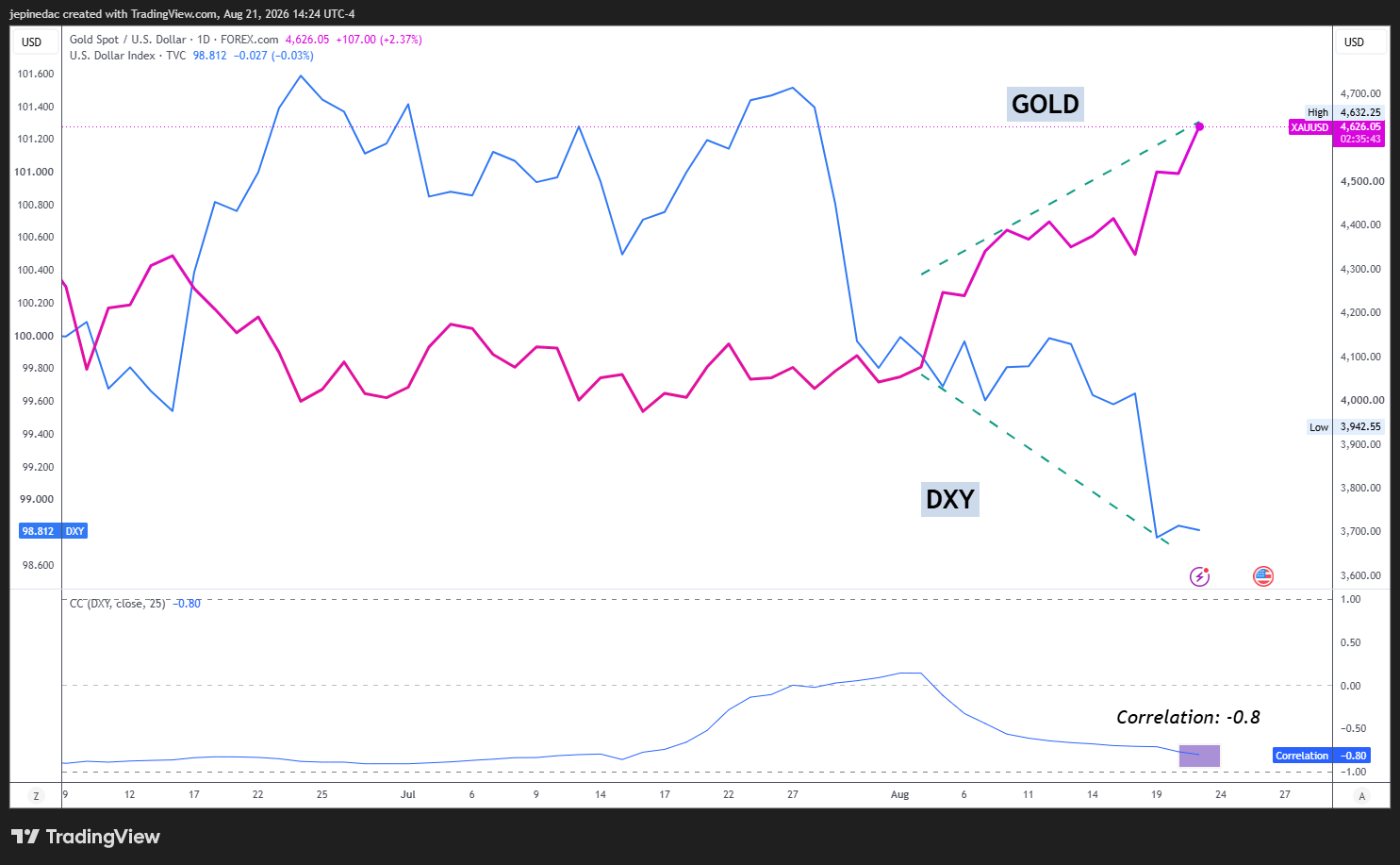
Source: TVC, StoneX, Tradingview
Against this backdrop, the current dynamic is particularly interesting because broad-based weakness in the U.S. dollar appears to be allowing gold to regain prominence as an alternative asset in the short term. In addition, uncertainty is not limited to the dollar itself but also extends to the bond market, another key competitor to precious metals. Together, these factors have contributed to increased activity within the gold market.
This trend can also be observed through futures market activity. During the week, trading volumes increased above the levels recorded the previous week, and on August 19 alone, the number of gold futures contracts traded exceeded 300,000 contracts. This not only reflects growing participation across the market but also coincides with the relative loss of appeal among substitute assets such as the U.S. dollar, a combination that may be supporting renewed interest in gold.
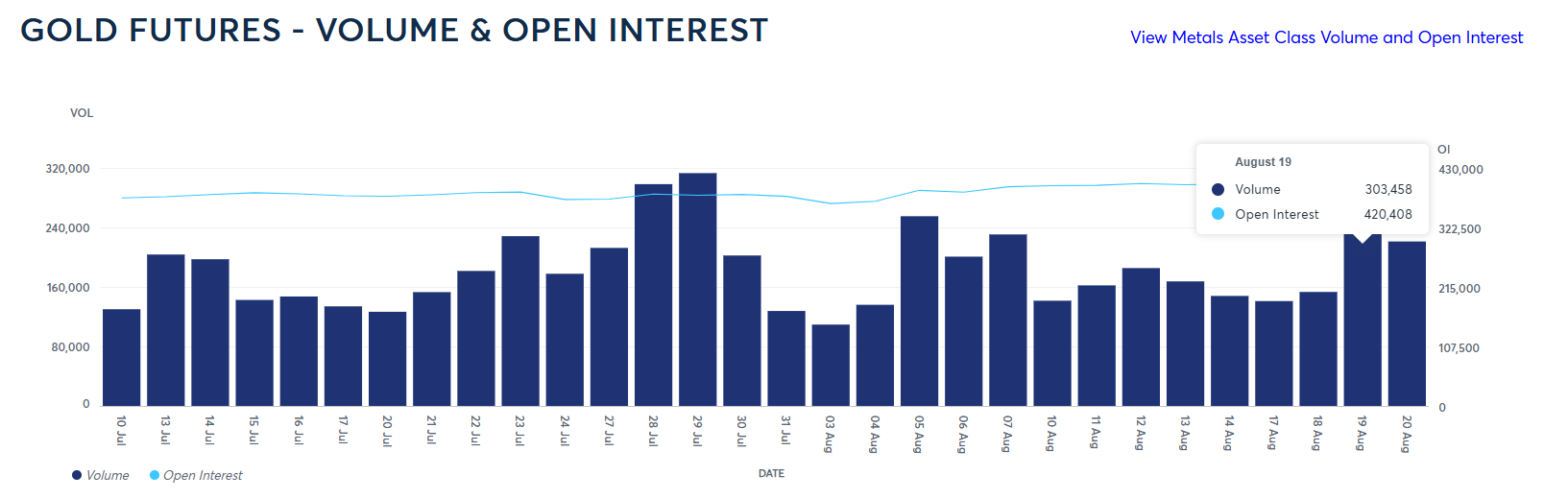
Source: CMEGROUP
Given this environment, gold may continue benefiting from the weakness observed in alternative markets such as the U.S. dollar. If this relationship remains consistent, buying pressure could continue to play an important role in the performance of XAU/USD during the upcoming trading sessions.
Gold Technical Outlook
Source: StoneX, Tradingview
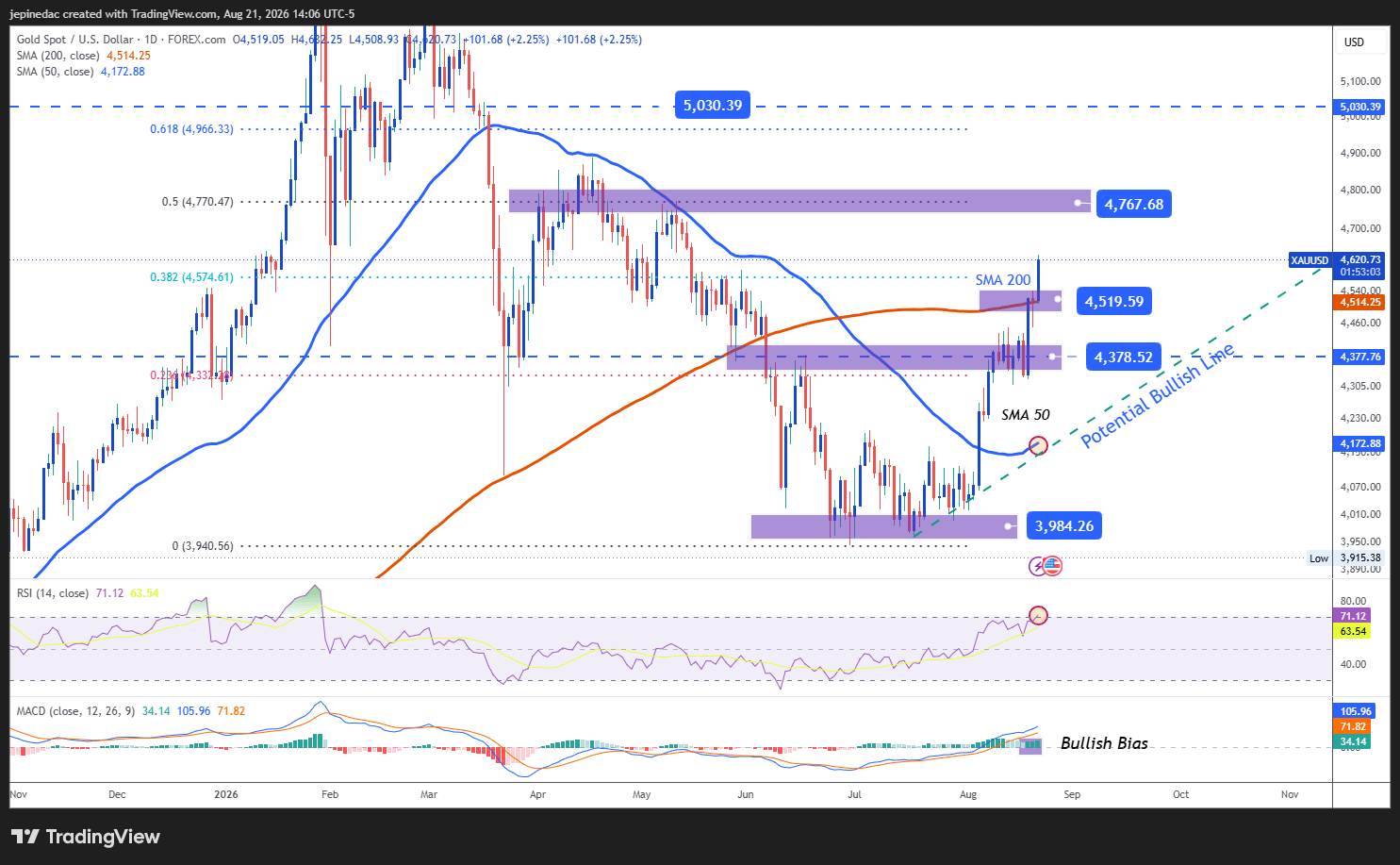
- A New Potential Trend Begins to Take Shape: Price action in recent sessions has started to form a possible short-term bullish trendline. The break above key technical levels, including both short- and long-term moving averages, is beginning to reinforce the significance of this pattern. If buying pressure stabilizes, this structure could gain greater relevance over the coming weeks. However, it is also important to consider that the speed of the recent rally has been considerable, which could leave room for temporary bearish corrections.
- MACD: The MACD histogram continues to post consistent readings above the neutral 0 line. This suggests that the strength of short-term moving averages remains supportive of a dominant bullish bias that could continue to be relevant in the weeks ahead.
- RSI: On the other hand, the RSI has already moved above the overbought threshold defined by the 70 level. This reading could be signaling an excessive buildup of buying momentum, which may eventually create room for short-term corrective pullbacks.
Key Levels to Watch:
- $4,700 – Critical Resistance: A major upside barrier that coincides with the 50% Fibonacci retracement level of the most relevant move on the chart and with highs not seen in several months. This level could become a significant obstacle for the continuation of the current bullish momentum over the coming weeks.
- $4,500 – Nearby Barrier: An important area that coincides with the 200-period moving average and represents one of the key technical levels to monitor should corrective downside movements begin to develop in the near term.
- $4,378 – Critical Support: This level corresponds to an important equilibrium zone observed several weeks ago and represents one of the most significant downside barriers on the chart. Price action that returns toward this area could weaken the credibility of the recent recovery and reintroduce a more pronounced sense of indecision into the market. It could even open the door to the formation of a broader consolidation range in the weeks ahead.
Written by Julian Pineda, CFA, CMT – Market Analyst
Follow him on: @julianpineda25
Latest market news










Web Trader platform
Our sophisticated web-based platform is packed with features.
Open an account today
Experience award-winning platforms with fast and secure execution.
Economic calendar
Related articles

Gold and S&P 500 analysis: What now after Warsh’s hawkish speech?
The dollar surged across the board after the Fed Chair Kevin Warsh surprised with a hawkish-leaning speech at the Jackson Hole summit. All the bearish dollar bets that had been accumulated since last Friday on the back of data weakness and bond market troubles had to be squared and that triggered a short squeeze rally for the dollar. Gold and silver dropped, as a result, as too did bitcoin, while US indices were giving back earlier gains.


Nasdaq 100 Forecast: NDX slips ahead of Fed Chair Warsh’s speech
U.S. stocks are edging lower on Friday, giving back some of yesterday's gains after Nvidia's strong outlook revived the tech trade. The focus has now shifted firmly to Fed Chair Kevin Warsh's Jackson Hole speech, with investors looking for more clarity on the outlook for interest rates.


S&P 500 Forecast: SPX after Nvidia revives confidence in the AI trade
U.S. stocks are heading higher on Thursday, with technology leading the move after Nvidia's stronger-than-expected outlook revived confidence in the AI trade.