


Australian Dollar Outlook: AUD/USD Bounce Losing Steam Ahead of US CPI
AUD/USD's recovery is showing signs of fatigue as traders await US CPI. Options, yield spreads and technicals point to downside risks for the Aussie.
Written by
Matt Simpson
Market Analyst
The Australian dollar enters the week on uncertain footing after its recent recovery began to lose momentum. Australian consumer and business sentiment will be monitored, but the spotlight falls on Tuesday's US CPI report and Fed Chair Kevin Warsh's congressional testimony. While CPI is likely to drive markets, traders will also be listening for any fresh policy signals from Warsh. Futures positioning, options markets and yield spreads point to growing downside risks, although a stronger US dollar may still be needed to trigger a meaningful move lower in AUD/USD.
View related analysis:
- Nasdaq 100 Bulls Seek Swing Low, Though COT Positioning Lacks Conviction
- FX Futures Positioning: US Dollar, EUR, GBP, JPY | COT Report
- Australian Dollar Outlook: AUD/USD Bounce Lacks Conviction, ISM, FOMC Mins Loom
- AUD/USD Outlook 2026: Key Drivers for the Australian Dollar in Q3
- How to Read the COT Report to Track Forex Market Sentiment
Australia This Week: Economic Data and Events for AUD/USD Traders
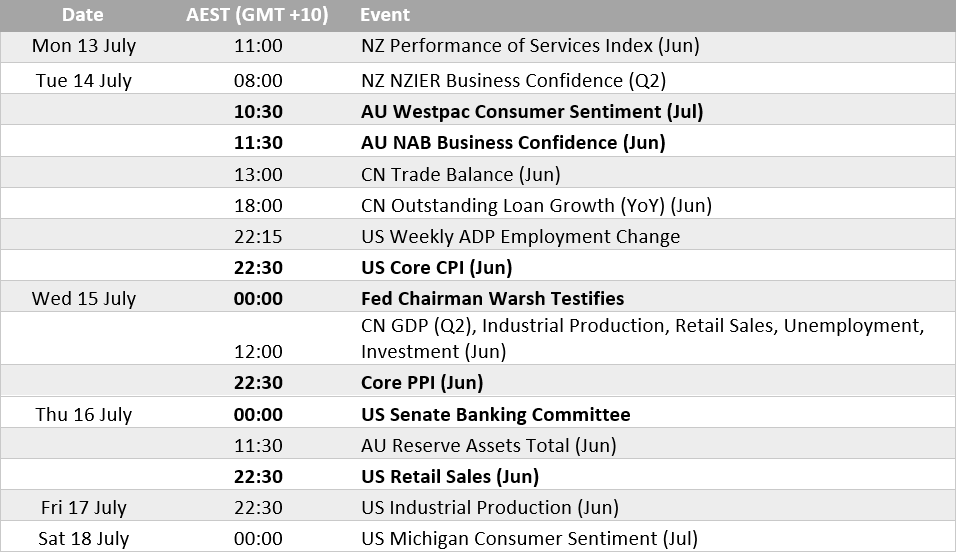
Australian Business or Consumer Sentiment Unlikely to Shift the RBA
I see a lot of data points, but only one or two with real substance. Australian consumer and business sentiment will be worth monitoring, but unless they deteriorate sharply, they are unlikely to be enough for the RBA to abandon its hawkish bias. While business confidence plunged back in March after the RBA’s tightening cycle began, negativity has eased across all industries and the headline figure has recouped around half of its losses from -29 to -14.
The main focus will, of course, be Tuesday's US inflation report. With inflation already expected to rise, the key question is whether the pace of the increase slows. ISM Services Prices Paid edged higher from already elevated levels, and a similar trend has emerged in recent CPI and PPI data. Producer prices and retail sales are also released on Wednesday and Thursday, although their impact will likely depend on whether Tuesday's CPI delivers any surprises.
US CPI Headlines a Busy Week for the US Dollar
Fed Chair Kevin Warsh's testimony before Congress will also be on traders' radar, although it may struggle to compete with US CPI for market attention. As this is one of his first major appearances as Fed chair, markets will be listening for clues on his policy stance and communication style. Unless he signals a meaningful shift in the Fed's outlook for inflation or interest rates, his remarks are unlikely to trigger a sustained move in the US dollar.
China's data dump, alongside Q2 GDP on Tuesday, also warrants a look. However, these releases have had little meaningful impact on global markets or the Australian dollar for some time.

AUD/USD Technical Analysis: Australian Dollar vs US Dollar
AUD/USD Futures Positioning | COT Report
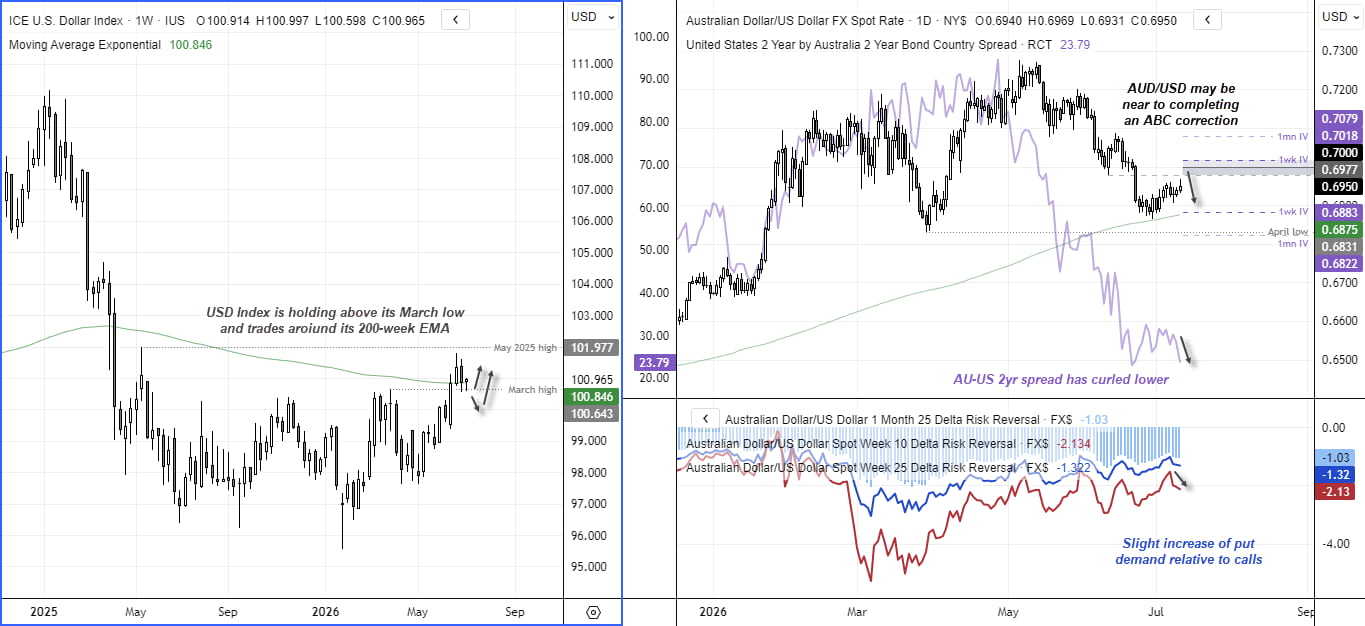
Net-short exposure continued to rise for a fourth consecutive week, although the move was driven primarily by a reduction in long positions rather than a surge in fresh short selling. The 7k increase in net-short exposure among large speculators lifted their bearish positioning to a 30-week high of 25.2k contracts. Asset managers, meanwhile, reduced their net-short exposure by 1.9k contracts.
While neither group is positioned near a sentiment extreme, neither appears especially bearish either. AUD/USD posted another modest bullish week following its extended selloff, and with markets entering one of the quieter periods of the year, volatility is likely to remain subdued unless a fresh catalyst emerges.
Source: CFTC (COT) CME, LSEG
For traders wanting a deeper understanding of futures positioning, I’ve also published a guide on how to read and interpret weekly COT data in forex markets.
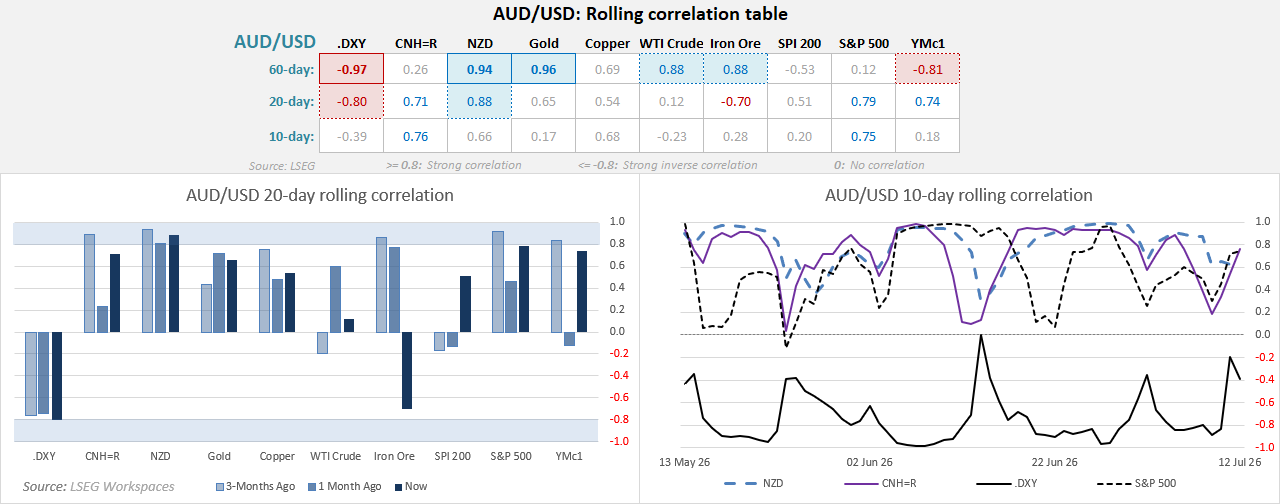
AUD/USD Correlations
Source: LSEG
AUD/USD Technical Outlook: Risk Reversals Turn Bearish as Yield Spread Weakens
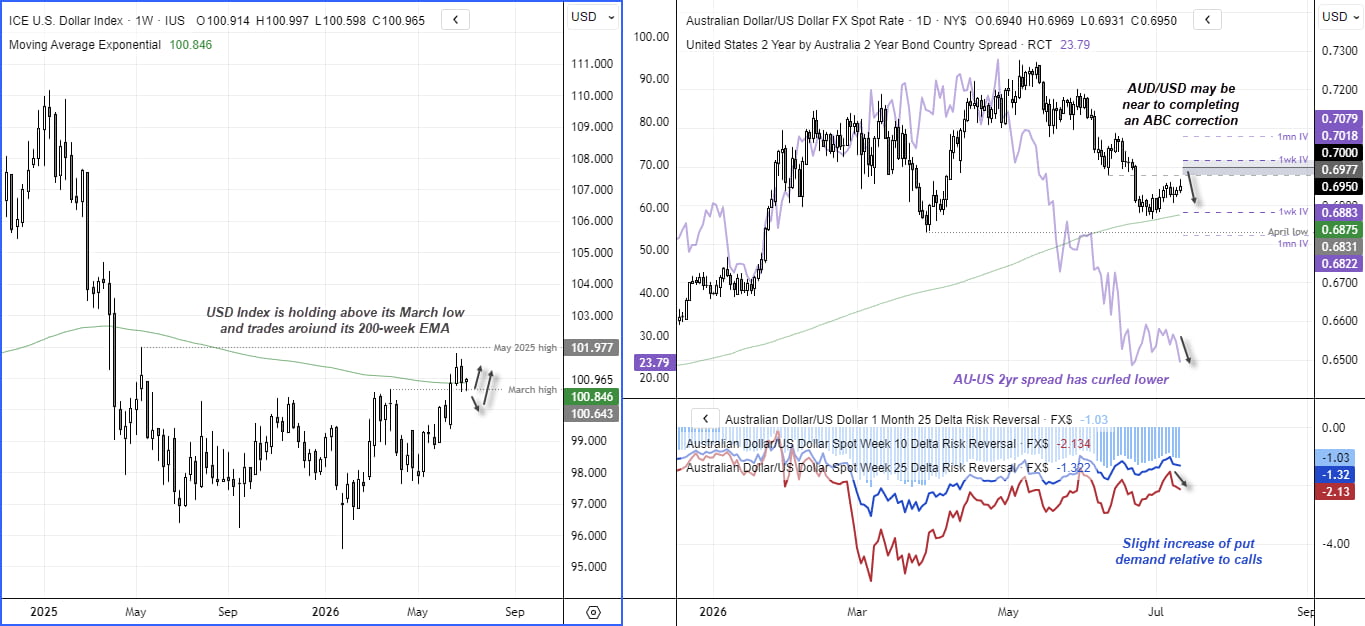
The downtrend on the daily chart remains intact, and bulls already appear to be losing momentum after a modest bounce from just below the 69c handle. Friday's bearish shooting star candle fell short of both the June 11 low (0.6979) and the monthly pivot point (0.6990), suggesting AUD/USD may be nearing the end of a three-wave countertrend bounce around its 20-day EMA.
Risk reversals have begun to turn lower, indicating that demand for puts is rising relative to calls. While they remain elevated relative to AUD/USD prices, the move points to a subtle shift in sentiment among options traders against the Aussie. More importantly, the AU-US two-year yield spread has turned lower and appears on the brink of breaking to a new cycle low. This could prove significant, as the spread led the top in AUD/USD by a couple of weeks.
While this paints a more bearish near-term picture for AUD/USD, a fresh catalyst and a notable rise in the US dollar may still be required before assuming a break below the 200-day EMA (0.6875), which sits near the lower one-week implied volatility band.
The US Dollar Index formed an inside week and a spinning top doji above the March high as prices consolidated around the 200-week EMA. If the index can hold above 100.50, the odds of renewed downside for AUD/USD remain elevated this week.
Source: ICE, TradingView

Australian Dollar Performance Across Major Currency Pairs
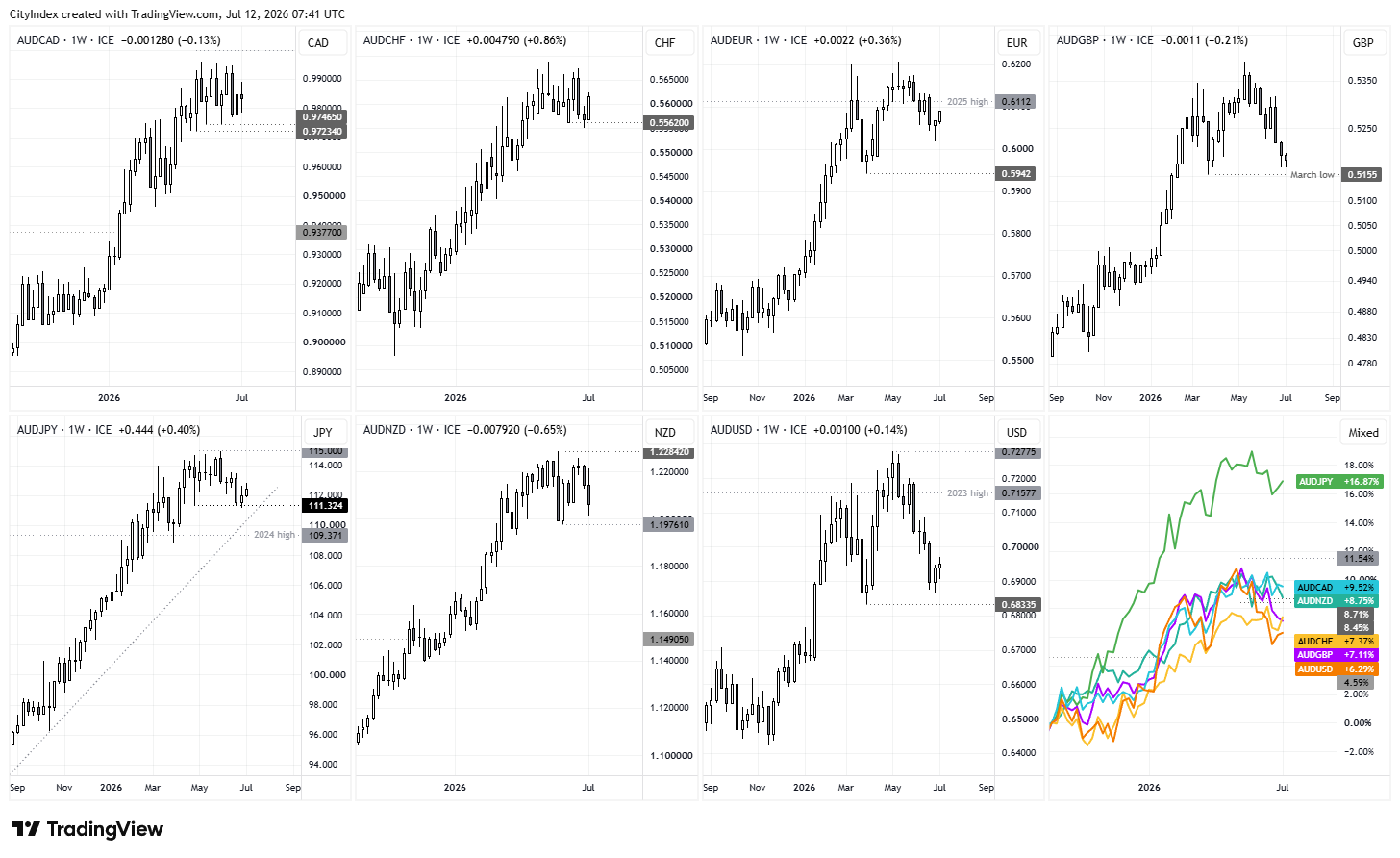
It was another mixed week for the Australian dollar, and a clear game of two halves against its commodity FX peers. This ties in with my suspicion that moves in AUD/USD could remain limited, as the bigger macro trends tend to unfold when a currency's direction is broad-based.
The Aussie was effectively flat against the Canadian dollar, with AUD/CAD mostly trading between 0.98 and 0.99 within a sideways range, despite an otherwise solid uptrend. Yet the Aussie weakened against the New Zealand dollar for a second consecutive week, sending AUD/NZD to a five-week low after the RBNZ meeting, with bears now eyeing a potential break below 1.20.
AUD/EUR rose for a second week as the Aussie gained traction against the euro, and I suspect this could be an early signal for a slightly more bullish AUD/GBP after its third consecutive weekly decline posted a particularly narrow range.
A modest recovery in risk sentiment helped the Australian dollar rise against the safe havens. A weaker yen on Friday also provided support after the Ministry of Finance (MOF) announced that large institutions are being encouraged to buy domestic assets. While the policy is supportive of the yen over the longer term, it was not an intervention. A broadly weaker Swiss franc also helped AUD/CHF climb 0.9% for its best weekly performance in three months.
Source: LSEG
View the full economic calendar
-- Written by Matt Simpson
Follow Matt on Twitter @cLeverEdge
How to trade with City Index
You can trade with City Index by following these four easy steps:
- Open an account, or log in if you’re already a customer
• Open an account in the UK
• Open an account in Australia
• Open an account in Singapore
- Search for the market you want to trade in our award-winning platform
- Choose your position and size, and your stop and limit levels
- Place the trade
Related tags:







Web Trader platform
Our sophisticated web-based platform is packed with features.
Open an account today
Experience award-winning platforms with fast and secure execution.
Economic calendar
Related articles

Gold Falters at Resistance, Grappling With PCE, Month-End Flows and Jackson Hole
Gold has pulled back from resistance after sticky PCE data, with month-end flows and Jackson Hole now shaping the near-term outlook.

AUD/USD Nears 72c as AU and US CPI, Jackson Hole Loom
AUD/USD is closing in on 72c as Australian and US inflation reports collide with Jackson Hole, setting the stage for a potentially volatile end to the week.

ASX 200 Outlook: Jackson Hole Puts Monday Volatility in Focus
ASX 200 volatility tends to rise after Jackson Hole, while sector correlations highlight the clearest support, resistance and leadership signals.