


Australian Dollar Outlook: AUD/USD Wobbles on RBA Hold, US CPI Up Next
The RBA kept rates at 4.35% but retained a hawkish bias. AUD/USD now looks to US CPI for direction as traders scale back RBA hike expectations.
Written by
Matt Simpson
Market Analyst
The RBA held its cash rate at 4.35% as widely expected and maintained its hawkish bias in the statement. It arguably had to do so to help manage inflation expectations. While it closed with a warning of further hikes, it was conditional on “if upside risks materialise”. And with the decision to hold being unanimous, there appears to be no urgency to tighten.
View related analysis:
While the impact of the Middle East conflict has not resulted in the higher inflation feared, the RBA acknowledged that elevated commodity prices continue to pose an inflation risk. Ultimately, inflation remains too high and is unlikely to fall quickly – and that should be enough to expect hawkish holds from the RBA going forward, even if the hawkish bias is viewed as an insurance policy against upside inflation risks rather than signalling an assured move to raise rates.
This provides a mildly bullish case for the Australian dollar, thanks to its higher yield and traders scaling back expectations for Fed rate hikes. But those seeking a more meaningful policy divergence between the RBA and Fed are likely to be disappointed.
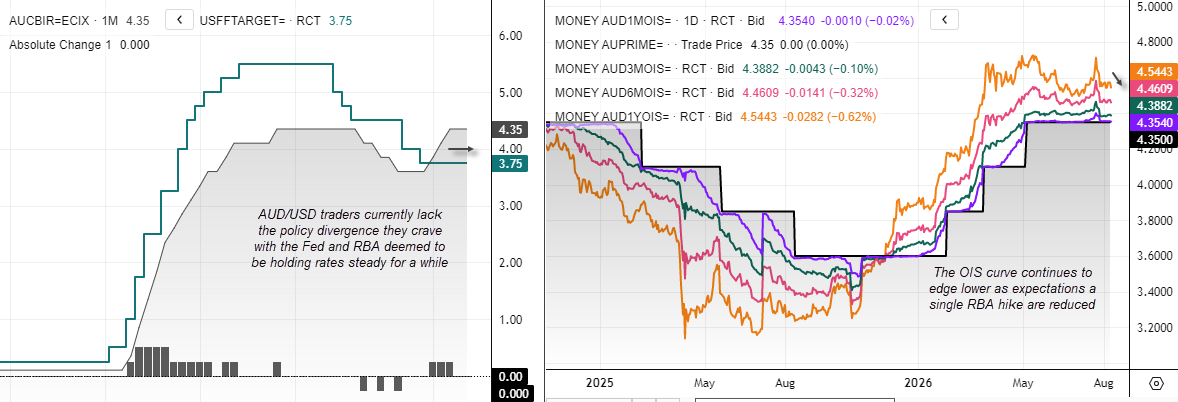
Source: RBA, LSEG
AUD/USD Wobbles as Hawkish RBA Hold Meets US CPI
Money Markets Price Out Further RBA Rate Hikes
- The OIS curve is broadly lower as money markets continue to price out even a single hike a year from now.
- ASX 200 rose 0.4% and trades just beneath its record high, with the prospects of no further hikes deemed as a good sign from local equity traders
- The Australian dollar was a touch lower against all FX majors, aside from thew Swiss franc
- AUD/NZD is leading the way lower among Aussie pairs, down for a second day and 0.2% lower on the day
- AUD/USD is down less than 0.1% from yesterday’s close, making it a low volatility even for the Australian dollar with no policy divergence to lean into
AUD/USD Technical Analysis: Australian Dollar vs US Dollar
The Australian dollar continues to grind higher in a somewhat predictable yet messy way. Notice that AUD/USD seems to print a solid bullish candle every few days, but each time its range loses momentum as it tries to make its way to 71c. The Aussie is currently lower for a second day, though it is hardly showing any signs of strength from the bear camp.
With a mildly bullish fundamental backdrop, Australian dollar bulls may be seeking dips with the 71c handle in sight. But given the hard work it is making of any gains, I am also on guard for a pullback. Perhaps just to its 10-day EMA (0.7032), or the potential support zone between 0.70–0.7128, comprising the 20- and 50-day EMAs and the 70c handle.
Focus now shifts to US CPI data tomorrow, which is likely to have a bigger sway over whether AUD/USD finishes the week above or below 71c.
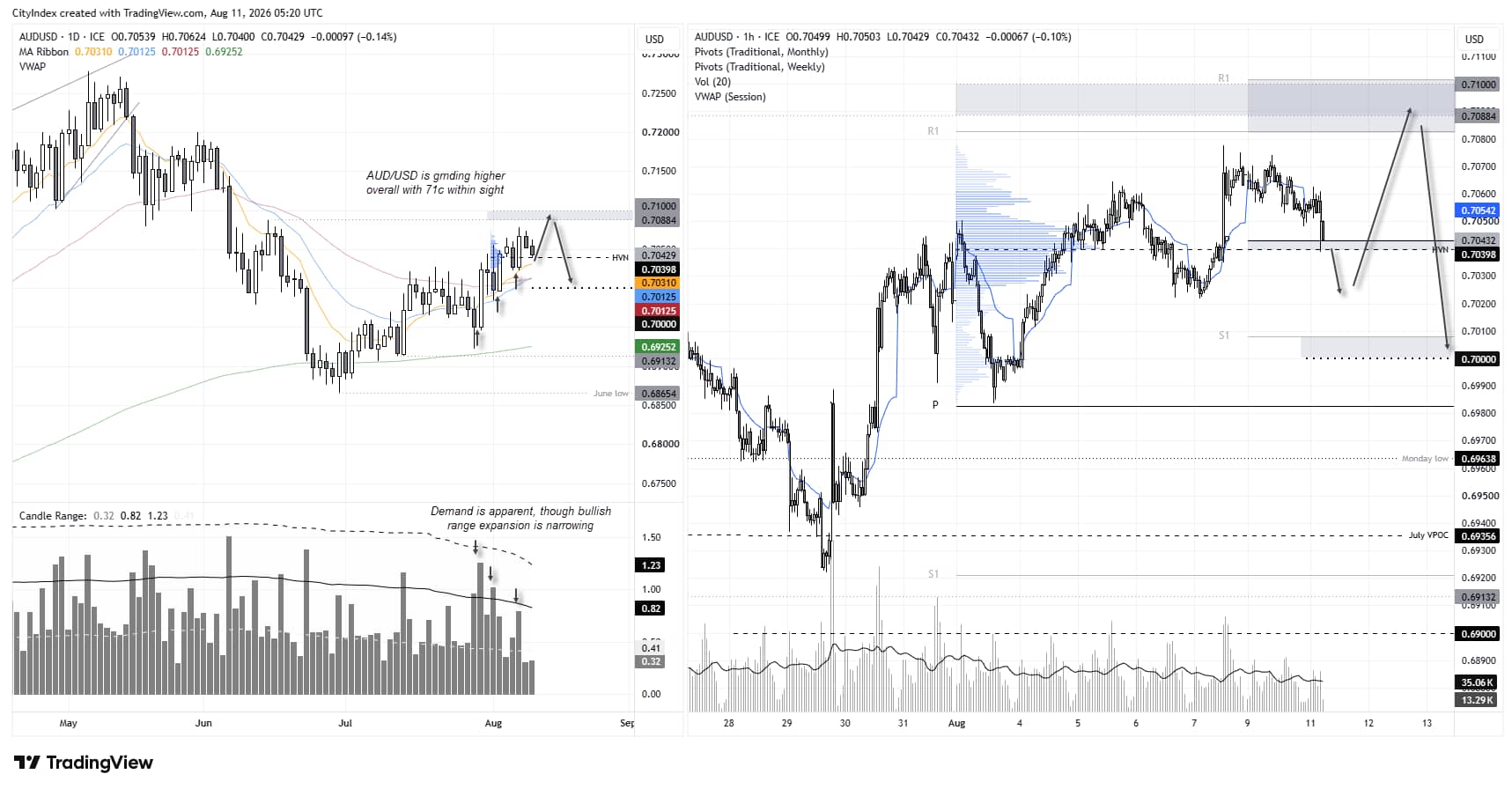
Source: ICE, TradingView

Highlights of the RBA Statement
- RBA held the cash rate at 4.35%, with the decision unanimous.
- Inflation remains too high, with trimmed mean inflation still elevated and little changed from the March quarter.
- The impact of the Middle East conflict on inflation has been less severe than expected, although oil and related commodity prices remain elevated.
- Inflation expectations have eased, but remain higher than earlier in the year.
- The RBA expects inflation to remain high for some time, with inflation not expected to return to around the midpoint of the target range until late 2027.
- Financial conditions have tightened following three rate hikes this year, while consumer spending is slowing as expected.
- The labour market has eased slightly more than expected, although only limited further easing is anticipated in the near term.
- The RBA remains concerned about upside risks to inflation and will raise rates further if those risks materialise.
- With monetary policy judged to be “somewhat restrictive”, the Board opted to hold rates while assessing how the economy evolves.
View the full economic calendar
-- Written by Matt Simpson
Follow Matt on Twitter @cLeverEdge
How to trade with City Index
You can trade with City Index by following these four easy steps:
- Open an account, or log in if you’re already a customer
• Open an account in the UK
• Open an account in Australia
• Open an account in Singapore
- Search for the market you want to trade in our award-winning platform
- Choose your position and size, and your stop and limit levels
- Place the trade
Related tags:
Latest market news









Web Trader platform
Our sophisticated web-based platform is packed with features.
Open an account today
Experience award-winning platforms with fast and secure execution.
Economic calendar
Related articles

EUR/USD forecast: All eyes on Warsh at Jackson Hole - Forex Friday
For much of this week, the EUR/USD has been edging lower with the US dollar regaining some ground after last week’s sell-off that was triggered, in part, by the bond market worries. Investors have been unwilling to bet further against the US dollar so far this week ahead of Kevin Warsh’s keynote speech at the Jackson Hole summit, due later today.


DAX and EUR/USD forecast: Lower energy prices, yields offer support
But the question, of course, is how much further oil prices and bond yields can fall. For now, the combination is supportive of risk assets and is helping to sustain a relatively benign decline in the dollar. The focus today will be on US core PCE inflation, due for release shortly, while Nvidia’s second-quarter earnings will provide another test for risk appetite after the US markets close – not just for US indices but for global tech-heavy indices given the influence Nvidia has over the global tech and AI names.

AUD/USD Shorts Bear the Brunt of Hot CPI, Renewed RBA Hike Bets
Hot Australian CPI revives RBA hike bets, lifts bond yields and adds fresh pressure to crowded AUD/USD short positions.