
Crypto Outlook: Is a More Restrictive Fed Reducing Market Demand Appetite?
As November moves closer to its end, the weakness across the cryptocurrency market continues to stand out in the short term. Most digital assets remain under significant selling pressure and a broad deterioration in demand has become increasingly evident as the market stays sensitive to the growing appeal of more stable alternative markets and the possibility of a more restrictive Federal Reserve in the United States.
Written by
Julian Pineda
Market Analyst
As November moves closer to its end, the weakness across the cryptocurrency market continues to stand out in the short term. Most digital assets remain under significant selling pressure and a broad deterioration in demand has become increasingly evident as the market stays sensitive to the growing appeal of more stable alternative markets and the possibility of a more restrictive Federal Reserve in the United States. This dynamic has been accompanied by a notable slowdown in demand activity and highlights the market's inability to maintain confidence in the face of these developments. As long as these catalysts remain relevant, weakness across the cryptocurrency market could continue to be an important feature during the coming trading sessions.
Is the Fed Becoming the Market's Main Enemy?
One of the most important themes shaping this week's trading activity has been expectations surrounding the U.S. central bank. For several sessions, markets had already been considering the possibility that persistent inflationary pressures could leave room for a more aggressive policy stance in the coming months. However, that expectation gained even more momentum following the release of the minutes from the Fed's October meeting, which revealed that not all policymakers support keeping interest rates unchanged. This development further reinforced the view that a more restrictive monetary policy could become increasingly relevant in the months ahead.
The impact is already visible in current market pricing. For the December 9 meeting, markets are assigning more than a 98% probability to another interest rate increase before year-end. The story goes even further, as the January 27 meeting now carries a probability above 60% for an additional rate hike. This would take the current benchmark rate from around 4.00% to a potential 4.50% by the first months of 2027, reinforcing expectations that the Federal Reserve could be entering a new cycle of rate increases.
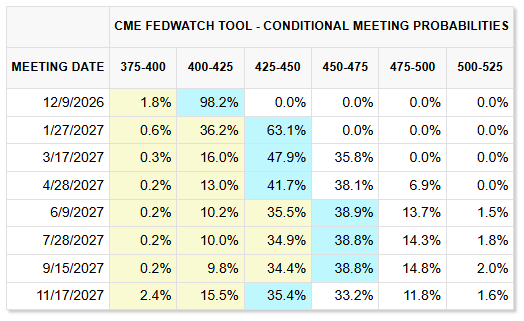
Source: CME
This dynamic could become increasingly concerning for cryptocurrency market confidence because a higher interest rate environment tends to increase borrowing costs and reduce the liquidity available for risk-oriented assets. In addition, uncertainty surrounding a more restrictive monetary policy often favors more stable markets such as the U.S. dollar and the bond market, a situation that could also be reducing the relative appeal of crypto assets. As a result, part of the appetite for risk assets may have been deteriorating consistently over recent weeks.
This trend can also be observed in Bitcoin's demand dynamics. Since expectations for a more aggressive Fed began gaining traction, demand activity around the leading cryptocurrency has shown a consistent deterioration. This can be seen in the behavior of Bitcoin ETFs, which have continued to register meaningful capital outflows since November 9. During this week alone, withdrawals approached $300 million, while no significant inflows have been recorded either in the short term or over the last two weeks. This reflects that demand has weakened not only among retail investors but also within the institutional segment, highlighting Bitcoin's sensitivity to expectations of higher interest rates.
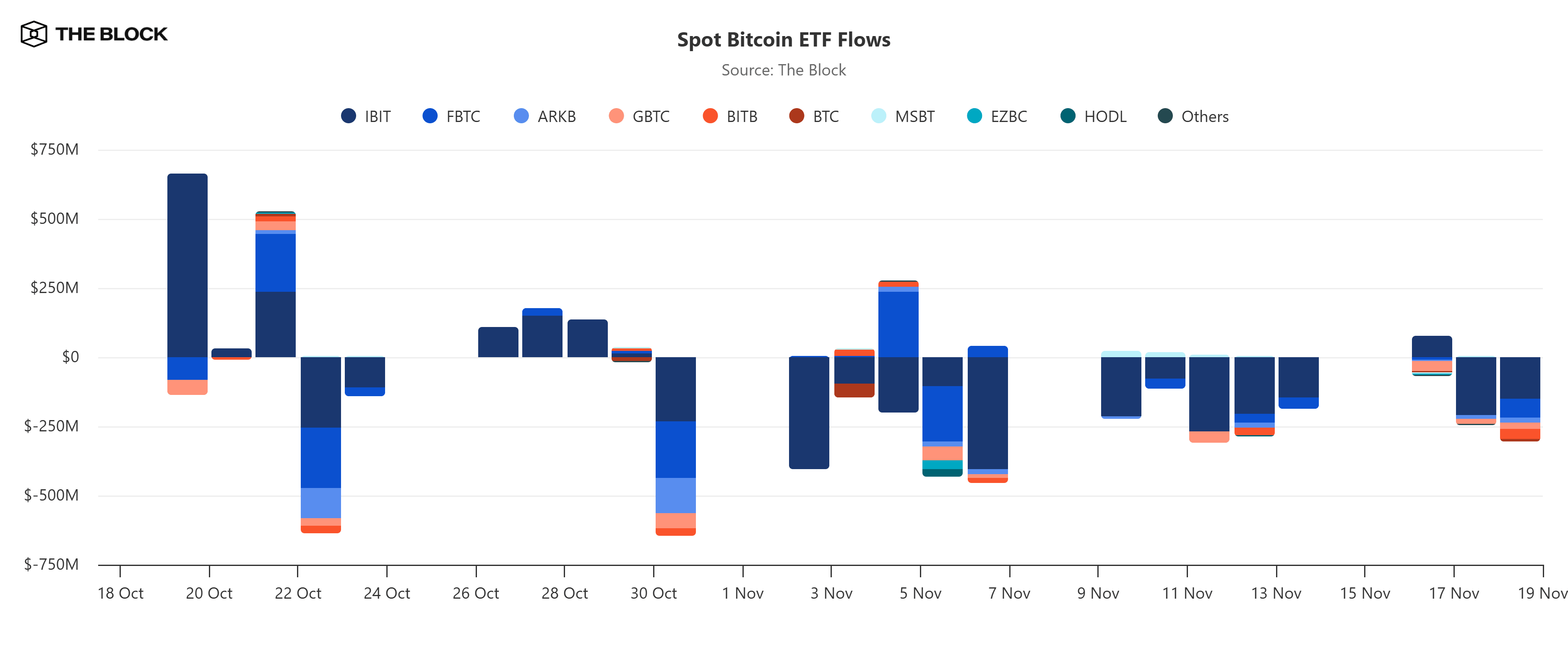
Source: theblock
All of this remains relevant because, as long as uncertainty surrounding a more aggressive Federal Reserve persists, demand appetite for risk markets such as cryptocurrencies could continue to be constrained. This environment may sustain a relatively consistent lack of confidence and continue to reinforce selling pressure across the crypto market during the coming weeks.
Bitcoin Versus Other Markets
The current dynamic is not limited solely to expectations of higher U.S. interest rates. Bitcoin's weakness has also been reinforced by the behavior of alternative markets such as the U.S. dollar. The dollar tends to benefit from a higher-rate environment and often acts as a liquidity-based safe haven, a situation that could be limiting capital flows into assets such as BTC.
This relationship has become increasingly evident in the relative performance of Bitcoin and the DXY Index. At the moment, the correlation coefficient between the two assets remains close to -1 over the last 25 trading sessions, reflecting a particularly strong inverse relationship in the short term. Correlation coefficients can change over time.
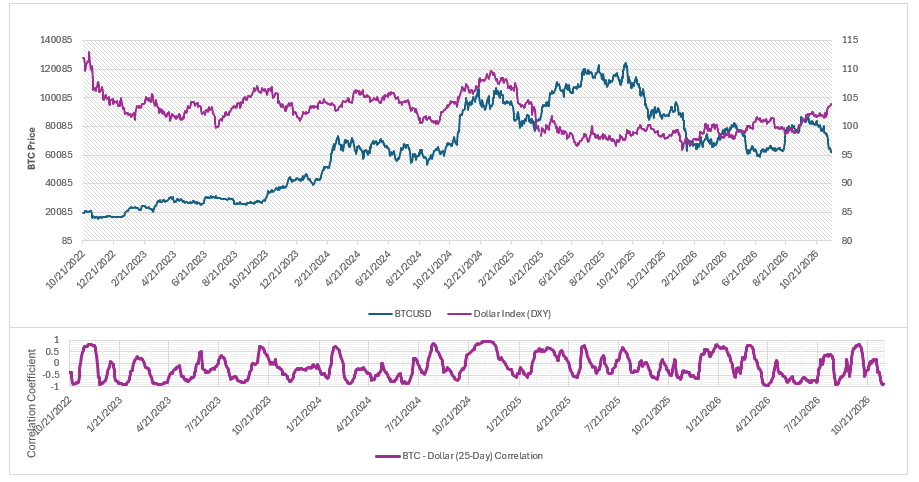
Source: Data – TVC, StoneX, TradingView
This dynamic is especially important because, as the DXY Index continues to reach new highs and reinforce U.S. dollar strength, Bitcoin has responded with a similarly consistent pattern of weakness. This suggests that while markets perceived as more stable continue to gain appeal, risk assets are finding it increasingly difficult to maintain investor confidence. Even Bitcoin, as the leading cryptocurrency, is not currently being viewed as a stability alternative relative to other markets, highlighting a significant slowdown in confidence as safe-haven assets continue gaining prominence.
With this in mind, as long as Bitcoin maintains this strong inverse relationship with more stable alternative markets and those assets continue to gain attractiveness, the broader cryptocurrency market may continue facing difficulties in recovering lost ground. As a result, a potentially bearish phase could remain relevant across the crypto market in the sessions ahead.
Confidence Returns to Extreme Lows
Recent movements in the Fear & Greed Index continue to reflect weakening conditions across the crypto market. The indicator currently stands near 8 points, returning once again to extreme fear territory after the temporary improvement observed several weeks ago.
This development is particularly relevant because it reflects a meaningful slowdown in the optimism that had begun to build during previous weeks and highlights a much more consistent deterioration in confidence across the cryptocurrency market following recent events.
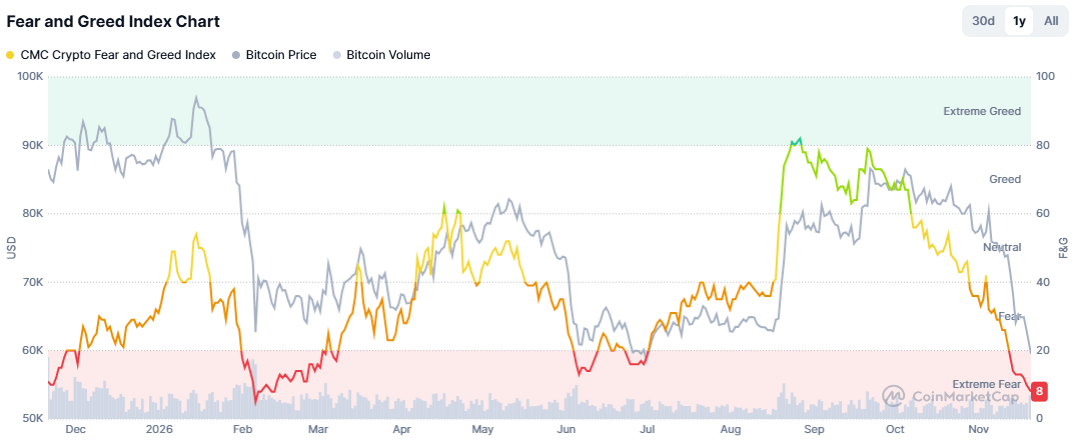
Source: Coinmarketcap
The evolution of this indicator remains important because it serves as a gauge of risk appetite within the crypto market. If confidence continues struggling to recover, it could limit the market's ability to sustain stronger demand and reinforce the perception that part of investor flows continues to migrate toward alternatives considered more stable outside risk assets.
Under this scenario, the loss of momentum observed in sentiment could continue to support the phase of relative weakness that has recently gained prominence across the cryptocurrency market and could remain a relevant factor during the upcoming trading sessions.
Written by Julian Pineda, CFA, CMT – Market Analyst
Follow him on: @julianpineda25
Latest market news










Web Trader platform
Our sophisticated web-based platform is packed with features.
Open an account today
Experience award-winning platforms with fast and secure execution.
Economic calendar
Related articles

USD/JPY Weekly Outlook: AI earnings could overshadow the Fed and BoJ
AI sentiment has become a major driver of US Treasury yields and USD/JPY. With Microsoft, Alphabet and Amazon reporting this week, central bank decisions may have competition for traders' attention.


Bitcoin Forecast: BTC/USD Back to $80K Ahead of Warsh’s Jackson Hole Speech
After surging over $15,000 in the past 10 days alone, there is risk of a near-term pullback if Warsh says anything remotely hawkish at Jackson Hole - what are the levels to watch from here?


Bitcoin, Gold Price Outlook: US CPI & Overbought Risks in Focus
Bitcoin, Gold Price Outlook Following a steep risk-on rally across US equity indices and precious metals, several major markets are approaching critical technical levels as momentum becomes increasingly stretched.