


Gold Update Can XAUUSD start to recover?
The trading week is coming to an end, and although gold has tried to recover in the short term, the move still looks insufficient against the selling pressure that has remained in place over the past few weeks. Over the last five trading sessions, gold is still down close to -3.00%.
Written by
Julian Pineda
Market Analyst
The trading week is coming to an end, and although gold has tried to recover in the short term, the move still looks insufficient against the selling pressure that has remained in place over the past few weeks. Over the last five trading sessions, gold is still down close to -3.00%.
For now, a phase of indecision is starting to stand out in the metal’s price action, as inflation pressures and the possibility of higher interest rates remain important factors for the market. If this backdrop remains in place, XAU/USD could continue to show an indecisive structure over the coming trading sessions.

Are higher rates ahead?
Despite recent comments pointing to progress in Middle East negotiations, the risk of persistent inflation during 2026 remains important for markets. In the United States, annual inflation is already above 4.00% based on May data, a level not seen since 2023 and still far from the Federal Reserve’s 2.00% target. A significant part of this increase is tied to higher energy costs linked to the conflict, a dynamic that could also start to affect regions such as Europe and Canada, where recent data already shows inflation moving higher.
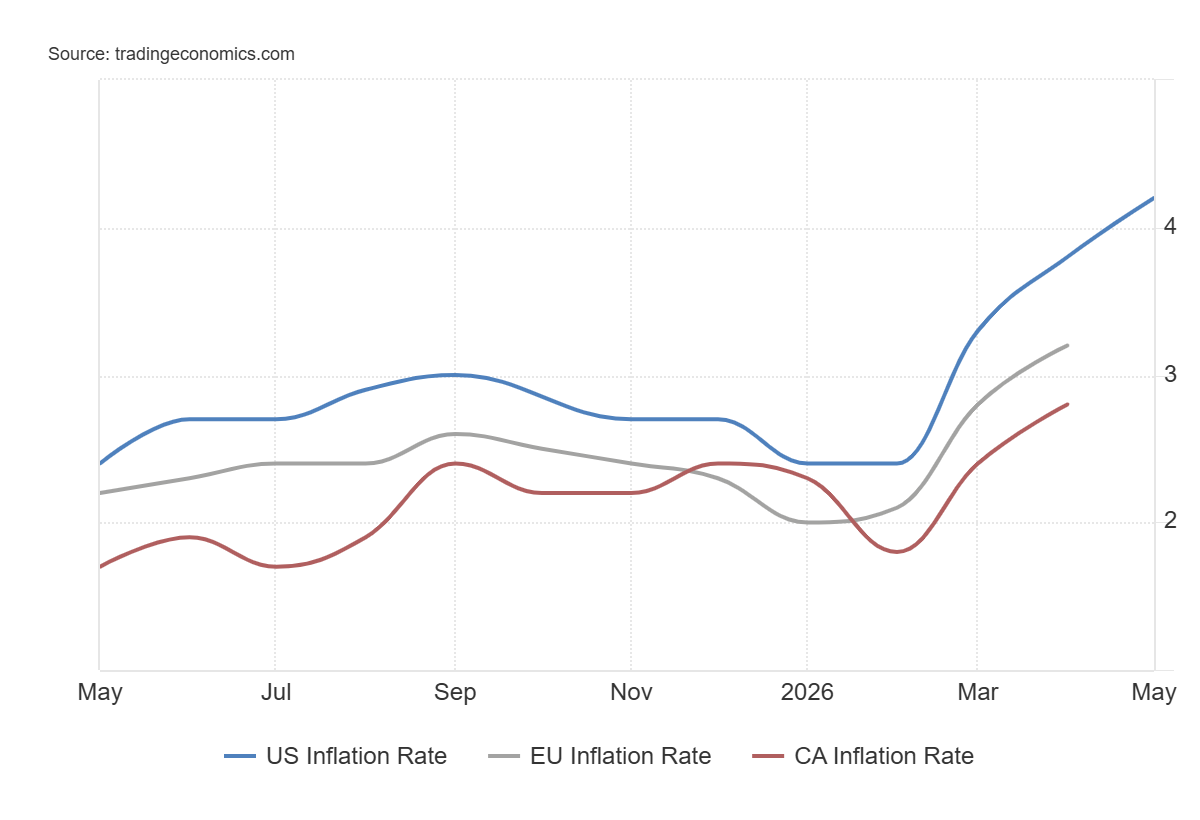
Source: TradingEconomics
This scenario has become especially relevant because more persistent inflation could push central banks to maintain a stricter monetary policy stance. In fact, for the Federal Reserve’s January 2027 meeting, markets are pricing in a probability above 40% of a possible rate increase. If upcoming inflation data continues to show upward pressure, this expectation could move forward in the probability table.
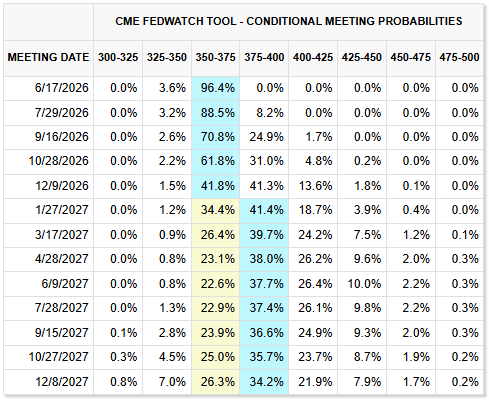
Source: CMEGROUP
For gold, this environment is not entirely favorable. The lack of clear signals of a more flexible monetary policy keeps attention on the bond market, especially 10-year yields, which remain one of the main competing assets for the metal. Part of the recent recovery in XAU/USD has coincided with a mild loss of momentum in US 10-year Treasury yields, and the correlation between both markets remains near -0.7, reflecting a relevant inverse relationship over the last 50 trading sessions. The correlation coefficient can change over time.

Source: StoneX, TVC, Tradingview
However, the recent pullback in yields does not remove the competitive risk for gold. The US 10-year yield remains close to 4.5%, so any Federal Reserve comments pointing to a more aggressive stance could push yields higher again and limit the metal’s recovery, as already happened in previous weeks.
Demand for gold still lacks enough strength to support a sustained recovery. Although futures trading volume increased slightly on June 10 and 11, with just over 220,000 contracts traded per day, the figure remains below the more relevant sessions seen at the end of May, when volume was above 300,000 contracts. This suggests that market activity remains cautious, possibly as investors wait for new central bank signals and the monetary policy decisions expected next week.
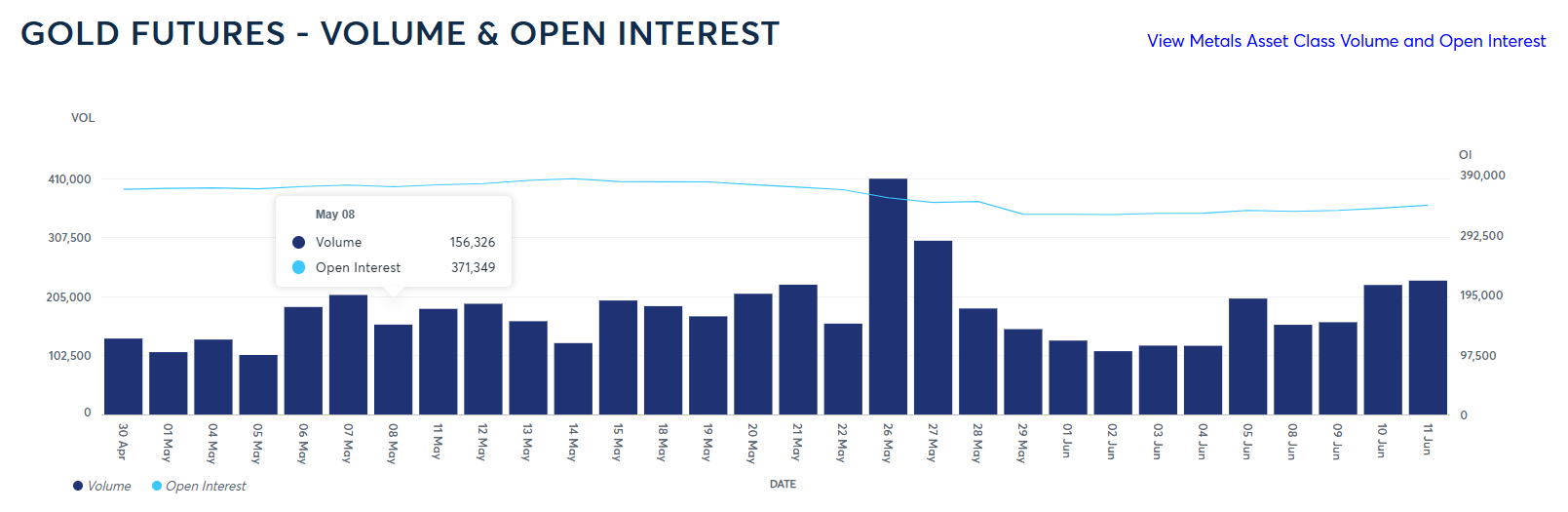
Source: CMEGROUP
Overall, demand for gold still does not seem strong enough to support dominant buying pressure in the short term. If bond yields do not show a more pronounced decline, XAU/USD could continue to struggle to gain ground consistently and may remain in a phase of indecision over the coming sessions.
Technical outlook for gold
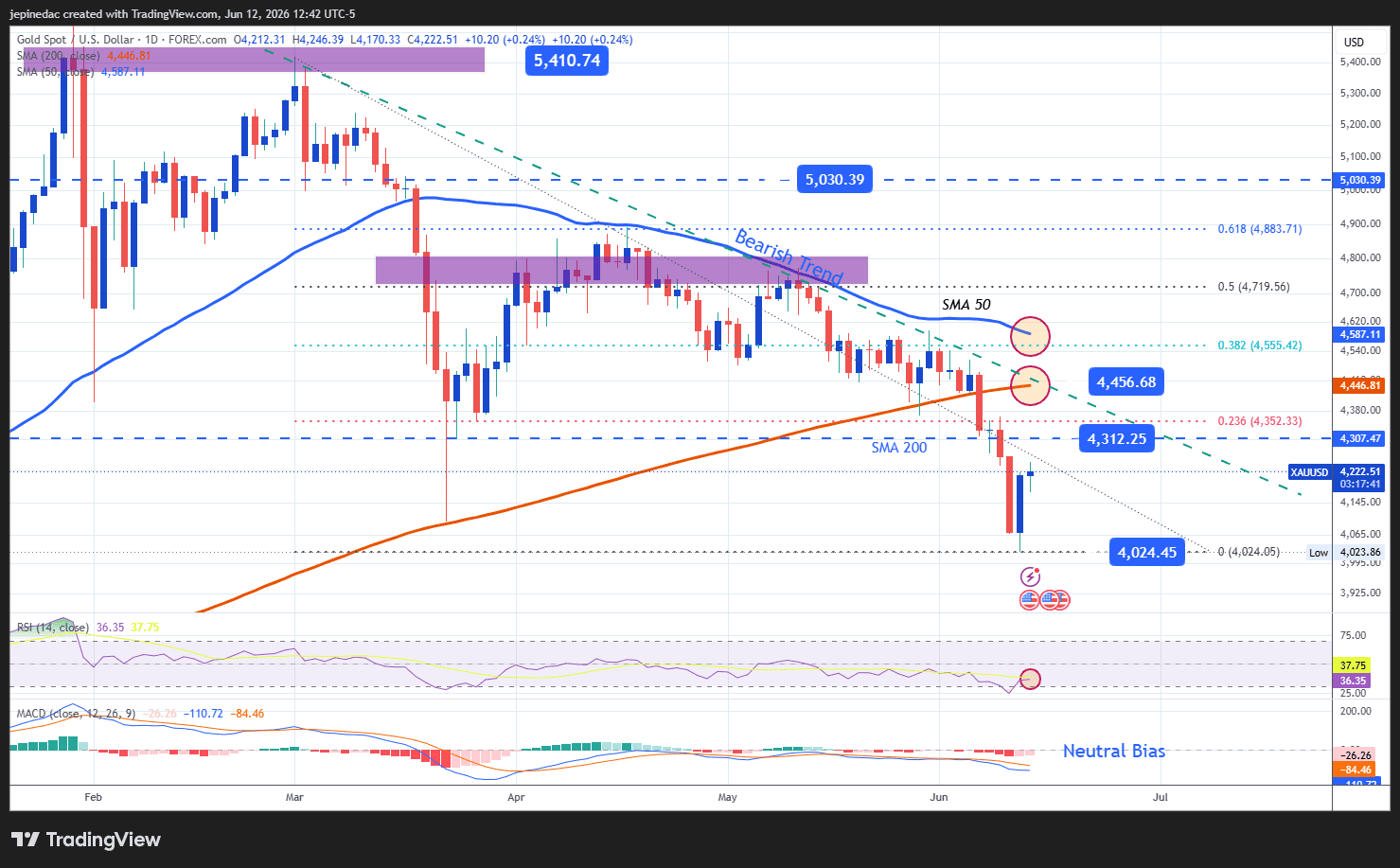
Source: StoneX, Tradingview
- The long bearish trendline remains relevant: Although XAU/USD has tried to recover ground in recent sessions, the current bullish move is still not strong enough to challenge the long bearish trendline that has remained the dominant technical pattern over the past several months. For this reason, unless buying pressure gains more relevance, this trendline could continue to guide gold’s short-term behavior.
- RSI: Now, RSI has started to flatten, pointing to a meaningful loss of bearish momentum. However, it still does not show enough strength to confirm dominant buying pressure on the chart. This dynamic may be starting to highlight a phase of indecision in price action.
- MACD: Meanwhile, the MACD histogram remains too close to the neutral 0 line, suggesting an important balance in the strength of short-term moving averages. This also indicates that a phase of indecision could start to gain relevance in the short term.
Key levels to watch:
- 4,450 USD – Crucial resistance: Relevant high level that aligns with the major bearish trendline and coincides with the barrier formed by the 200-period simple moving average. Price action moving toward this level could start to put the broader bearish structure at risk and open the door to a possible dominant buying bias over the following weeks.
- 4,300 USD – Near-term barrier: Relevant neutral zone that coincides with the 23.6% Fibonacci retracement line. This level could act as a tentative area to watch if bullish corrections continue over the coming sessions.
- 4,000 USD – Critical support: Important low level that coincides with recent lows and represents the most relevant psychological area at the moment. Price action below this level could revive the selling bias seen in previous weeks and give continuity to the major bearish trendline over the coming weeks.
Written by Julian Pineda, CFA, CMT – Market Analyst
Follow him on: @julianpineda25







Web Trader platform
Our sophisticated web-based platform is packed with features.
Open an account today
Experience award-winning platforms with fast and secure execution.
Economic calendar
Related articles

Gold and S&P 500 analysis: What now after Warsh’s hawkish speech?
The dollar surged across the board after the Fed Chair Kevin Warsh surprised with a hawkish-leaning speech at the Jackson Hole summit. All the bearish dollar bets that had been accumulated since last Friday on the back of data weakness and bond market troubles had to be squared and that triggered a short squeeze rally for the dollar. Gold and silver dropped, as a result, as too did bitcoin, while US indices were giving back earlier gains.


AUD/CAD breakout puts the Bradman barrier in sight
A bullish breakout has pushed AUD/CAD to its highest level since early 2021. Whether it can clear 0.9994 may determine if the move extends well above parity.


Gold Pullback Risk Builds as AUD/USD and USD/CAD Set Up
Gold has stalled near major resistance after a powerful rally, while AUD/USD looks stretched and USD/CAD attempts to extend its rebound.
