


S&P 500 Forecast: SPX Falls after hot inflation and as AI debt concerns mount
U.S. stocks are falling after hotter-than-expected readings on producer prices and retail sales, while concerns over AI-related debt are also mounting.
Written by
Fiona Cincotta
Senior Market Analyst
US futures
Dow futures 0.46%, S&P 500 futures -0.45% & Nasdaq futures -1.4%
European futures
FTSE 0.74%, DAX -0.27%
- US stocks head to a mixed open with tech underperforming
- U.S. PPI and retail sales are hotter than expected.
- CoreWeave is at the centre of concern surrounding AI debt.
- Oil falls with Russian developments in focus, although the Middle East conflict limits the downside.
U.S. Stocks Fall as Inflation and AI Debt Worries Weigh on Sentiment
U.S. stocks are falling after hotter-than-expected readings on producer prices and retail sales, while concerns over AI-related debt are also mounting.
Inflation and Retail Sales Keep Pressure on Markets
Data showed that U.S. PPI was hotter than expected, rising 1.3% month on month and 3.6% year on year, according to the figures provided.
The hotter-than-expected PPI reading comes hot on the heels of yesterday’s hotter-than-expected CPI data. Both headline and core CPI were stronger than expected, suggesting that it is not just energy prices pushing inflation higher, but also broader price pressures.
Given that PPI can provide an indication of future consumer price pressures, the latest reading suggests that inflation could remain elevated, particularly if higher input costs are passed on to consumers.
Data also showed that U.S. retail sales rose more than expected, as spending at petrol stations masked mixed spending at other retailers. The value of retail purchases increased 0.8% after rising 1.3% in August. However, sales excluding motor vehicles and petrol rose only 0.2% last month.
Delving deeper into the numbers, an increase in purchases at petrol stations overshadowed consumers pulling back on spending in areas such as hobbies and building materials. The control group, which feeds directly into the government’s calculation of GDP, increased by just 0.1%.
These figures suggest that the consumer paused for breath at the end of Q3, as faster inflation takes its toll on paycheques and squeezes household budgets.
Looking ahead, attention will turn to Federal Reserve Chair Kevin Warsh’s speech at the IMF annual meeting. Markets will watch closely for any clues about the outlook for monetary policy.
AI Debt Concerns Add to Selling Pressure
Markets are also reacting to a sell-off in AI stocks, with CoreWeave, a heavily indebted data centre operator, at the centre of the storm. The stock fell sharply on Wednesday and is under further pressure ahead of the open.
The latest moves suggest that investors are questioning how much future growth is already priced into valuations and how the AI expansion is being financed. The repricing of CoreWeave’s debt suggests investors are becoming less willing to finance AI infrastructure at any cost.
The sell-off in technology and AI stocks has also seen investors rotate into the relative safety of U.S. Treasuries, which offer attractive yields. As a result, the 10-year Treasury yield has dropped below 5.1% to 5.05% at the time of writing, down from a multi-decade high of 5.33% earlier this month.
Corporate Movers
CoreWeave, the cloud infrastructure technology company, is falling for a second day as investors worry that it is borrowing too much to finance its AI buildout.
SK Hynix, the South Korean company, is down 7% as concerns over funding the AI buildout weigh on sentiment. This follows a 7.6% drop in South Korea’s Kospi overnight.
Chipmakers are also losing ground, with Nvidia down 1.7%, while Micron Technology and AMD are down 4.3% and 3.1%, respectively. The broader chip index has lost more than 11% over the last six sessions, its longest losing streak since May 2025.
Walmart is up more than 2% after Deutsche Bank upgraded the stock from Buy to Hold, citing a positive outlook for 2027.
S&P 500 Forecast – Technical Analysis
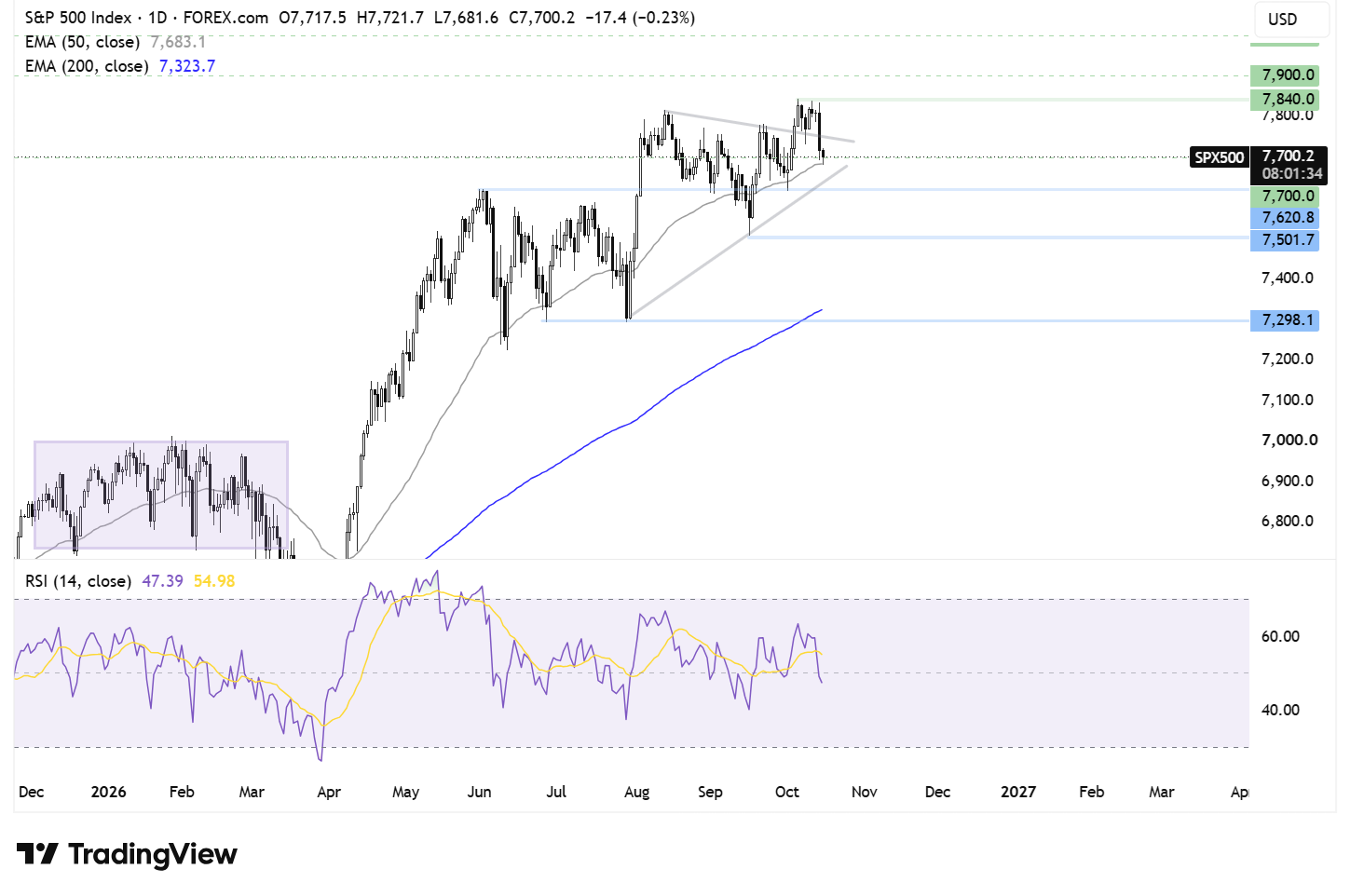
The S&P 500 broke out of a symmetrical triangle pattern, rising to a record high of 7,830 before reversing lower and falling back into the triangle. It is currently testing 7,700, the 50 EMA and the midpoint of the pattern.
Sellers will look to break below the 50 EMA at 7,700 to test rising trendline support at 7,640. A break below 7,615, the October low, would confirm a downside breakout from the triangle pattern.
From here, attention turns to 7,500, the September low.
Should the 50 EMA hold, buyers would need to rise above falling trendline resistance around 7,750 to bring 7,700, 7,840 and fresh record highs back into focus.
FX Markets – Dollar Eases from 18-Month High
The U.S. dollar is falling back from an 18-month high in choppy trade, following a sharp drop in Treasury yields and cautious remarks from Fed officials that have tempered expectations of an October rate hike, despite hotter inflation data.
EUR/USD is rising, recovering to 1.12 after falling to a low near 1.1110 in the previous session, its lowest level in around 18 months. Expectations that the ECB will postpone further rate hikes until December, coupled with concerns that persistent inflation could dampen growth, are keeping the euro’s gains in check. Fiscal uncertainty in highly indebted countries such as France is also clouding the outlook for the euro.
GBP/USD is rising amid a weaker U.S. dollar and after UK GDP data came in stronger than expected. ONS data showed that the UK economy grew 0.1% month on month in August, defying expectations of a 0.1% decline. This follows growth of 0.4% in July, putting output growth on a three-month basis at 0.7%.
Part of this growth came from a 1.2% surge in manufacturing output, its strongest performance since November. The data supports the view that the Bank of England could hike interest rates in November. However, it is worth keeping in mind that these figures do not capture the increase in energy costs and oil prices seen since September.
Oil falls as Russia developments ease supply worries
Oil prices fell 1% on Thursday as steps by the U.S. to ease restrictions on Russia’s shadow fleet tankers helped ease some supply concerns, although attacks on ships in the Middle East kept declines limited.
On Wednesday, U.S. officials said the administration was considering easing sanctions on some of Russia’s unregulated tankers, which could help lower freight costs and support diesel shipments.
These latest developments came after President Trump lifted sanctions on Russian diesel fuel at the weekend.
However, escalating conflict involving Saudi Arabia and Yemen’s Iran-backed Houthis, together with renewed attacks on ships in the Strait of Hormuz, is limiting the downside in oil prices.
Attacks around the Strait of Hormuz have ramped up significantly over the past 10 days, with Iran saying it is stepping up strikes in response to the U.S. blockade of its ports.
Data also showed that U.S. crude stockpiles fell by 11.1 million barrels in the week ending October 9, a much larger draw than expected, providing further support for oil prices.
Latest market news










Web Trader platform
Our sophisticated web-based platform is packed with features.
Open an account today
Experience award-winning platforms with fast and secure execution.
Economic calendar
Related articles

Gold and S&P 500 analysis: What now after Warsh’s hawkish speech?
The dollar surged across the board after the Fed Chair Kevin Warsh surprised with a hawkish-leaning speech at the Jackson Hole summit. All the bearish dollar bets that had been accumulated since last Friday on the back of data weakness and bond market troubles had to be squared and that triggered a short squeeze rally for the dollar. Gold and silver dropped, as a result, as too did bitcoin, while US indices were giving back earlier gains.


Nasdaq 100 Forecast: NDX slips ahead of Fed Chair Warsh’s speech
U.S. stocks are edging lower on Friday, giving back some of yesterday's gains after Nvidia's strong outlook revived the tech trade. The focus has now shifted firmly to Fed Chair Kevin Warsh's Jackson Hole speech, with investors looking for more clarity on the outlook for interest rates.

S&P 500 Forecast: SPX after Nvidia revives confidence in the AI trade
U.S. stocks are heading higher on Thursday, with technology leading the move after Nvidia's stronger-than-expected outlook revived confidence in the AI trade.