


USD/CAD Outlook: Loonie left behind as US CPI looms
USD/CAD's sharp rebound has coincided with widening US–Canada interest rate differentials. With US CPI approaching and bullish momentum building, another breakout may be on the cards.
Written by
David Scutt
Market Analyst
- Canadian dollar badly lags G10 peers on Monday
- Divergent jobs data drives rate repricing
- US CPI threatens further USD/CAD volatility
- Bullish momentum builds beneath 1.4137 resistance
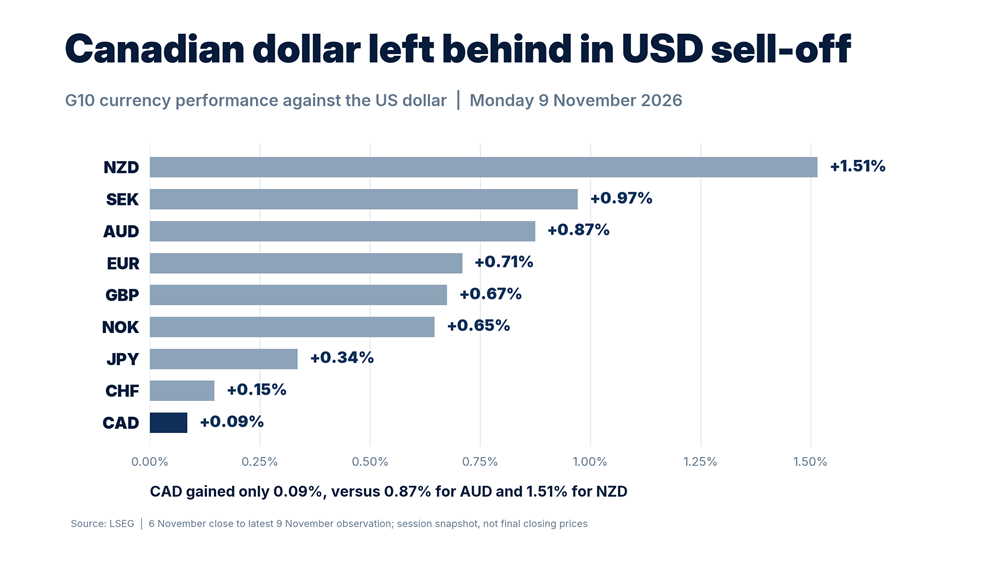
The Canadian dollar was a notable laggard among G10 currencies against the US dollar on Monday, staging a dramatic reversal after strengthening sharply earlier in the session. To put the loonie's underperformance in context, the Kiwi dollar surged more than 1.5%, while the Australian dollar, another commodity-linked currency, gained nearly 0.9%, in contrast to a miserly 0.09% gain for CAD.
While there are plenty of moving parts behind the story, the stark divergence in labour market data released last Friday appears to be continuing to have after-effects on USD/CAD heading into Tuesday's key US inflation report.
Source: LSEG
Friday's jobs data drives rate repricing
While it's now fading into the distance in the rearview mirror, it's clear that Friday's jobs reports on either side of the border continue to influence USD/CAD.
To recap, US nonfarm payrolls surged by 165,000 last month, nearly three times expectations, while unemployment ticked down to 4.1%. Average hourly earnings, which have linkages to domestic services inflation, rose by an impressive 0.4%, with the three-month annualised rate picking up to 3.9%, suggesting wage pressures may be starting to accelerate.
In Canada, the picture was the polar opposite. Employment unexpectedly fell by 4,700 against expectations for an increase of nearly 14,000, marking a third consecutive monthly decline, while unemployment unexpectedly rose to a six-month high of 6.7%. The weakness further calls into question the wisdom of the Bank of Canada's decision to raise interest rates pre-emptively last month over concerns about potential second-round inflationary effects. Put simply, there is little evidence of wage pressures emerging in the Canadian labour market, with substantial slack still evident.
Source: LSEG
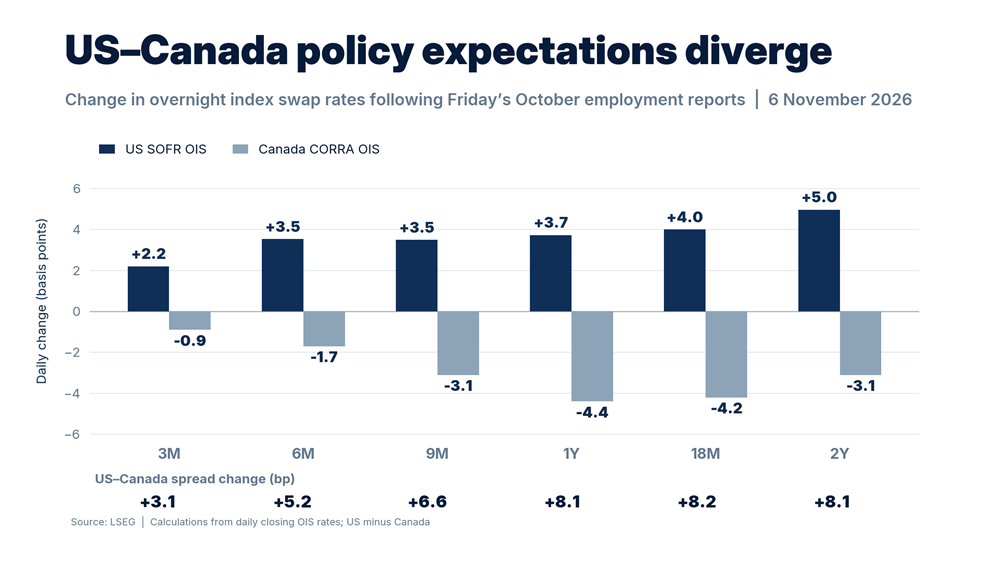
The divergent jobs reports had an immediate impact on the relative interest rate outlooks for the Bank of Canada and Fed. The one-year US–Canada OIS differential widened by 8.1 basis points on Friday, followed by a further 1.9 basis points on Monday, providing a potential explanation for the loonie's stark underperformance.
Relative rates offer a clue to USD/CAD's reversal
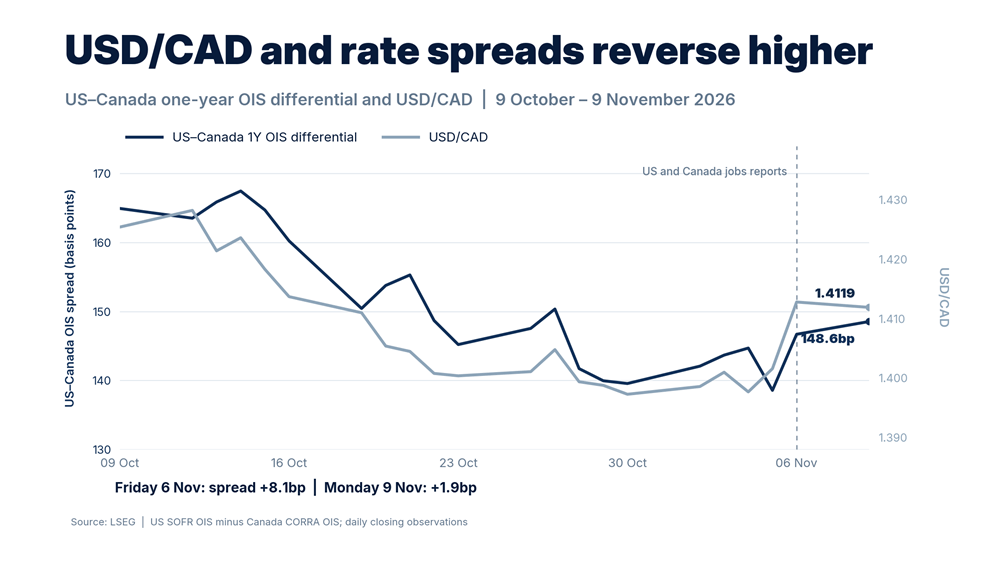
Analysis of LSEG data suggests relative interest rate expectations have been an important influence on USD/CAD movements. Over the past year, the correlation between twenty-session changes in the currency pair and the one-year US–Canada overnight index swap (OIS) differential has been approximately +0.79, indicating a strong positive relationship over longer periods.
While the relationship has weakened considerably over recent weeks, the price action remains consistent with the direction of relative rate movements. The widening in the one-year OIS differential since Friday has coincided with USD/CAD's sharp recovery, as seen in the graphic below. Should relative rates continue to exert a strong influence on the pair, Tuesday's US consumer price inflation report could determine whether Monday's rebound extends or falters during the session.
Source: LSEG
US CPI looms as the next major catalyst
Headline consumer prices are expected to rise 0.25% in October, with core inflation seen increasing 0.22%, according to a survey of economists conducted by the Wall Street Journal. The Bureau of Labor Statistics will not publish year-on-year headline or core inflation rates because of missing October 2025 data resulting from last year's government shutdown.
While market pricing for Fed tightening over the coming year has roughly halved from levels seen a couple of months ago, an inflation report broadly in line with expectations would still leave a strong possibility of another rate hike in December, following the increase delivered in September. Our calculations using SOFR OIS pricing suggest markets are assigning approximately a 74.5% probability to a 25 basis point hike at the next meeting.
An upside inflation surprise, similar to September's report, could all but cement another Fed increase in December, potentially widening US–Canada interest rate differentials further in favour of the US dollar and encouraging additional upside in USD/CAD. Conversely, a downside surprise could see those differentials narrow, undermining the pair's recent recovery.
USD/CAD bulls eye another breakout
Source: TradingView
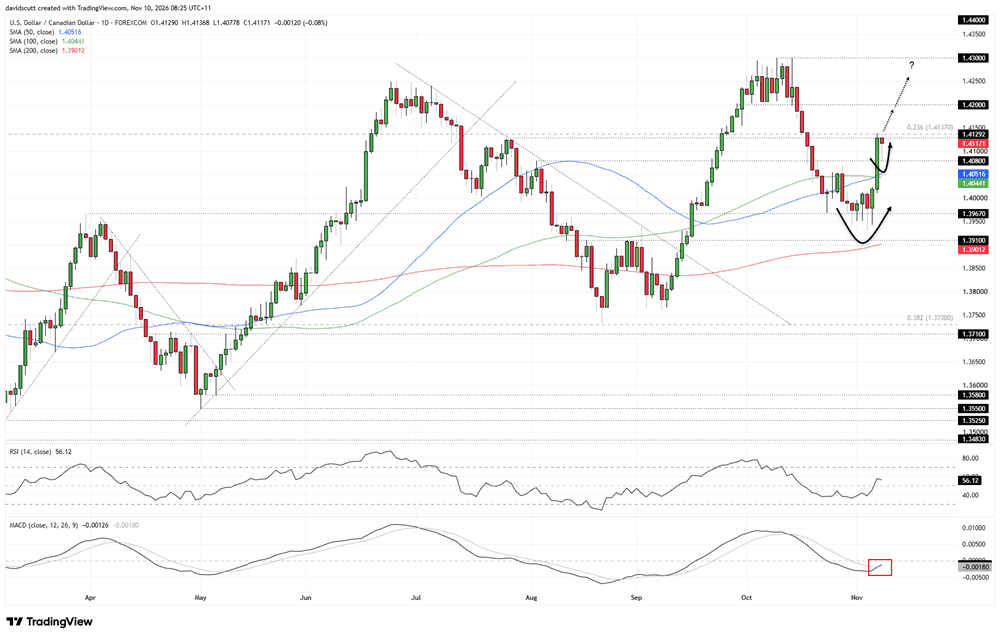
Before the latest leg higher, USD/CAD had repeatedly attracted buying interest on pullbacks towards 1.3967, the swing high set in late March that has acted as both support and resistance on several occasions. The subsequent breakout saw the price reclaim its 50- and 100-day moving averages and clear resistance at 1.4080 before stalling between the July high of 1.4129 and the 23.6% Fibonacci retracement of the June 2021 to 2025 bull move at 1.4137.
What stood out during Monday's session was the sharp rebound after the price retested former resistance at 1.4080. Buyers stepped in aggressively, sending USD/CAD back towards where it began the trading week. Combined with the strength of the preceding rally, the velocity of that rebound suggests bulls may be preparing for another attempt to break higher.
A break above 1.4137 that sticks would put 1.4200 on the radar initially, followed by 1.4300, where the pair stalled on a couple of occasions in October. Alternatively, should resistance between 1.4129 and 1.4137 continue to hold, 1.4080 would be the first level to watch on the downside.
Momentum indicators also mildly favour long setups over shorts. RSI (14) has recovered above the neutral 50 level as bearish momentum has faded and upside momentum has started to build. MACD has also staged a bullish crossover, although it remains in negative territory for now, suggesting a potential shift in momentum is taking place.
Latest market news









Web Trader platform
Our sophisticated web-based platform is packed with features.
Open an account today
Experience award-winning platforms with fast and secure execution.
Economic calendar
Related articles

USD/JPY Weekly Outlook: AI earnings could overshadow the Fed and BoJ
AI sentiment has become a major driver of US Treasury yields and USD/JPY. With Microsoft, Alphabet and Amazon reporting this week, central bank decisions may have competition for traders' attention.

Gold and S&P 500 analysis: What now after Warsh’s hawkish speech?
The dollar surged across the board after the Fed Chair Kevin Warsh surprised with a hawkish-leaning speech at the Jackson Hole summit. All the bearish dollar bets that had been accumulated since last Friday on the back of data weakness and bond market troubles had to be squared and that triggered a short squeeze rally for the dollar. Gold and silver dropped, as a result, as too did bitcoin, while US indices were giving back earlier gains.


EUR/USD forecast: All eyes on Warsh at Jackson Hole - Forex Friday
For much of this week, the EUR/USD has been edging lower with the US dollar regaining some ground after last week’s sell-off that was triggered, in part, by the bond market worries. Investors have been unwilling to bet further against the US dollar so far this week ahead of Kevin Warsh’s keynote speech at the Jackson Hole summit, due later today.