


USD/JPY Analysis: Is the Yen Still Weak Despite the BOJ Rate Hike?
The Japanese yen continues to face challenging conditions in the short term. By the end of the week, USD/JPY had gained nearly 2.00% over the previous five trading sessions, highlighting ongoing weakness in the yen and showing that the U.S. dollar continues to gain ground.
Written by
Julian Pineda
Market Analyst
The Japanese yen continues to face challenging conditions in the short term. By the end of the week, USD/JPY had gained nearly 2.00% over the previous five trading sessions, highlighting ongoing weakness in the yen and showing that the U.S. dollar continues to gain ground. Buying pressure around the pair has remained intact even after the Bank of Japan's latest rate hike, suggesting that markets remain more focused on the prospect of a more aggressive Federal Reserve. As long as this fundamental backdrop remains in place, buying pressure around USD/JPY could continue to play an important role in the sessions ahead.
Can the BOJ Keep Up with the Fed?
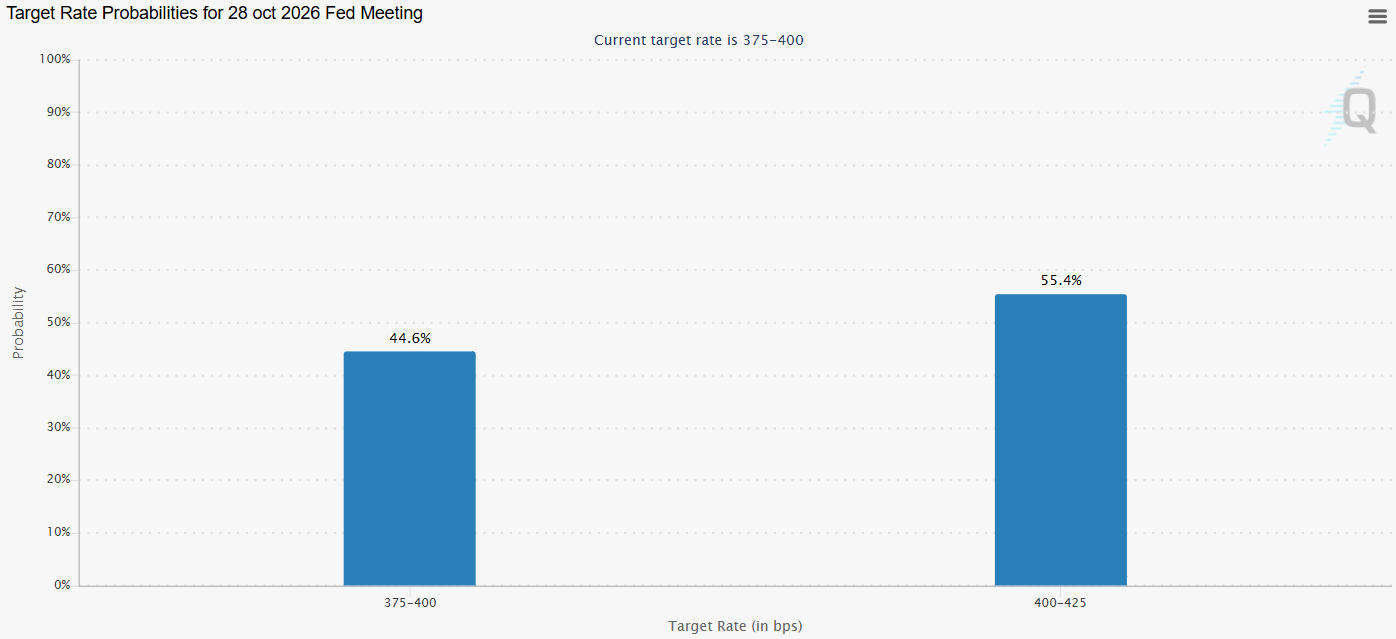
One of the most important events of the week was the Federal Reserve's decision to raise interest rates from 3.75% to 4.00%. The move marked the institution's first rate increase of the year and reinforced expectations of a more aggressive stance in the months ahead. In fact, the CME Group probability tracker still assigns roughly a 55% chance of another increase toward the 4.25% area at the October 28 meeting, highlighting that markets continue to lean toward a more restrictive Federal Reserve.
Source: CMEGROUP
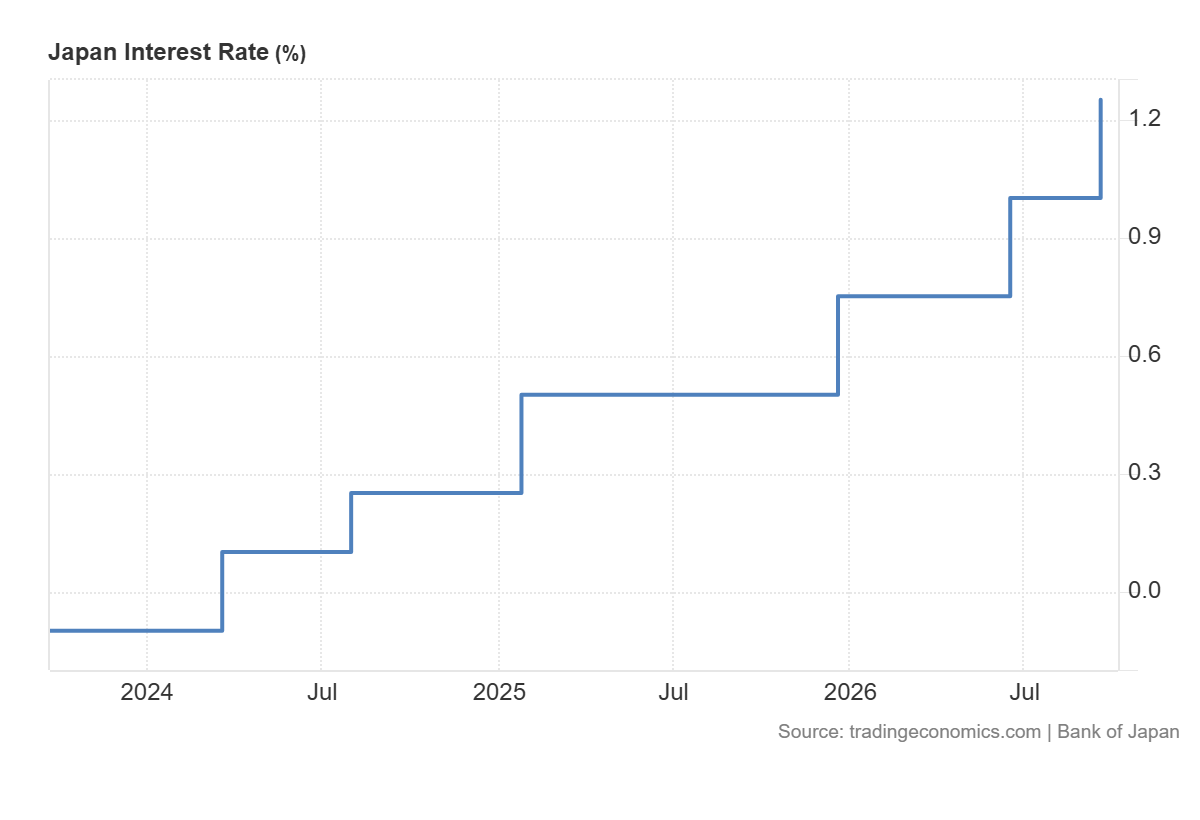
Following that event, the Bank of Japan also announced its latest policy decision, raising rates from 1.00% to 1.25%, the highest level seen in decades. The move reinforces the normalization process that the institution has been pursuing and shows that Japan continues to gradually move away from the ultra-low-rate environment that characterized much of the last several years.
Source: TradingEconomics
In broader terms, a more aggressive Bank of Japan could increase the appeal of yen-denominated investments, as it reflects an important shift in Japanese monetary policy. However, the decision ultimately failed to provide meaningful support for the currency. On one hand, markets had largely priced in the rate hike in advance. On the other, comments from Kazuo Ueda maintained a more cautious tone regarding future tightening. The governor emphasized that there is no predetermined path for accelerating rate increases and left the door open for upcoming meetings to pass without additional changes.
This outlook contrasts with current expectations for the Federal Reserve. While investors continue to anticipate further rate hikes in the United States, the Bank of Japan appears closer to entering a pause phase. This divergence between the two institutions may be limiting the relative attractiveness of yen-denominated investments while continuing to support demand for dollar-linked assets.
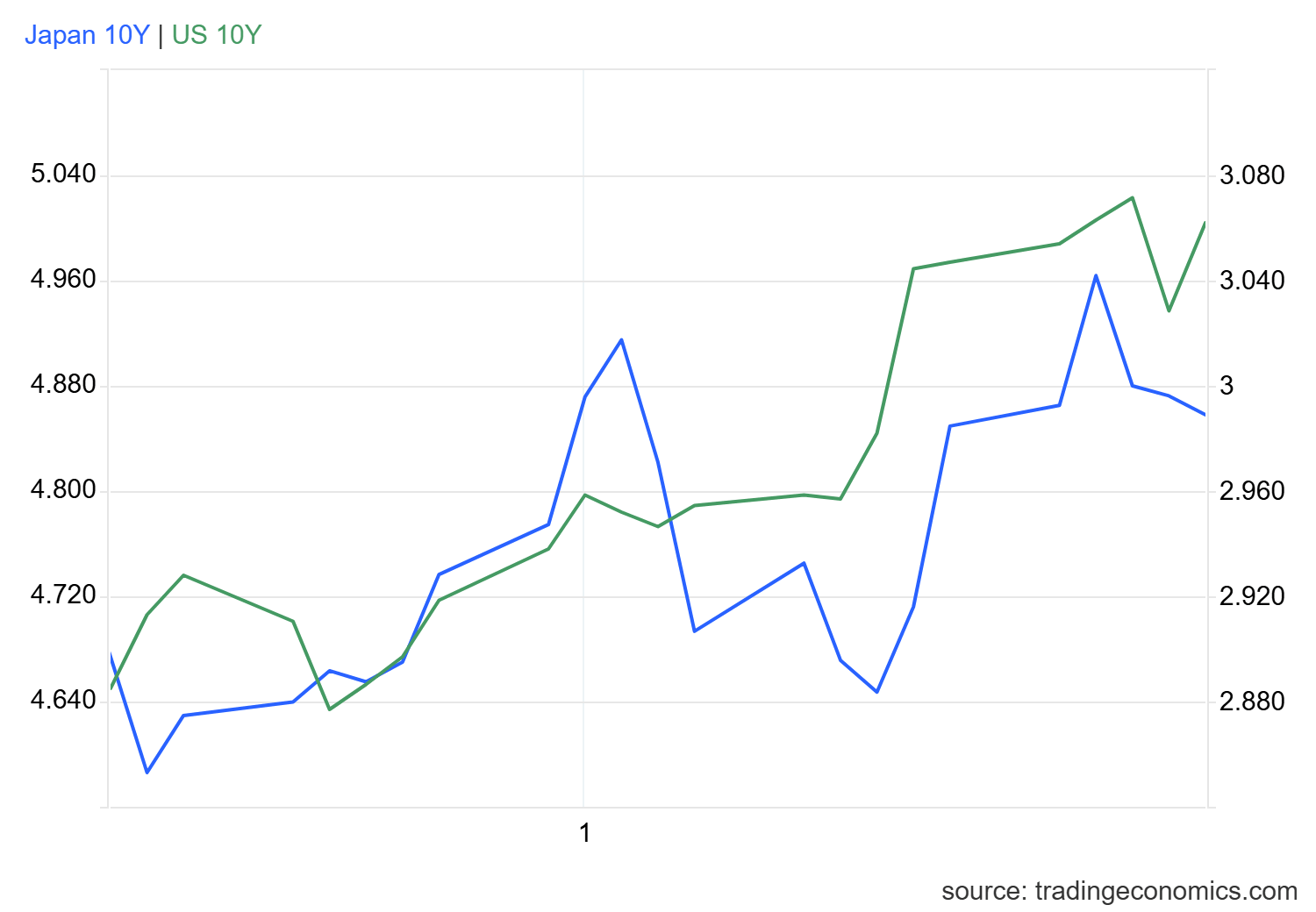
It is also important to monitor the reaction of the bond market following the decisions of both central banks. While U.S. 10-year Treasury yields continue to trade near highs above 5.00%, Japanese bonds of the same maturity have shown renewed weakness and have retreated below the 3.00% area. This suggests that while U.S. fixed-income assets continue to gain appeal, Japanese bonds are still struggling to narrow the yield differential. As a result, the relative advantage remains firmly tilted in favor of the United States.
Source: TradingEconomics
Taking all of this into account, the central bank landscape continues to favor the U.S. dollar. Markets expect the Federal Reserve to remain more aggressive than the Bank of Japan over the coming months, a divergence that could continue to influence bond markets and make it more difficult for the yen to stage a sustained recovery against the dollar. As long as this dynamic remains intact, meaningful buying pressure around USD/JPY could continue to dominate price action in the weeks ahead.
USD/JPY Technical Forecast
Source: StoneX, Tradingview
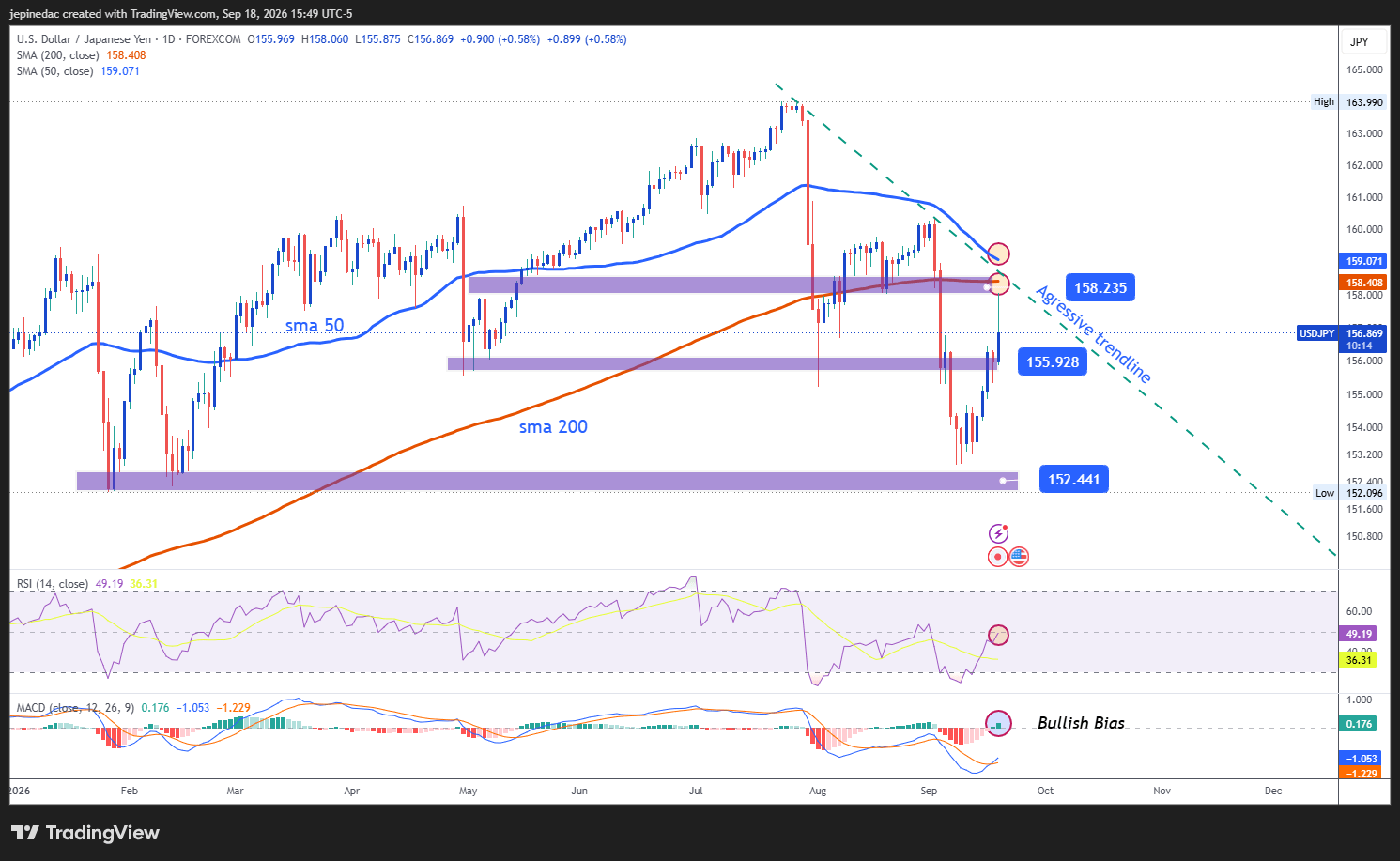
- Trendline Struggles to Hold: Over recent weeks, USD/JPY had been developing a well-defined bearish trendline that emerged as one of the most important technical structures on the daily chart. However, this reference is beginning to lose relevance as the recent recovery in price gains momentum. If selling pressure fails to return over the coming sessions, the structure could lose influence and open the door to a more established bullish move over the weeks ahead.
- RSI: The RSI continues to trend higher and is now approaching the 50 neutral level. This reading suggests that buying momentum over the last 14 sessions is becoming increasingly relevant and, if this behavior persists, could signal a stronger bullish bias around USD/JPY.
- MACD: A similar picture can be observed in the MACD, whose histogram continues to trade above the 0 neutral line. This reading indicates that the average strength of shorter-term moving averages remains constructive and reinforces the possibility of a more consistent bullish bias during upcoming sessions.
Key Levels:
- 158.23 – Key Resistance: This level coincides with important retracement areas from previous weeks and the 200-period simple moving average. Price action above this level could bring an end to the bearish structure seen in recent weeks and open the door to a more meaningful bullish bias on the daily chart.
- 55.92 – Near-Term Barrier: This is the closest relevant retracement zone and remains the primary level to monitor in the event of short-term corrective pullbacks.
- 152.44 – Major Support: A key support area that coincides with lows not seen since February of this year. A move back toward this level could restore relevance to a bearish bias that has recently faded and extend the downward trend as the dominant structure over the coming weeks.
Written by Julian Pineda, CFA, CMT – Market Analyst
Follow him on: @julianpineda25
Latest market news











Web Trader platform
Our sophisticated web-based platform is packed with features.
Open an account today
Experience award-winning platforms with fast and secure execution.
Economic calendar
Related articles

FX Futures Positioning: Dollar Rebound Meets Diverging Forex Bets | COT Report
US dollar longs held firm into Jackson Hole, while euro, yen and commodity FX positioning diverged ahead of ISM and NFP.


EUR/USD forecast: All eyes on Warsh at Jackson Hole - Forex Friday
For much of this week, the EUR/USD has been edging lower with the US dollar regaining some ground after last week’s sell-off that was triggered, in part, by the bond market worries. Investors have been unwilling to bet further against the US dollar so far this week ahead of Kevin Warsh’s keynote speech at the Jackson Hole summit, due later today.


DAX and EUR/USD forecast: Lower energy prices, yields offer support
But the question, of course, is how much further oil prices and bond yields can fall. For now, the combination is supportive of risk assets and is helping to sustain a relatively benign decline in the dollar. The focus today will be on US core PCE inflation, due for release shortly, while Nvidia’s second-quarter earnings will provide another test for risk appetite after the US markets close – not just for US indices but for global tech-heavy indices given the influence Nvidia has over the global tech and AI names.