


Weekly Equities Forecast: Costco, JD Sports & Strategy
Earnings Costco, JD Sports report earnings and crypto stocks are in focus with after Friday's SEC announcement which boosted BTC.
Written by
Fiona Cincotta
Senior Market Analyst
Costco Q4 earnings preview
The wholesale retailer will announce earnings on September 24 after the market close.
Expectations are for revenue to come in between $94.85 billion and $94.89 billion, up around 10% year-on-year, whilst adjusted earnings are expected at EPS of $6.54-$6.55 per share, marking around a 12% increase.
This comes as Costco has continued to deliver strong sales growth for full-year 2026. Net sales were reported at $297.3 billion, up 10%, whilst comparable sales increased 8.4%, and digitally enabled comparable sales were up 20.7%. However, there is some sign that the underlying growth rate could be slowing.
A key focus will be membership growth, which will provide clues over whether the company's sales growth is being supported by a growing and increasingly engaged customer base.
In Q3, membership-fee revenue rose to $1.37 billion, up from $1.24 billion. Meanwhile, renewal rates will show whether members continue to see enough value in the Costco proposition to pay the annual fee again.
The question is whether growth is strong enough to justify the premium valuation. With shares trading at $894, the stock is trading at roughly 45x trailing earnings.
How to trade Costco earnings
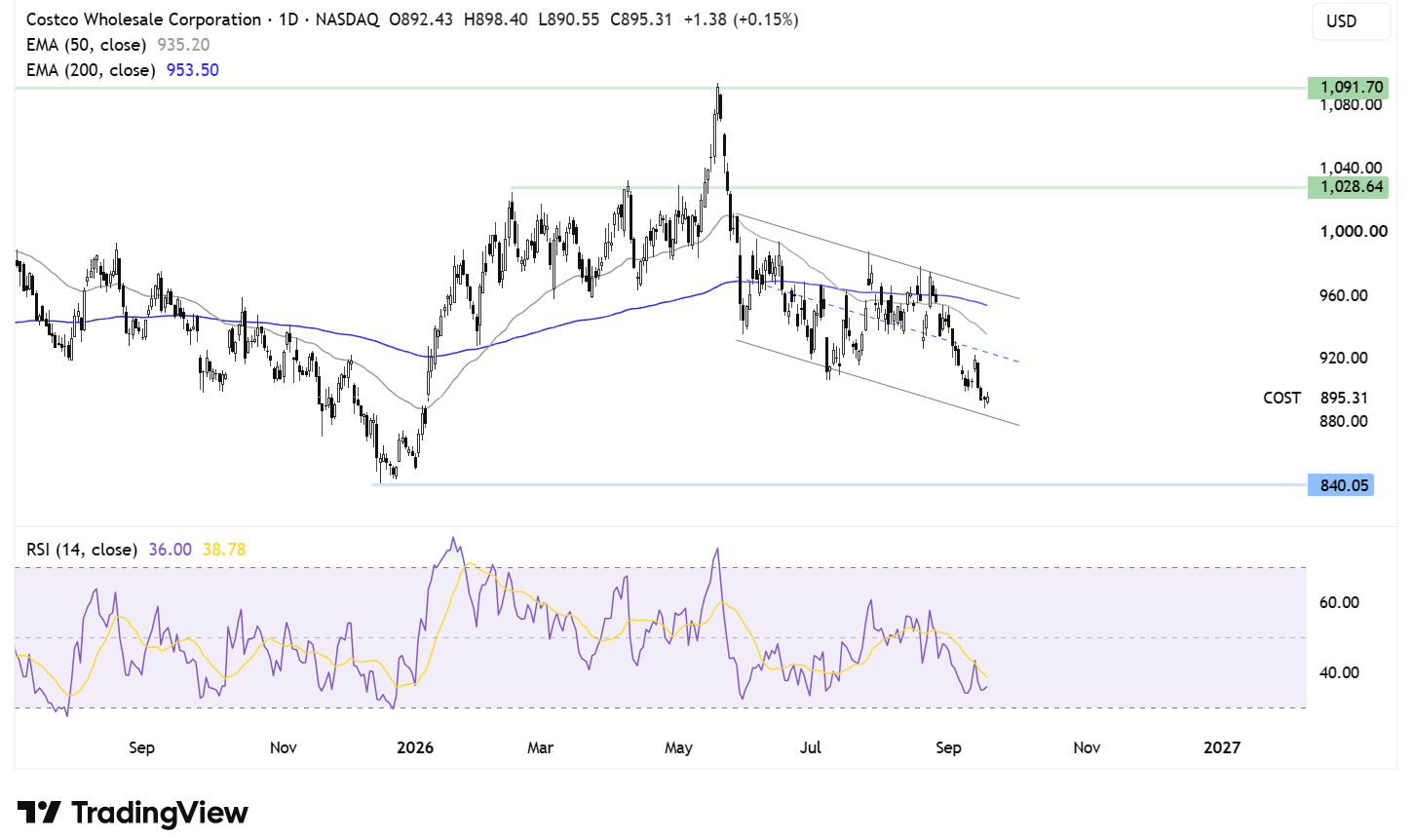
Costco trades in a descending channel below its 50 and 200 EMAs and at its lowest level since early January.
Immediate support is seen at $881, the lower bound of the falling channel, before attention turns to $840, the December 2025 low.
On the upside, buyers will look for a rise above the 50 EMA at $937 and the 200 EMA at $955 before attention turns to $964, the upper band of the falling channel. A rise above here would turn the outlook more constructive.
JD Sports half-year earnings
JD Sports will report results on September 23 ahead of the UK market open and will provide signals over the health of the consumer, despite continued pressure from higher prices and the increasing cost of living.
The results come against a mixed backdrop for the UK consumer. Retail sales rose 0.5% month-on-month in August, recovering from a 0.5% decline in July and ahead of expectations for a 0.2% fall. Clothing stores also saw a recovery in August after a weaker July.
However, with inflation rising to 3.1% amid higher energy and food prices, pressure is building on household budgets. Meanwhile, the UK labour market is showing signs of weakening. Together, this paints a less positive picture for a discretionary retailer such as JD Sports.
If consumers are becoming more cautious, it could show up in JD's results. Margins will also be important, with investors likely to watch the promotional environment. Consumers may be under pressure but can still spend and are simply becoming more price-sensitive, which may see JD increase promotions to maintain sales growth.
North America will be a key focus too. This is an increasingly important part of JD's business, and any evidence of weakening discretionary demand in the region could have a larger impact on the group's outlook.
The market will be watching to see whether the weakness is just a blip or the start of a new trend.
How to trade JD Sports earnings
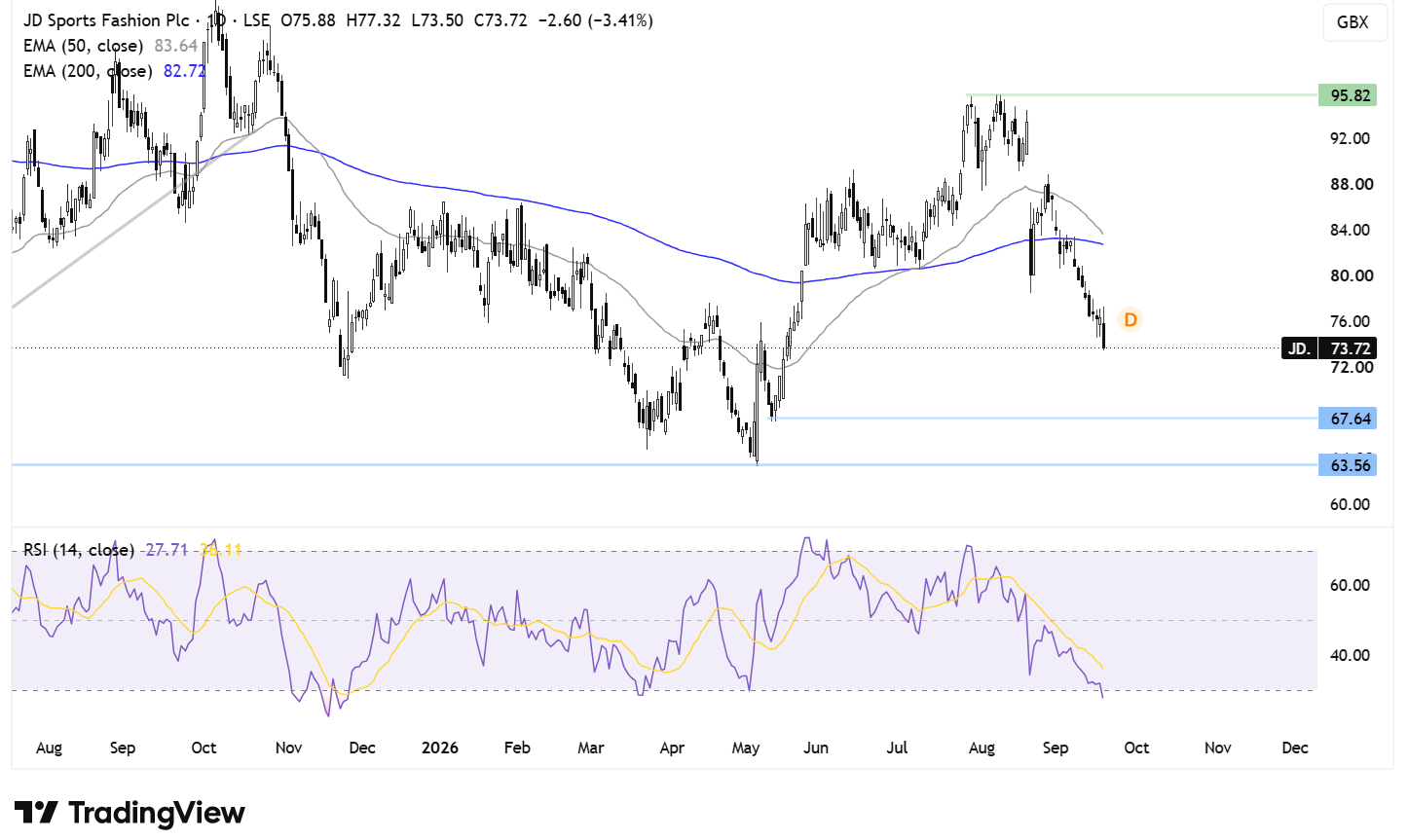
After running into resistance and forming a double-top reversal pattern at 95, JD Sports' share price rebounded lower, breaking below the 50 and 200 EMAs and dropping to 73 at the time of writing, its lowest level since May. The RSI is tipping into oversold territory, so a period of consolidation or a move higher could be on the cards.
Any serious recovery would need to retake 82, the 200 EMA, to put the price on a more neutral footing ahead of 95, the 2026 high.
Sellers will then look to break below the mid-May low at 67 before attention turns to 63, the May low.
Strategy in focus as BTC tests key resistance
Strategy, the Bitcoin treasury company, surged 16% on Friday and could potentially gain further should Bitcoin break out of its range.
Bitcoin soared over 5% on news that the Securities and Exchange Commission unveiled its long-awaited exemption that will allow companies to offer trading in blockchain-based or tokenised stocks and other securities, in a major move that could integrate digital assets more deeply into traditional markets.
The announcement followed the Senate's failure to advance the Clarity Act last week, with regulators pursuing changes under their existing powers.
Securities and Exchange Commission Chairman Paul Atkins said the SEC will move forward with regulatory action following the Senate's failure to pass the Clarity Act. He said the SEC will act decisively within its existing legal authority to provide certainty to American investors, regardless of whether new legislation passes.
The comments helped drive cryptocurrencies higher, with Bitcoin gaining over 5% across the week. Bitcoin is now testing a key resistance zone around $81,000. A break above here could see the cryptocurrency gain traction, and Bitcoin treasury firms could also extend their gains.
How to trade Strategy
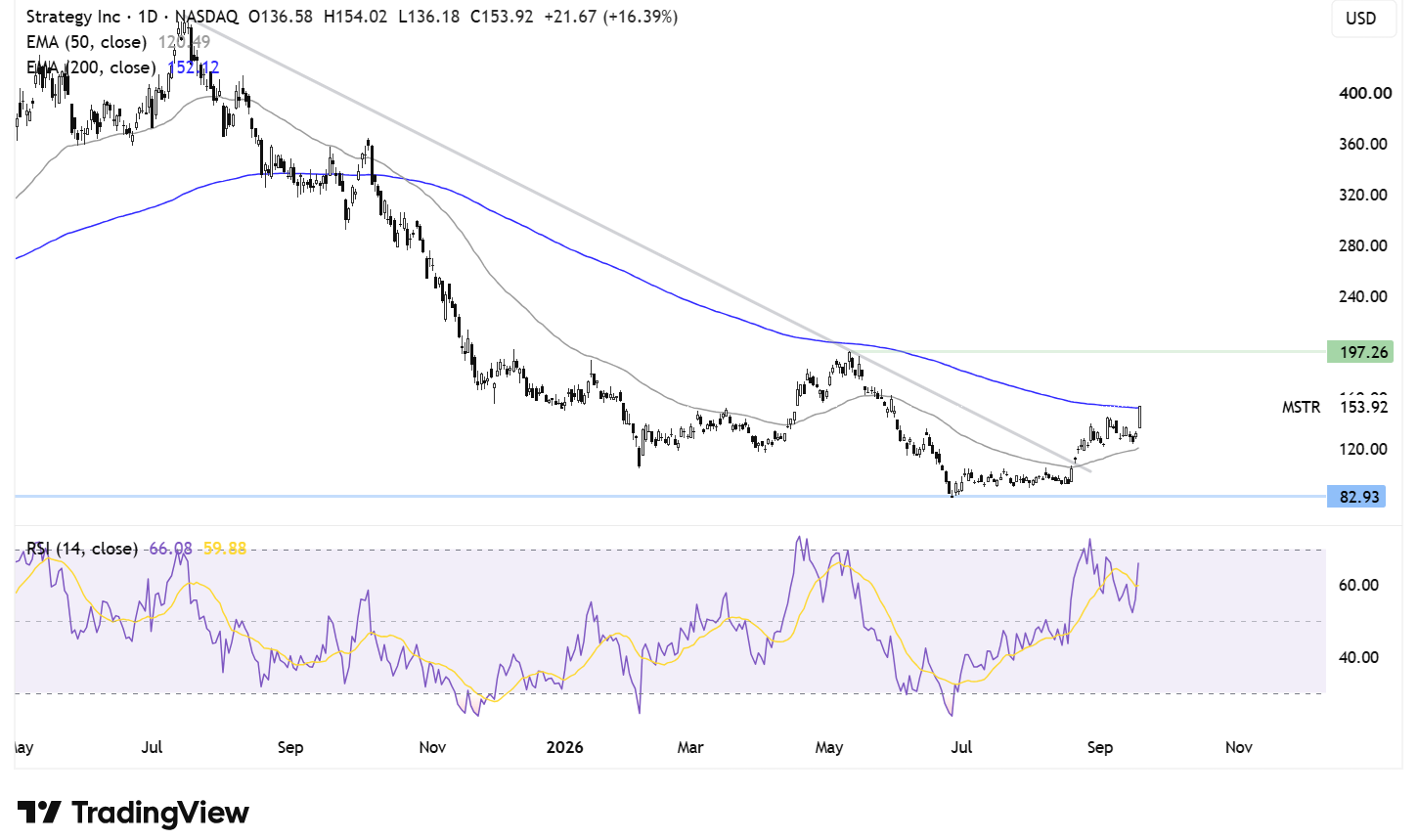
Strategy has recovered from its $81.82 2026 low, rising above the falling trend line resistance and the 50 and 100 EMAs, with the price now testing the 200 EMA.
Buyers will need to rise above $150 to bring $197, the 2026 high, into focus. A rise above here would create a higher high, putting the outlook on a more bullish footing.
Immediate support can be seen at $126, the 100 EMA, and $122, the 50 EMA. A break below this level opens the door to $81.82, the 2026 low.
Related tags:
Latest market news










Web Trader platform
Our sophisticated web-based platform is packed with features.
Open an account today
Experience award-winning platforms with fast and secure execution.
Economic calendar
Related articles

Weekly Equities Outlook: Broadcom, Palo Alto Networks, Dell
Earnings this week from Broadcom, Palo Alto Networks and Dell week keep AI in focus.
Weekly Equities Outlook: Nvidia, Salesforce, Strategy
Earnings from Nvidia and Salesforce are in focus, as well as crypto stocks such as Strategy after Bitcoin's 20% jump last week.

Equities Weekly Outlook: Walmart, Home Depot and Target
Three major U.S. retailers report earnings this week, with Walmart, Home Depot and Target offering different views on the strength of the U.S. consumer.