
Nasdaq breakout builds as crude falls and chip stocks surge
Lower oil prices, semiconductor strength and improving technical momentum are helping Nasdaq futures overcome a hostile backdrop of higher Treasury yields and a stronger US dollar.
Written by
David Scutt
Market Analyst
- Nasdaq futures push to fresh multi-week highs
- Treasury yields have risen sharply, led by the front end
- Brent correlation with Nasdaq falls to around -0.75
- Semiconductor outperformance versus industrials reaches historical extremes
A combination of improving technicals, falling crude oil prices and a rotation away from cyclical sectors toward more structural earnings plays has helped the Nasdaq push to fresh multi-week highs, overcoming what would otherwise be a hostile backdrop for long-duration stocks following a large increase in Treasury yields and renewed strength in the US dollar.
Higher yields fail to derail Nasdaq rally
Often when you see US Treasury yields backing up and the US dollar rebounding, strength in the Nasdaq is not something many would anticipate. But that has not been the case over the past fortnight.
The US 2-year yield has risen around 38 basis points, an historically rare move, particularly by the standards of recent decades. The US dollar index has also gained just over 1%.
Despite that, Nasdaq futures are up around 1.8% over the same period, with the move gathering pace late last week following the Fed’s first interest rate hike in more than three years.
Crude emerges as latest macro focal point
Some may point to ongoing strength in earnings as justification to buy the dip. In this instance, I suspect macro forces may be playing a bigger role.
While crude prices are not something that immediately come to mind when assessing Nasdaq trades, anyone watching markets over recent weeks will have noticed how closely oil has been tied to many of the major macro drivers, whether interest rates or currency moves. Nasdaq may be no exception.
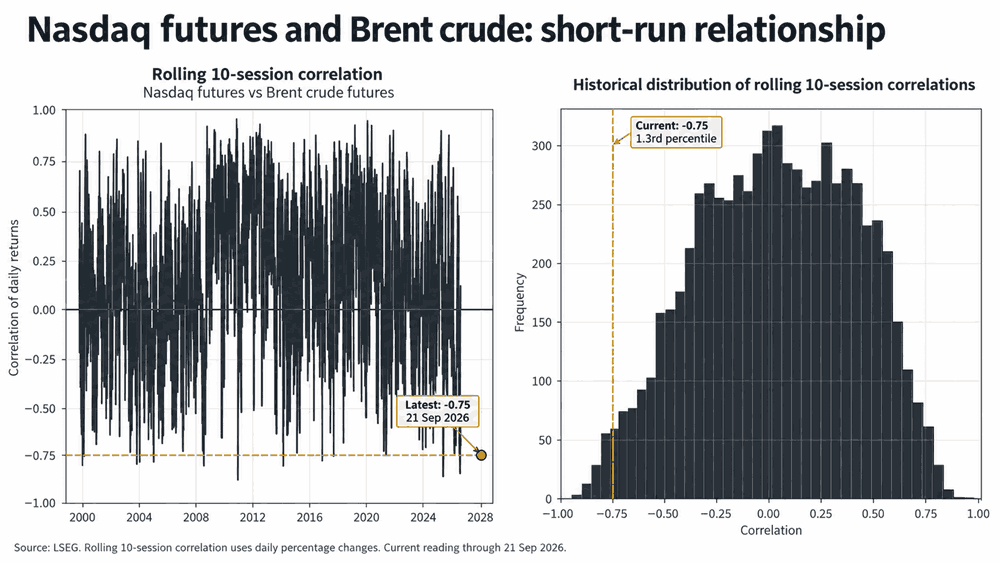
Source: LSEG
Over the past 10 sessions, the rolling correlation between daily moves in Nasdaq futures and Brent has fallen to around -0.75, placing it near the extreme lower tail of the historical distribution going back to 1999. That stands out because the relationship is usually weak, with the correlation between daily moves averaging only around +0.12 over the full sample.
That doesn’t mean crude has suddenly become the go-to swing factor when making trading decisions involving tech stocks. But it does suggest that, like so many other markets right now, attention has shifted heavily toward what is happening in crude.
Higher rates may be helping tech indirectly
While higher interest rates, driven in part by elevated crude prices and reinforced by the hawkish hike delivered by the Federal Reserve last Wednesday, would normally be expected to weigh directly on the Nasdaq, they may also be having an indirect positive effect by increasing the relative appeal of AI-linked earnings over more cyclically sensitive parts of the market.
A clear divergence has developed between tech stocks and more cyclical parts of the market. Since September 14, the Philadelphia Semiconductor Index (SOX) has gained around 7%, while the US industrials ETF XLI has been broadly flat, leaving semiconductor outperformance around the 97th percentile historically over that four-session window.
It doesn’t definitively prove investors are rotating out of cyclicals and into AI-linked stocks, given the short window. But it is consistent with the macro view that higher borrowing costs are creating greater headwinds for sectors whose earnings are more closely tied to the economic cycle.
Nasdaq eyes 30,000 as upside momentum builds
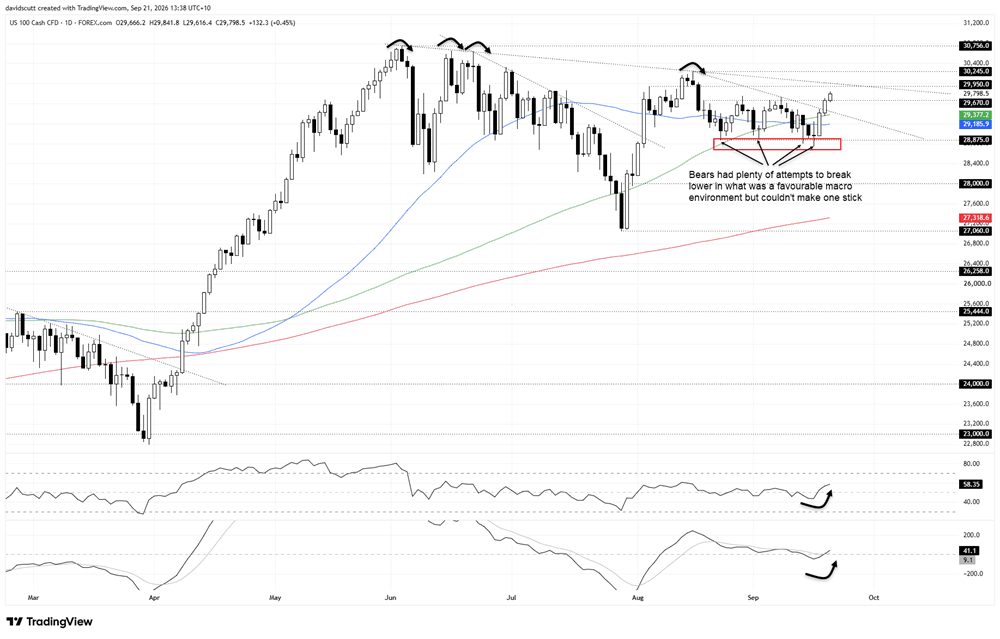
Source: TradingView
In what has been a difficult environment, with doubts about the AI demand outlook combining with a significant increase in energy prices, higher Treasury yields and a stronger US dollar, Nasdaq bears have had plenty to work with over the past month or so. Yet despite that, they’ve struggled to capitalise.
Technically, the price had been coiling in what was effectively a descending triangle, albeit with a fairly shallow slope. Support beneath 28,875 was tested multiple times, with the latest attempt last week briefly taking out the low set a couple of days earlier before bouncing sharply.
That rebound gathered pace on Thursday following the Fed, with the price breaking the minor downtrend running from the August highs before stalling around 29,670. The move has extended further during Asian trade today, albeit on extremely thin volumes with Japanese markets closed, helped by gains in South Korea’s KOSPI.
That has bulls eyeing a potential retest of the broader downtrend running from the highs set in early June. It comes in around 30,000 today, making that psychological level an important barrier to watch.
The oscillators point to gradually building upside momentum. RSI (14) has moved back above the neutral 50 level, while MACD has staged a bullish crossover of the signal line and turned positive. The speed of the momentum shift is nothing to write home about, but for now it still favours long setups over shorts.
If downtrend resistance from the highs set earlier this year were to break, the next port of call could be 30,245, the swing high set on August 17. Beyond that, there were multiple failures at and above 30,600 earlier this year, extending up to the record high of 30,756.
It may take a more palatable macro backdrop than the one we have now to get there. But with earnings season approaching, such a move is not out of the realms of possibility.
Of course, if the breakout fizzles and the price moves back below 29,670, it would point to the risk of a resumption of sideways range trade between 29,670 on the topside and 28,875 on the downside, with the 50- and 100-day moving averages providing reference levels in between.
Latest market news








Web Trader platform
Our sophisticated web-based platform is packed with features.
Open an account today
Experience award-winning platforms with fast and secure execution.
Economic calendar
Related articles

Gold and S&P 500 analysis: What now after Warsh’s hawkish speech?
The dollar surged across the board after the Fed Chair Kevin Warsh surprised with a hawkish-leaning speech at the Jackson Hole summit. All the bearish dollar bets that had been accumulated since last Friday on the back of data weakness and bond market troubles had to be squared and that triggered a short squeeze rally for the dollar. Gold and silver dropped, as a result, as too did bitcoin, while US indices were giving back earlier gains.


Nasdaq 100 Forecast: NDX slips ahead of Fed Chair Warsh’s speech
U.S. stocks are edging lower on Friday, giving back some of yesterday's gains after Nvidia's strong outlook revived the tech trade. The focus has now shifted firmly to Fed Chair Kevin Warsh's Jackson Hole speech, with investors looking for more clarity on the outlook for interest rates.

Bitcoin Forecast: BTC/USD Back to $80K Ahead of Warsh’s Jackson Hole Speech
After surging over $15,000 in the past 10 days alone, there is risk of a near-term pullback if Warsh says anything remotely hawkish at Jackson Hole - what are the levels to watch from here?