
Crypto Outlook: Is Uncertainty Still Holding Back the Market?
As the final month of 2026 approaches, a growing sense of indecision has become increasingly evident across the cryptocurrency market. Although the sector attempted to sustain bullish momentum during the week, the recovery has not been strong enough to signal a more consistent return of buying confidence.
Written by
Julian Pineda
Market Analyst
As the final month of 2026 approaches, a growing sense of indecision has become increasingly evident across the cryptocurrency market. Although the sector attempted to sustain bullish momentum during the week, the recovery has not been strong enough to signal a more consistent return of buying confidence. For now, several factors continue to limit demand, including recent tariff-related announcements and uncertainty surrounding the prospect of higher interest rates in the United States.
This combination of factors has allowed alternative markets perceived as more stable to continue attracting capital away from cryptocurrencies, potentially slowing the recovery in demand across the sector. As long as these risks remain in place, a phase of indecision and neutrality could continue to be an important feature of the crypto market in the short term.
Factors Still Limiting Demand
The week brought important developments on the international trade front. Over recent days, reports emerged that the United States is considering new tariffs on imports from 14 major economies, including tariffs of up to 20% on goods from China and up to 15% on imports from economies such as the European Union and Japan. This has reintroduced a risk that had largely faded from market attention in recent months: the possibility of renewed global trade tensions.
This development has not been particularly favorable for risk assets, as concerns about slower global economic growth typically encourage a more cautious stance among investors. As a result, liquidity available for speculative assets may decline while uncertainty surrounding markets such as cryptocurrencies continues to increase.
However, the most important catalyst remains the outlook for the Federal Reserve. Expectations for a more restrictive monetary policy remained in place throughout the week, and this scenario could even gain additional support from tariff-related developments, as higher import costs could eventually generate additional inflationary pressures within the U.S. economy.
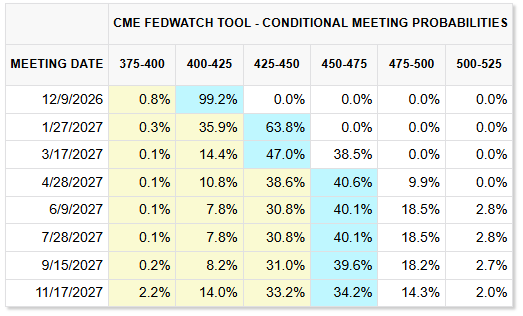
Currently, CME probabilities continue to reflect more than a 99% chance of a rate increase during the December 9 meeting, while the probability of an additional hike in January 2027 remains above 63%. This suggests that markets are not only dealing with trade-related uncertainty but also with expectations of an increasingly restrictive interest-rate environment.
Source: CME
The combination of these two dynamics remains challenging for cryptocurrencies. Both rising trade tensions and a more aggressive central bank can reduce liquidity available for risk assets. In addition, periods of uncertainty often favor more defensive assets, particularly the U.S. dollar.
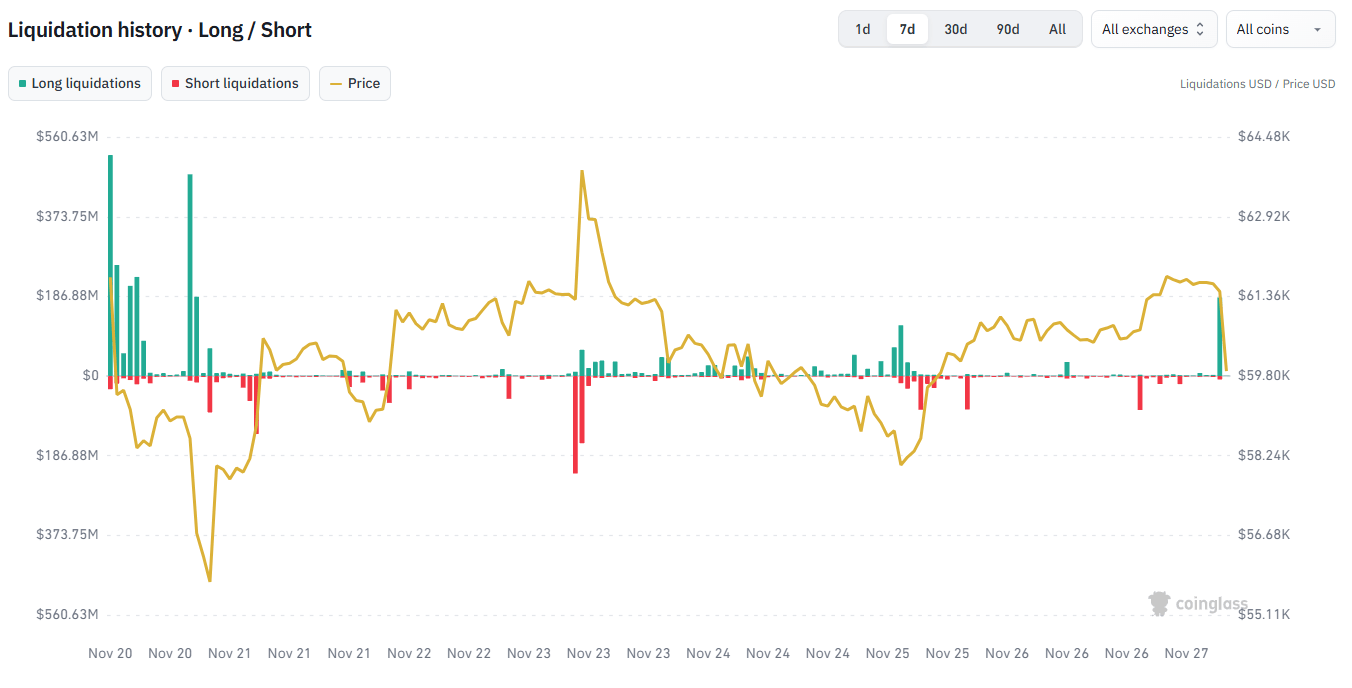
This situation is already beginning to appear in market activity. Looking at liquidation data from the last seven days, long positions continue to account for most liquidations. Toward the end of the week alone, nearly $200 million in long liquidations were recorded across major exchanges. This reflects that demand remains far from stable and continues to struggle to establish a more consistent recovery.
Source: Coinglass
With this in mind, the recovery attempts seen during the week continue to face important obstacles. As long as concerns surrounding a potential trade conflict and higher interest rates remain relevant, demand may continue struggling to recover in a sustained way, reinforcing a dynamic of indecision or even renewed weakness across the cryptocurrency market in the coming weeks.
Bitcoin Versus Other Markets
The current dynamic is not limited to higher-rate expectations or trade-related concerns. Bitcoin's weakness has also been accompanied by the performance of alternative markets such as the U.S. dollar, which typically benefits from both higher interest rates and its role as a liquidity safe haven during periods of uncertainty.
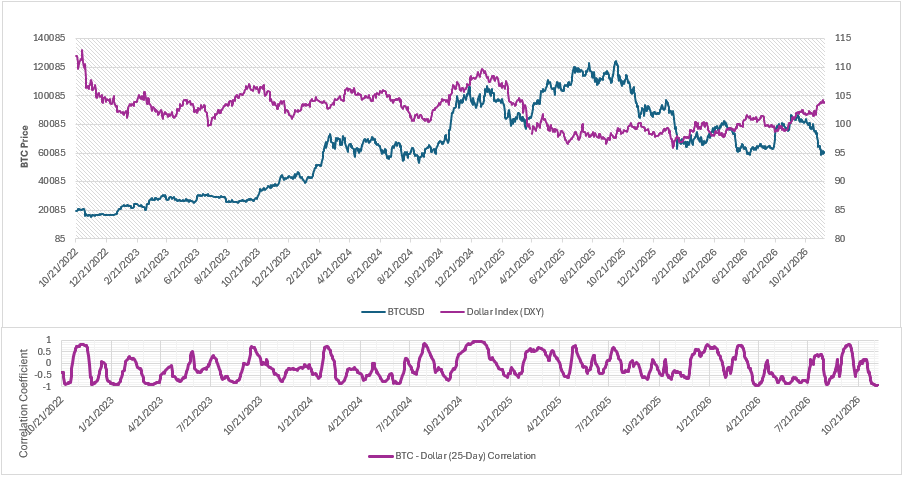
This relationship has become increasingly evident when comparing Bitcoin to the DXY Index. The correlation coefficient between the two assets currently remains close to -1 over the last 25 trading sessions, highlighting a particularly strong inverse relationship in the short term. Correlations can, of course, change over time.
Source: Data – TVC, StoneX, TradingView
This relationship is especially important because while DXY continues trading near recent highs, supported by continued dollar strength, Bitcoin remains unable to sustain a meaningful recovery. This suggests that assets perceived as more stable continue attracting capital that might otherwise flow toward higher-risk alternatives.
Even Bitcoin, as the leading cryptocurrency and benchmark for the broader market, is currently not being viewed as an alternative source of stability. As a result, confidence across the crypto ecosystem continues to slow as defensive assets gain a larger share of market attention.
For this reason, as long as this inverse relationship remains strong and the dollar continues to maintain its strength, the cryptocurrency market may continue facing challenges in rebuilding a more consistent demand backdrop during the short term.
Confidence Remains Near Extreme Lows
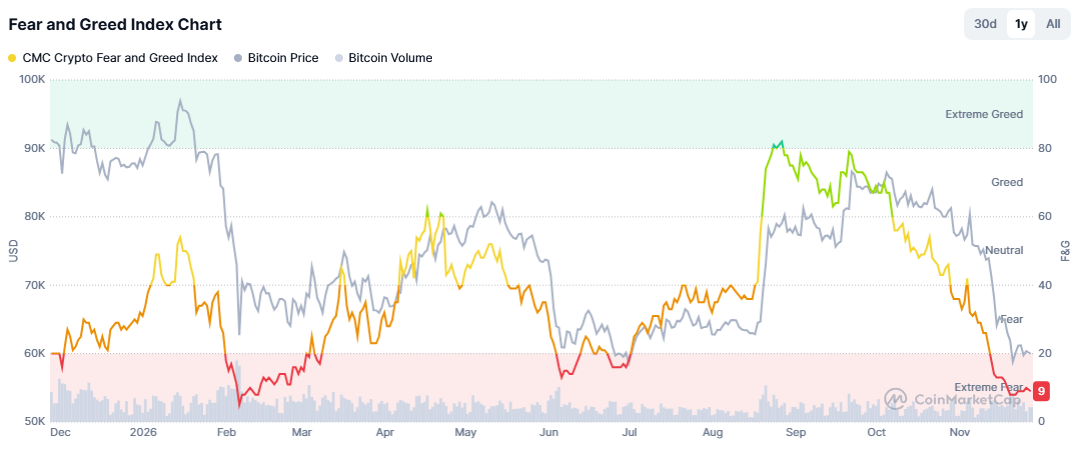
Recent movements in the Fear & Greed Index continue to reflect underlying weakness across the market. The indicator currently stands near 9 points, placing it firmly back in Extreme Fear territory and highlighting that confidence within the cryptocurrency market remains limited despite the recovery attempts seen during the week.
This situation is particularly important because it suggests that the optimism that had started to emerge several weeks ago continues to fade. In other words, while the market has attempted to recover, the move has not been sufficient to generate a meaningful improvement in overall sentiment.
Source: Coinmarketcap
The evolution of this indicator remains important because it serves as a gauge of risk appetite across the cryptocurrency market. If confidence continues to struggle, it could limit the market's ability to sustain more consistent demand and reinforce the perception that capital continues rotating toward alternatives viewed as more stable outside of risk assets.
Under this scenario, the loss of momentum in market confidence could continue supporting a phase of weakness and indecision that has become increasingly visible across the cryptocurrency market and may remain relevant throughout the coming trading sessions.
Written by Julian Pineda, CFA, CMT – Market Analyst
Follow him on: @julianpineda25
Latest market news











Web Trader platform
Our sophisticated web-based platform is packed with features.
Open an account today
Experience award-winning platforms with fast and secure execution.
Economic calendar
Related articles

USD/JPY Weekly Outlook: AI earnings could overshadow the Fed and BoJ
AI sentiment has become a major driver of US Treasury yields and USD/JPY. With Microsoft, Alphabet and Amazon reporting this week, central bank decisions may have competition for traders' attention.


Bitcoin Forecast: BTC/USD Back to $80K Ahead of Warsh’s Jackson Hole Speech
After surging over $15,000 in the past 10 days alone, there is risk of a near-term pullback if Warsh says anything remotely hawkish at Jackson Hole - what are the levels to watch from here?


Bitcoin, Gold Price Outlook: US CPI & Overbought Risks in Focus
Bitcoin, Gold Price Outlook Following a steep risk-on rally across US equity indices and precious metals, several major markets are approaching critical technical levels as momentum becomes increasingly stretched.