

NFP Preview: New Government, Same Jobs Market?
Traders are still sifting through the fallout of the US midterm elections, just in time to get hit with another volatility: The monthly Non-Farm Payrolls (NFP) report - what will the jobs report show, and what could it mean for the US dollar?
Written by
Matt Weller
Head of Market Research
NFP Key Points
- NFP report expectations: +65K jobs, +0.3% m/m earnings, unemployment at 4.2%.
- NFP leading indicators point to a potentially above-expected reading in this month’s jobs report, with headline job growth coming in somewhere in the 100-150K range.
- Technically speaking, USD/JPY remains within its 6-week range between 156.50 and 159.00, though it has put in a series of higher highs and higher lows.
When is the NFP Report?
The monthly NFP report will be released on Friday, November 6, at 8:30 ET.
NFP Report Expectations
Traders and economists expect the NFP report to show that the US created 65K net new jobs, with average hourly earnings rising 0.3% m/m (2.9% y/y) and the U3 unemployment rate at 4.2%.
NFP Overview
Traders are still sifting through the fallout of the US midterm elections, just in time to get hit with another volatility: The monthly Non-Farm Payrolls (NFP) report.
So far this year, the US economy has created an average of +68K jobs per month, so perhaps it’s not surprising that the consensus estimate for this month’s jobs report is +65K. For his part, FOMC Chairman Kevin Warsh characterized the employment side of his mandate as “quite positive,” citing payroll growth running above last year’s pace, a lower jobless rate than a year earlier, and unemployment claims near generational lows
For the October jobs report, traders are anticipating another reasonably solid report:
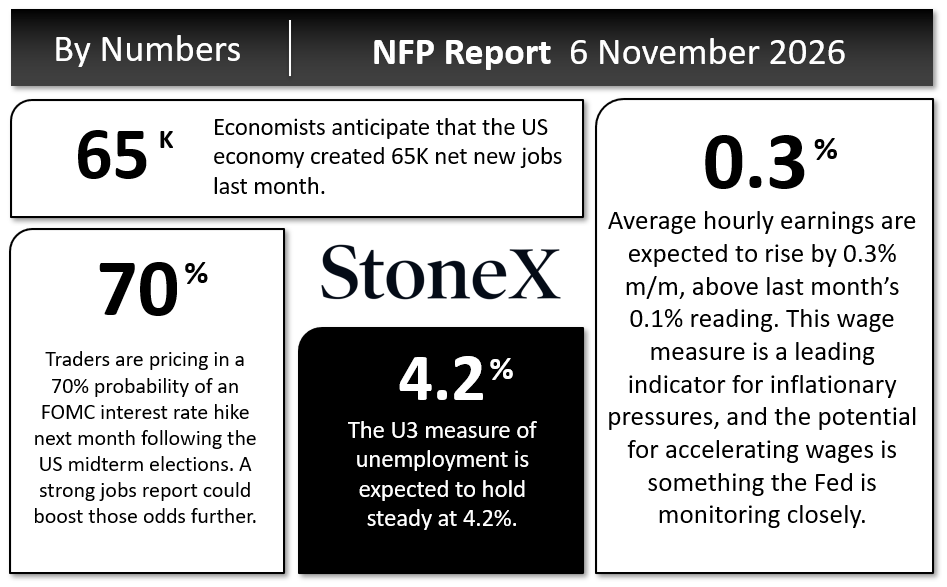
Source: StoneX
As the graphic above shows, expectations are for another positive reading on the labor market, with modest job growth, stable unemployment, and continued gradual wage increases.
With inflation holding well above the Federal Reserve’s 2% target, traders remain wary about the potential for another interest rate hike next month, with the CME’s FedWatch tool showing about a 70% probability of such a move:
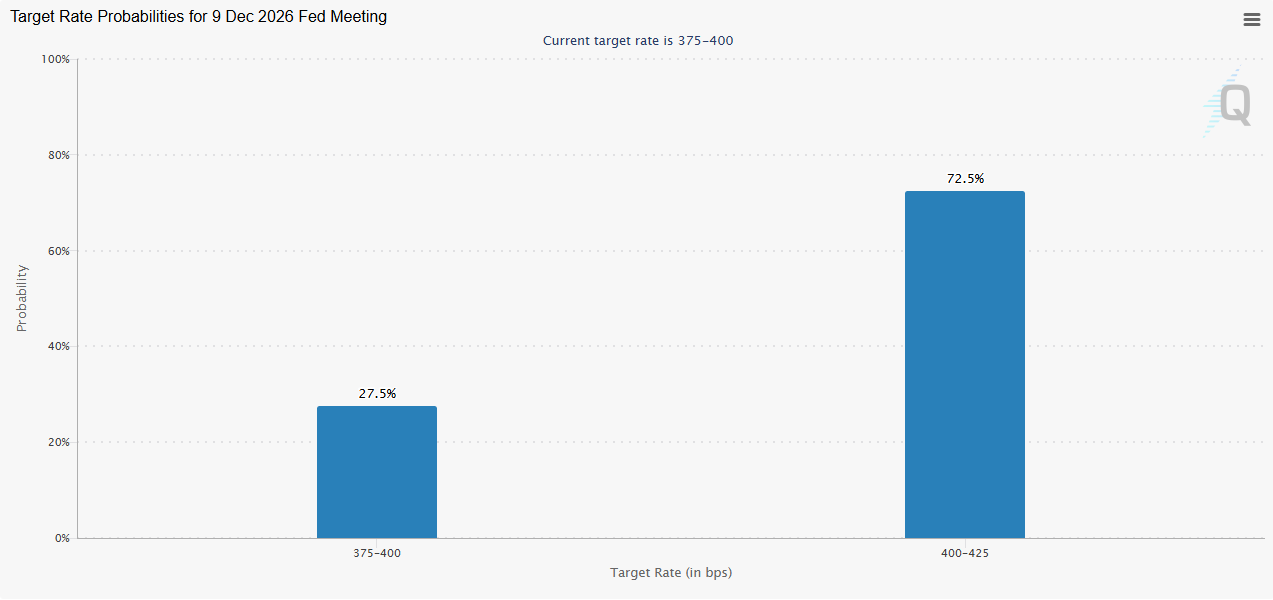
Source: CME FedWatch
NFP Forecast
As regular readers know, we focus on four historically reliable leading indicators to help handicap each month’s NFP report,:
- The ISM Services Employment subindex rose to 51.4 from 50.1 last month.
- The ISM Manufacturing Employment subindex held steady at 52.4 from 52.7 last month.
- The ADP Employment report came in at 86K jobs, up from last month’s 80K reading.
- The 4-week moving average of initial unemployment claims fell to 195K, down from 200K last month and near historic lows.
Weighing the data and our internal models, the leading indicators point to a potentially above-expected reading in this month’s jobs report, with headline job growth coming in somewhere in the 100-150K range, albeit with a big band of uncertainty given the limited response rates.
Regardless, the month-to-month fluctuations in this report are notoriously difficult to predict, so we wouldn’t put too much stock into any forecasts (including ours). As always, the other aspects of the release, including the closely watched average hourly earnings figure and unemployment rate will also impact how markets react to the release.
Potential NFP Market Reaction
|
Wages < 0.2% m/m |
Wages 0.2-0.4% m/m |
Wages > 0.4% m/m | |
|
< 25K jobs |
Bearish USD |
Slightly Bearish USD |
Slightly Bearish USD |
|
30-100K jobs |
Neutral USD |
Neutral USD |
Neutral USD |
|
> 100K jobs |
Slightly Bullish USD |
Slightly Bullish USD |
Bullish USD |
Technically speaking, the US dollar is trading near the middle of its 1-month range, leaving a relatively neutral balance of risks heading into the report. The fact that traders will get another jobs report, and two more inflation reports, before the FOMC meets again suggests that market volatility may be lower than usual unless we see a truly surprising reading on the labor market.
US Dollar Index Technical Analysis – USD/JPY 4-Hour Chart
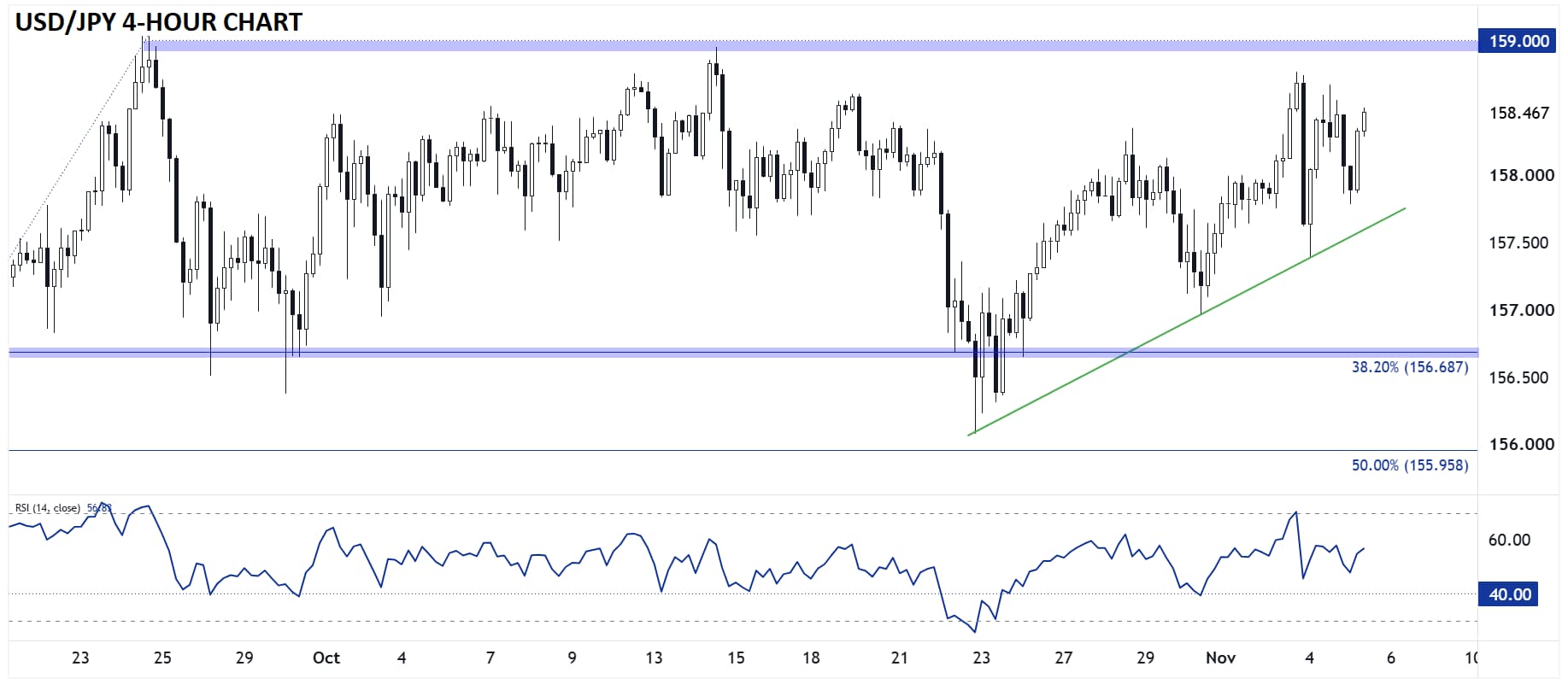
Source: TradingView, StoneX
As I’ve noted before, USD/JPY tends to have the “cleanest” reaction to US economic releases. Looking at the chart, the pair remains within its 6-week range between 156.50 and 159.00, though it has put in a series of higher highs and higher lows within that range over the past two weeks.
A strong jobs report that hints at an accelerating economy would likely accelerate the near-term bullish trend and bring 159.00 into view, with potential for a breakout above that key level to two-month highs, though fears of intervention would start to rise if it neared 160.00.
Meanwhile, a soft jobs report that raises stagflationary fears would likely break the near-term uptrend and could set the stage for a retest of support in the 156.60 zone next week.
-- Written by Matt Weller, Global Head of Research
Check out Matt’s Daily Market Update videos on YouTube and be sure to follow Matt on Twitter: @MWellerFX
Related tags:
Latest market news











Web Trader platform
Our sophisticated web-based platform is packed with features.
Open an account today
Experience award-winning platforms with fast and secure execution.
Economic calendar
Related articles

USD/JPY Weekly Outlook: AI earnings could overshadow the Fed and BoJ
AI sentiment has become a major driver of US Treasury yields and USD/JPY. With Microsoft, Alphabet and Amazon reporting this week, central bank decisions may have competition for traders' attention.


EUR/USD forecast: All eyes on Warsh at Jackson Hole - Forex Friday
For much of this week, the EUR/USD has been edging lower with the US dollar regaining some ground after last week’s sell-off that was triggered, in part, by the bond market worries. Investors have been unwilling to bet further against the US dollar so far this week ahead of Kevin Warsh’s keynote speech at the Jackson Hole summit, due later today.

DAX and EUR/USD forecast: Lower energy prices, yields offer support
But the question, of course, is how much further oil prices and bond yields can fall. For now, the combination is supportive of risk assets and is helping to sustain a relatively benign decline in the dollar. The focus today will be on US core PCE inflation, due for release shortly, while Nvidia’s second-quarter earnings will provide another test for risk appetite after the US markets close – not just for US indices but for global tech-heavy indices given the influence Nvidia has over the global tech and AI names.