

Silver's Brutal Rout Could Have a Sting in the Tail
Silver's historic collapse has coincided with an extraordinary tightening in US financial conditions. With a squeeze now underway, developments in equity markets may determine whether the recovery has legs.
Written by
David Scutt
Market Analyst
- Silver plunges nearly two-thirds from January's peak
- Downside stretch among most extreme since 1982
- Equity weakness drives rapid US financial tightening
- Dollar sensitivity extreme as silver squeeze gets underway
Silver was smashed late last week, with the latest wave of selling dragging the price back to levels not seen since September last year, leaving it down almost two-thirds from the record high hit in January. However, on the back of a rally in US stock futures in Asia, silver is now attempting to squeeze higher, hinting that Friday may have marked a short-term low.
But calling it anything more than that right now is risky business, particularly given silver has traded more like a risk asset this year than anything resembling a precious or industrial metal. With its latest decline coinciding with a rapid tightening in US financial conditions, much of it driven by falling equities, the performance of stocks may ultimately determine when silver eventually bottoms.
A collapse for the history books
Source: LSEG
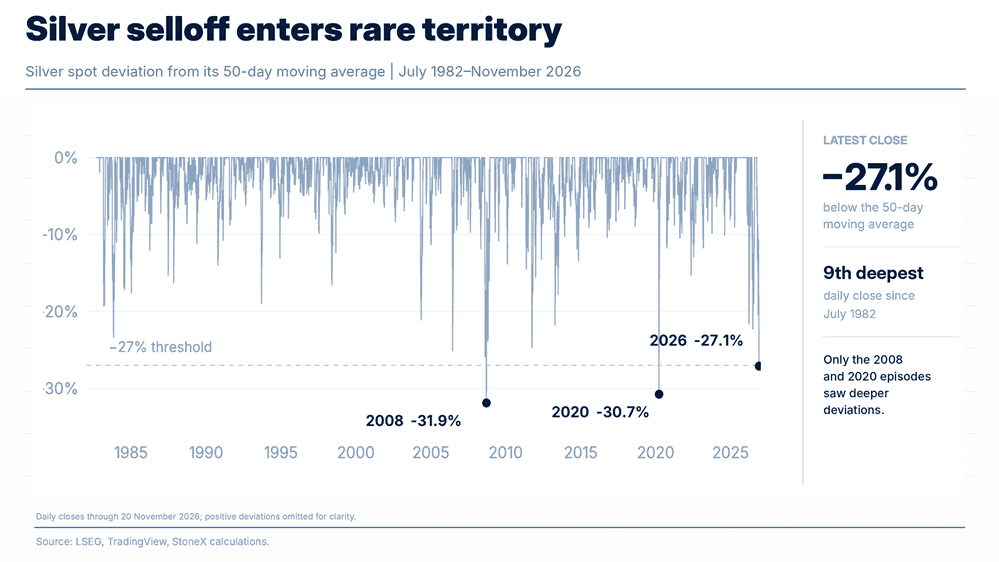
The graphic above shows just how abrupt silver's decline has been relative to its medium-term trend. At Friday's close, the price sat 27.1% beneath its 50-day moving average, the ninth most extreme downside deviation across more than four decades of daily data.
Only during the 2008 financial crisis and the March 2020 pandemic liquidation have we seen comparable extremes. Both episodes eventually produced powerful recoveries, but not before silver suffered further losses. It's a timely reminder that extreme oversold conditions can set the stage for violent rebounds without necessarily signalling that the lows are in.
Equities hold the key
Source: TradingView
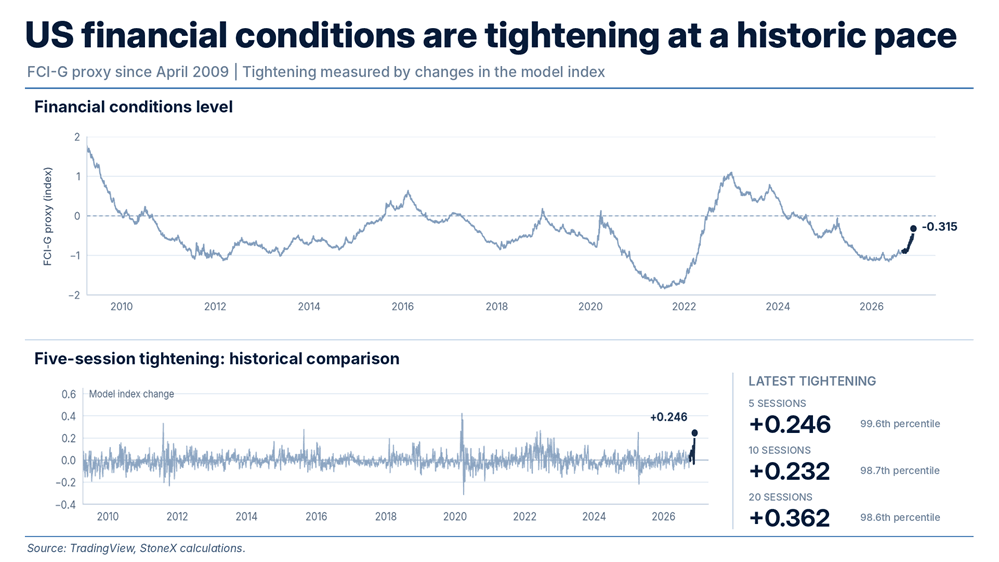
A major factor contributing to silver's slide, which has been mirrored across other high-beta risk assets, has been the rapid withdrawal of financial accommodation in the US since early October. Our daily proxy for the Federal Reserve's financial conditions index shows conditions have tightened by 0.560 points since 5 October, including a massive 0.246-point move over the past five sessions alone. That weekly increase ranks among the largest 0.4% of comparable five-session moves going back to April 2009.
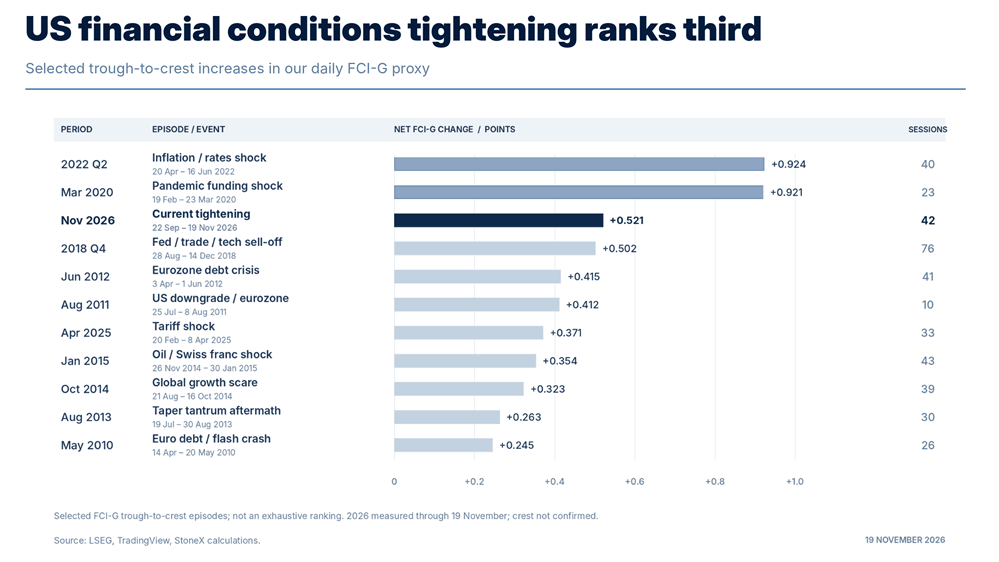
And it's not just the past week that stands out. Measured from its September trough, the broader tightening episode ranks as the third-largest trough-to-crest increase in our model since 2009.
Source: LSEG, TradingView
While financial conditions remain accommodative overall, it's the speed of the tightening that's eye-watering, particularly given how similar episodes have coincided with major bouts of market volatility, as shown in the graphic above. US equities accounted for more than 86% of last week's increase in the model, suggesting developments in stock markets may be crucial in determining whether pressure on silver begins to ease or intensifies again, at least in the short term.
Silver's dollar sensitivity off the charts
The sharp deterioration in sentiment towards AI market leaders hasn't been the only source of pressure on silver. The US dollar has also rallied strongly, compounding the selling pressure.
Source: LSEG
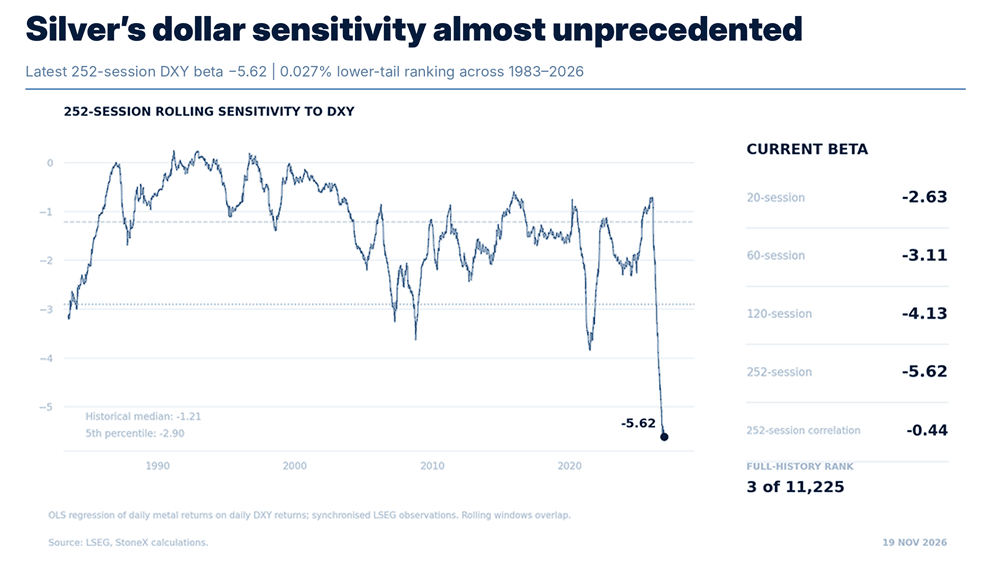
Our analysis reveals silver's rolling 252-session beta to DXY stood at −5.62 on 19 November, the third most negative reading across more than 11,200 observations dating back to 1983, with the only two more extreme readings occurring earlier this month.
To put that into perspective, a 1% rise in DXY has been associated with an average decline of around 5.62% in silver over the past year, based on the historical regression. That's an extraordinary degree of sensitivity to relatively modest movements in the greenback.
That sensitivity isn't just confined to the downside, meaning that if we see a recovery in risk appetite accompanied by a softer dollar, it could provide significant ammunition for a sizeable silver squeeze, just as a continuation of the recent dollar upside could heap even greater pressure on the metal.
Volatility reaches rare extremes
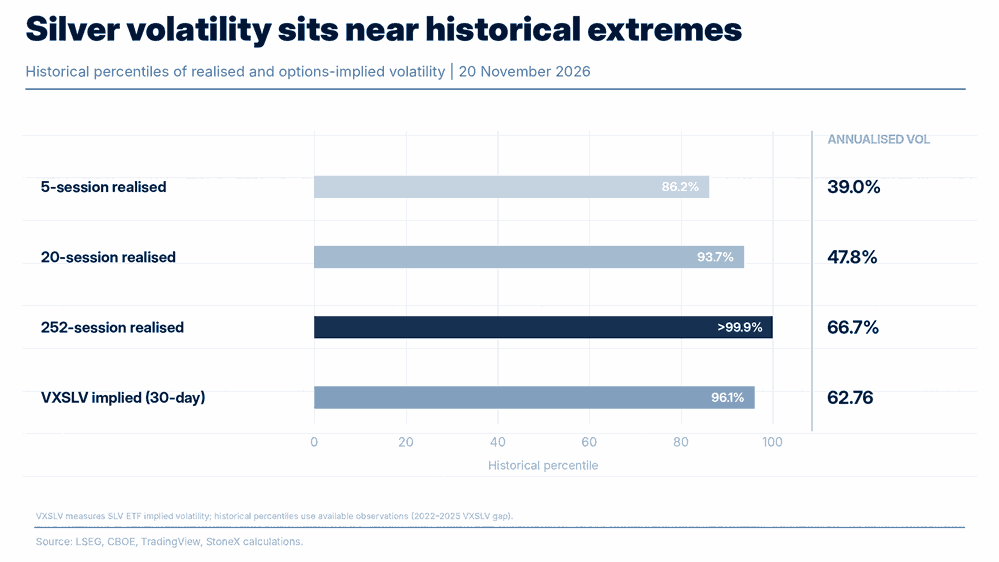
Further reinforcing just how wild silver's unwind has been are measures of realised volatility. As of Friday's close, annualised realised volatility over the preceding 252 sessions, essentially the past year, stood at 66.7%, exceeding 99.9% of comparable readings since 1982. Even over a shorter 20-session window, realised volatility was running at 47.8%, placing it in the 94th historical percentile over the same period.
Source: LSEG, TradingView
Ominously, there's little indication that traders expect calmer conditions anytime soon, with the CBOE Silver ETF Volatility Index (VXSLV), which measures expected volatility over the coming 30 days, surging to 62.76 on Friday. Again, a historically rare observation.
Neither realised nor implied volatility tells us which direction silver will move next. And while the elevated readings leave scope for the selloff to extend further, with the price already so stretched to the downside, you suspect it wouldn't take much good news to spark a sizeable squeeze.
Selling strength remains the preferred play
Source: TradingView
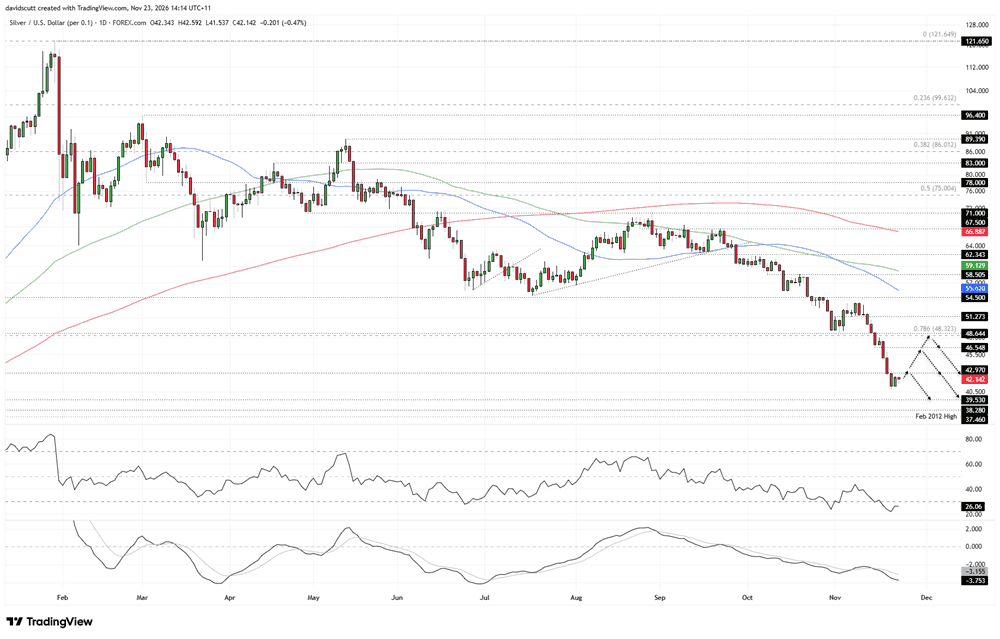
Silver's decline has accelerated sharply since the highs set in late August, particularly after the price broke beneath an important support zone comprising the 78.6% Fibonacci retracement of the April 2025 to January 2026 bull move at $48.32 and the November 2025 low at $48.64, around where the explosive rally to record highs began.
That break saw the price slice through former support at $46.55 and $42.97 before the selling finally stalled near $40.77 on Friday. With a modest rebound now underway, $42.97 is the immediate focal point overhead, followed by $46.55 and the more substantial resistance zone between $48.32 and $48.64.
Momentum indicators continue to favour the bears. RSI (14) has been setting fresh lower lows, pointing to building downside momentum, while MACD remains beneath its signal line, deep in negative territory. With the price also trading well below its key medium and long-term moving averages, all of which carry a negative slope, the broader technical picture continues to favour selling into strength, even if extreme oversold conditions leave the door open for a sizeable short-term squeeze.
While these resistance levels provide potential upside targets for a squeeze, a backtest and rejection of any could offer opportunities to establish short positions, particularly if risk appetite falters again. Stops could be placed above the relevant resistance to protect against a more substantial rebound. On the downside, Friday's low near $40.77 is the initial target, followed by $39.53, $38.28 and the February 2012 high at $37.46 should the selloff resume.
For those looking to position for a squeeze, risk management remains paramount given the prevailing bearish trend. It wouldn't be until silver broke above $54.50, establishing a new higher high, that the prospect of a more sustained trend reversal would start to look more convincing. Such a move would bring the falling 50 and 100-day moving averages into focus, with the 200-day moving average further overhead.
Latest market news









Web Trader platform
Our sophisticated web-based platform is packed with features.
Open an account today
Experience award-winning platforms with fast and secure execution.
Economic calendar
Related articles

USD/JPY Weekly Outlook: AI earnings could overshadow the Fed and BoJ
AI sentiment has become a major driver of US Treasury yields and USD/JPY. With Microsoft, Alphabet and Amazon reporting this week, central bank decisions may have competition for traders' attention.

Gold and S&P 500 analysis: What now after Warsh’s hawkish speech?
The dollar surged across the board after the Fed Chair Kevin Warsh surprised with a hawkish-leaning speech at the Jackson Hole summit. All the bearish dollar bets that had been accumulated since last Friday on the back of data weakness and bond market troubles had to be squared and that triggered a short squeeze rally for the dollar. Gold and silver dropped, as a result, as too did bitcoin, while US indices were giving back earlier gains.


EUR/USD forecast: All eyes on Warsh at Jackson Hole - Forex Friday
For much of this week, the EUR/USD has been edging lower with the US dollar regaining some ground after last week’s sell-off that was triggered, in part, by the bond market worries. Investors have been unwilling to bet further against the US dollar so far this week ahead of Kevin Warsh’s keynote speech at the Jackson Hole summit, due later today.