


USD/JPY Weekly Outlook: Fed, BOJ and Hormuz risks put 165 in focus
The bullish breakout played out exactly as anticipated last week. Now traders face a bigger question: can higher energy prices and widening policy divergence propel USD/JPY through 164?
Written by
David Scutt
Market Analyst
- Fed communication critical without rate move
- BOJ inflation outlook faces fresh test
- Hormuz risks compound yen headwinds
- AI hyperscaler weakness lifts carry trade unwind risk
- 165 looms overhead after textbook breakout
The bullish breakout flagged in last week's outlook played out exactly as anticipated, sending USD/JPY to fresh multi-decade highs. Whether the rally can extend further will likely be determined by a packed week headlined by policy decisions from the Federal Reserve and Bank of Japan, alongside key inflation, growth and labour market data from both economies.
The Fed's Communication Challenge
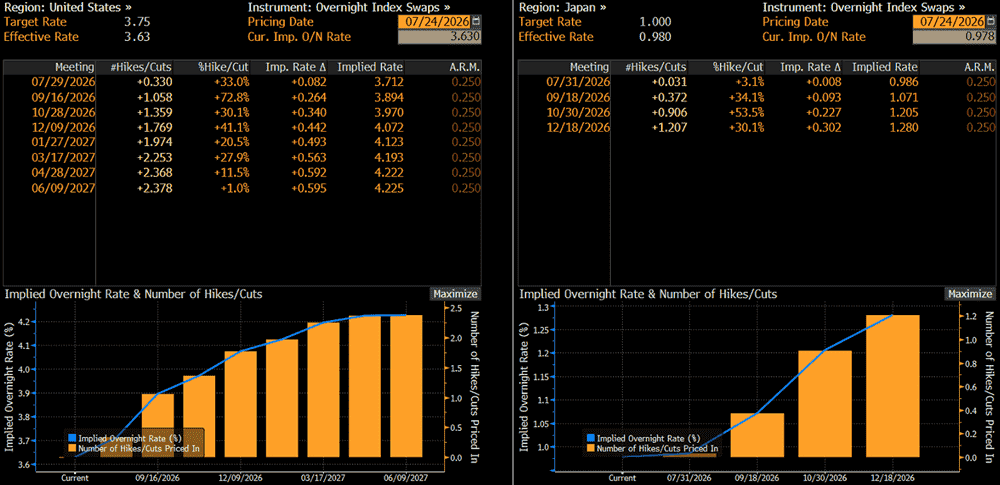
The Federal Reserve's interest rate decision on Wednesday looms as the most important event for USD/JPY this week. Overnight index swaps imply around a one-in-three chance of a 25bp rate hike, as shown in the graphic below.
Unlike previous meetings, there will be no Summary of Economic Projections or dot plot, leaving only the policy statement and Kevin Warsh's press conference to provide insight into the FOMC's thinking. If the statement is as brief as it was in June, ending simply with "The Committee will deliver price stability", it would only add to the confusion surrounding its reaction function.
That makes Warsh's press conference the most important communication event. But those expecting him to provide concrete guidance may be disappointed. Warsh has repeatedly said he does not provide forward guidance, preferring markets to assess incoming data rather than rely on central bank signalling. If he sticks to that approach, it may only fuel volatility.
If the Fed leaves rates unchanged, some initial US dollar selling would not be a surprise given markets are pricing a meaningful chance of a hike. Beyond that, the tone of the statement and how Warsh handles questions will likely determine the market reaction.
Source: Bloomberg
The Yen's Toxic Cocktail
While the Fed looms as the headline event, the Bank of Japan's policy decision less than 24 hours later could prove just as important for the near-term directional risk in USD/JPY.
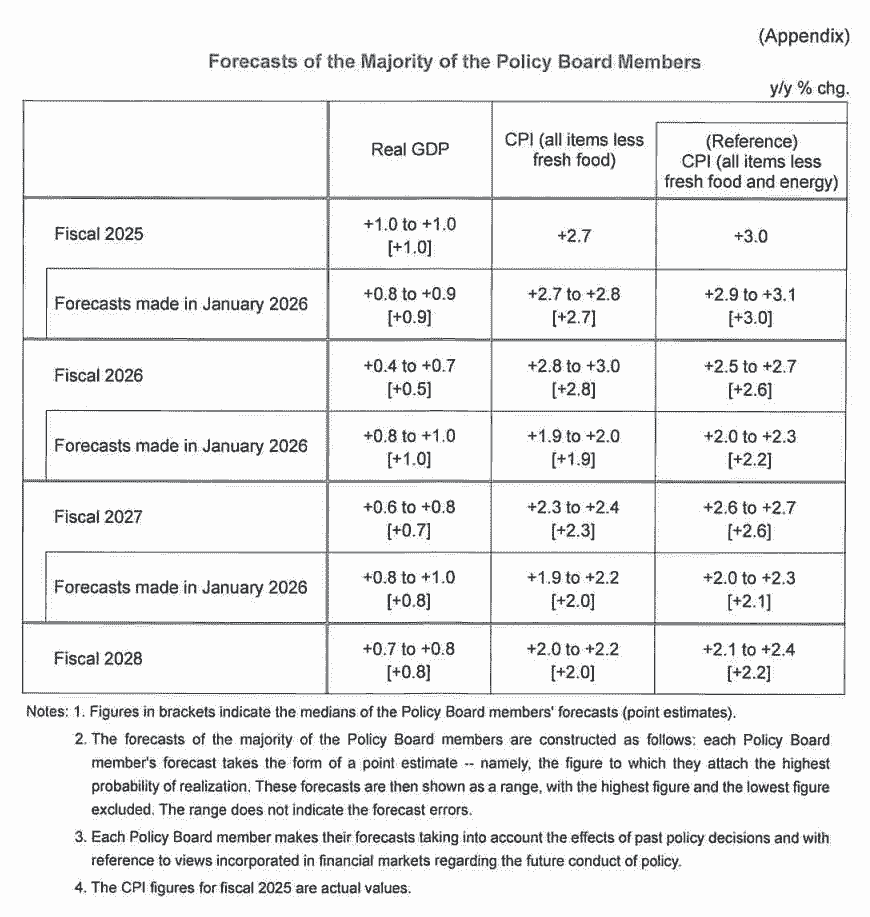
No change in the policy rate is expected, as the implied pricing above reveals, leaving the focus on the updated forecasts and Governor Kazuo Ueda's press conference. In April, the BOJ lowered its FY2026 growth estimate while revising its inflation outlook higher, lifting its core CPI forecast from 1.9% to 2.8%. It also maintained that risks to the inflation outlook remained skewed to the upside.
Source: BOJ
It's also worth remembering that Japan remains heavily reliant on imported energy. The recent rebound in oil and LNG prices not only risks adding to domestic inflation pressures, but also deteriorates Japan's terms of trade, creating another headwind for the yen.
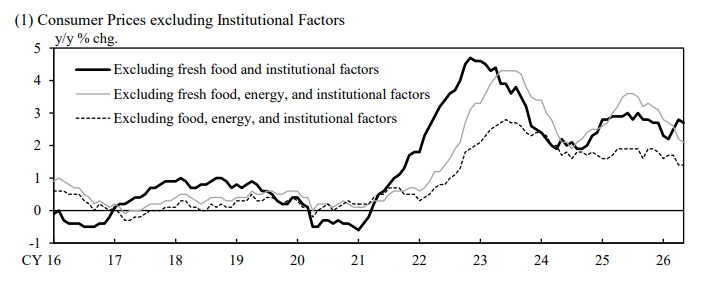
Before the policy decision, traders will receive the BOJ's preferred measure of underlying inflation when the Indicators for Core CPI report is released on Tuesday. Published two business days after the national CPI release, the report strips out government measures such as subsidies, providing a cleaner read on underlying price pressures.
Source: BOJ
At its previous meeting, the BOJ maintained that risks to inflation were skewed to the upside, citing the potential for a weaker yen and higher import prices to place additional upward pressure on prices. Traders should watch to see whether that assessment is maintained or strengthened in light of the recent rebound in energy prices and continued unwind in the yen.
Growth, Inflation and Risk Appetite Collide
Source: TradingView (US EDT)
Beyond central banks, traders will have plenty of other risks events to navigate this week.
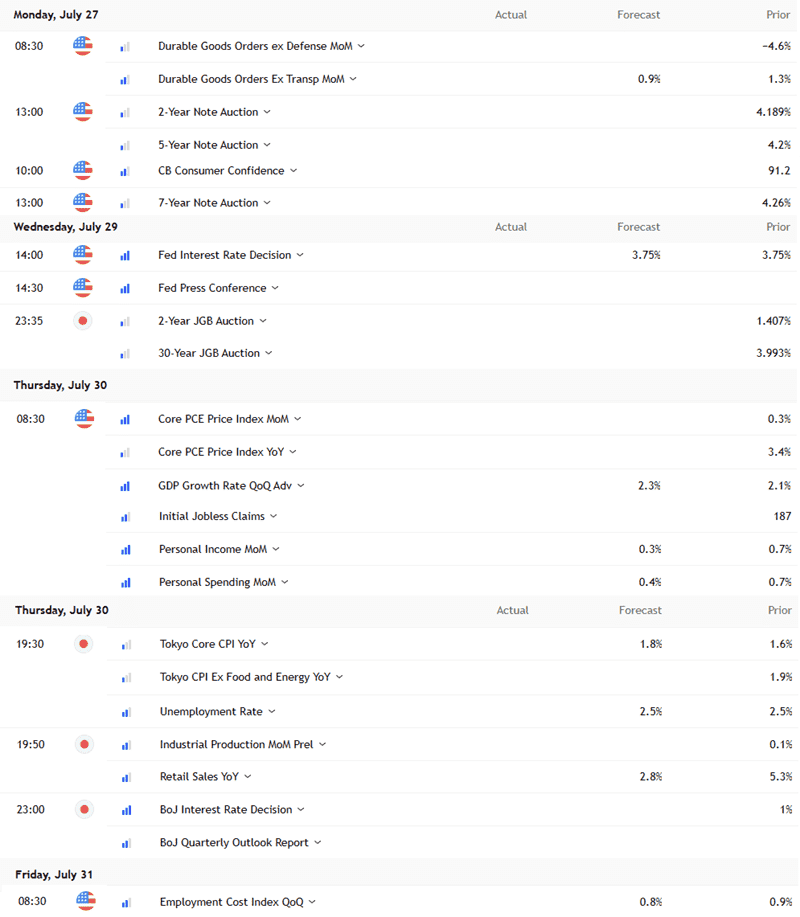
In Japan, Friday's Tokyo CPI report remains important even if it has been superseded by the BOJ's underlying measure in term of policy relevance. As a timely lead indicator for national inflation, traders should watch for any evidence that the recent rebound in energy prices is feeding through more quickly into consumer prices.
In the United States, the advance estimate of second-quarter GDP screens as the release most likely to generate volatility. While the report is built on assumptions given a full set of quarterly data is not yet available, it will provide the first broad read on how the US economy performed during the Iran war period.
Personal income, spending and the core PCE deflator for June are released together on Thursday. Core PCE remains the Fed's preferred inflation measure for now, although it rarely delivers meaningful surprises given economists can now accurately map the likely outcome from CPI and PPI data released earlier in the month.
The income and spending figures may therefore be more influential, offering insight into the ability of the US consumer, the powerhouse of the US economy, to continue driving growth. Will income growth be sufficient to sustain spending levels, or will households be forced to dip further into savings? Equally, is there evidence consumers are beginning to rein in spending in response to the inflationary environment?
Friday’s Employment Cost Index (ECI) is another release that can, on occasion, generate volatility given it's one of the Fed's preferred measures of labour costs. A stronger-than-expected reading would fuel concerns about persistent stickiness in services inflation, adding to an already uncomfortable backdrop from rising energy prices.
US earnings season should also be on the radar, headlined by results from Microsoft, Meta and Amazon. Given recent weakness in the AI hyperscalers, an accelerated decline in their share prices could spark a broader risk-off move, increasing the chance of carry trades being unwound. It’s not an immediate risk, but one every trader should be alert to if forced selling were to take place.
Breakout, Consolidate, Repeat
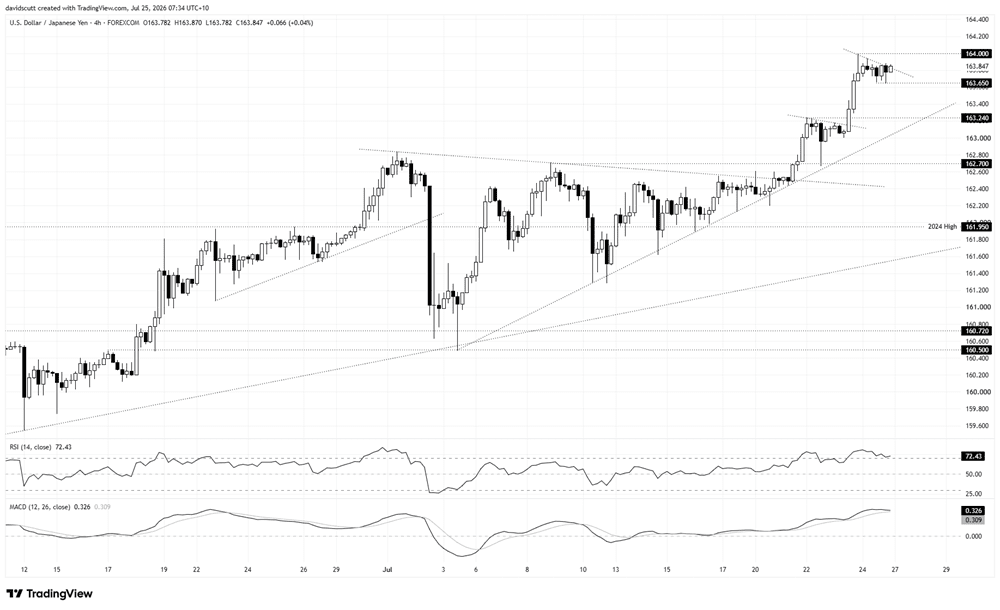
Source: TradingView
The textbook breakout from the symmetrical triangle flagged in last week's outlook played out almost immediately. After coiling throughout much of July, USD/JPY exploded above 163 before pausing beneath a minor downtrend. That consolidation proved temporary, with the pair breaking above 163.24 and extending to fresh multi-decade highs near 164.
Another period of consolidation is now underway, leaving the pair looking as though it may be preparing for another breakout. Immediate resistance is found at 164. A convincing break above that level would bring the big figures such as 165 into view, should the broader uptrend to extend further as favoured.
On the downside, 163.65 is the first level to watch, followed by 163.24. Beneath that, the July uptrend, currently found around 163, and horizontal support at 162.70 become the key technical levels for bulls to defend.
Momentum indicators continue to favour upside. RSI (14) sits at 72, comfortably above the neutral 50 level, while MACD remains above its signal line in positive territory. However, both indicators began to roll over into Friday's close, suggesting upside momentum is beginning to fade. That's not a bearish signal by any stretch, but it does suggest buyers no longer have the same momentum behind them as they did earlier in the week.







Web Trader platform
Our sophisticated web-based platform is packed with features.
Open an account today
Experience award-winning platforms with fast and secure execution.
Economic calendar
Related articles

Euro Short-term Outlook: EUR/USD Pullback Nears Pivotal Uptrend Support 8 28 2026
Warsh's comments accelerated the EUR/USD selloff, raising the stakes as buyers look to stabilize the broader recovery.


EUR/USD forecast: All eyes on Warsh at Jackson Hole - Forex Friday
For much of this week, the EUR/USD has been edging lower with the US dollar regaining some ground after last week’s sell-off that was triggered, in part, by the bond market worries. Investors have been unwilling to bet further against the US dollar so far this week ahead of Kevin Warsh’s keynote speech at the Jackson Hole summit, due later today.


AUD/CAD breakout puts the Bradman barrier in sight
A bullish breakout has pushed AUD/CAD to its highest level since early 2021. Whether it can clear 0.9994 may determine if the move extends well above parity.